
Introduction
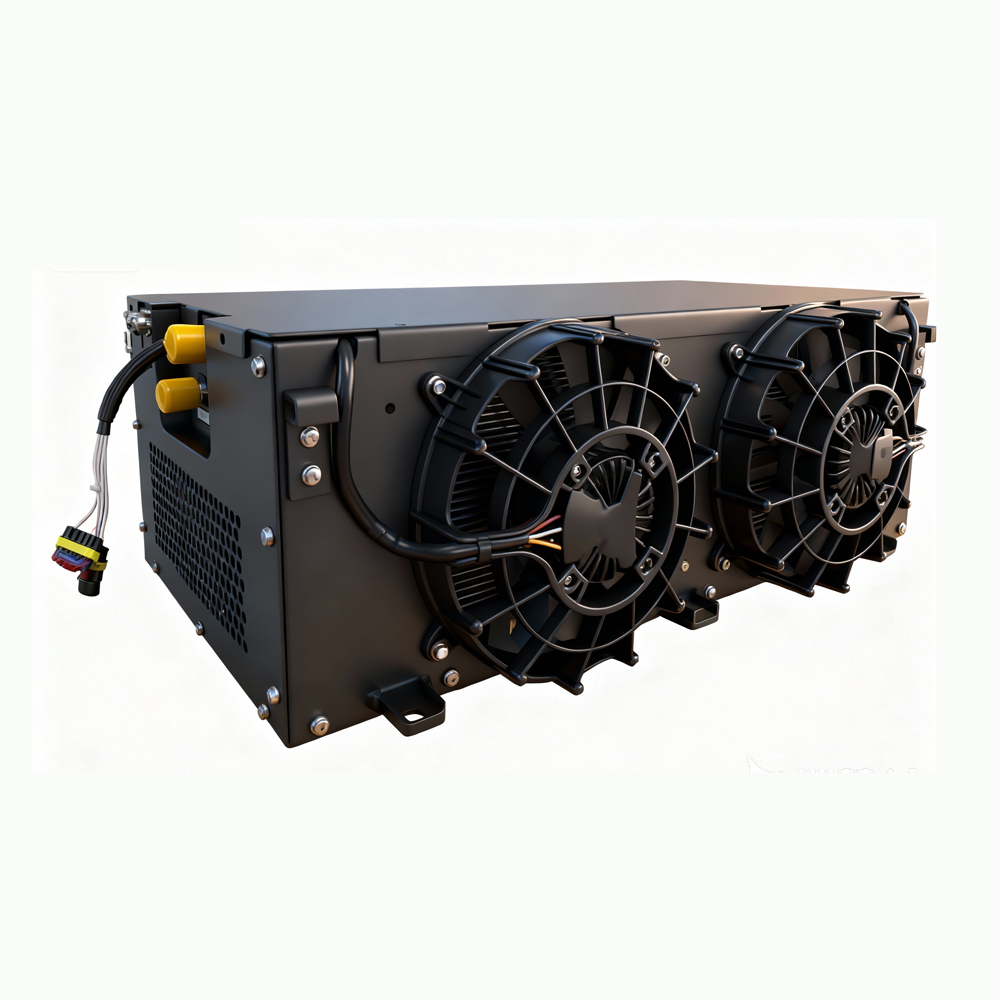
As electric vehicles (EVs) and energy storage systems (ESS) continue to accelerate global energy transition, battery thermal management has become a critical factor determining system performance, longevity, and safety. This article provides a comprehensive technical analysis of 8kW-class liquid-cooled battery thermal management systems (BTMS), based on practical engineering implementation and industry best practices.
System Architecture Overview
Core Components
An 8kW liquid-cooled BTMS typically comprises four primary subsystems:
1.Liquid Cooling – Includes corrosion-resistant aluminum alloy cooling plates, magnetic levitation centrifugal pumps, and expansion tanks. Flow rate adjustment range spans 0.5-8 L/min with pipeline pressure tolerance of 1.6MPa.
2.Heat Exchange Subsystem – Employs plate-fin heat exchangers combined with electronic compression to achieve a two-stage heat exchange architecture. Refrigerant charging accuracy reaches ±5g, with heat exchange efficiency exceeding 92%.
3.Intelligent Control Unit – Features a 32-bit MCU controller integrating CAN bus and RS485 communication interfaces. The system monitors 16 temperature sensor channels and 4 pressure sensor channels with response latency under 50ms.
4.Safety Protection Mechanism – Implements three-level fault protection (warning/derating/power-off) with early intervention capabilities for thermal runaway through gas detection and pressure relief valves, compliant with UL1973 safety standards.
Working Principle
The system utilizes a plate-wing type heat exchanger combined with electronic compressor to form a secondary heat exchange architecture. The 50% water + 50% glycol coolant mixture circulates through the battery pack, absorbing thermal energy and transferring it to the refrigerant circuit for dissipation.
Technical Performance Specifications
Temperature Control Precision
•Operating Temperature Range: -30°C to 55°C ambient
•Temperature Control Accuracy: ±0.5°C
•Cell Temperature Difference: ≤3°C (≤5°C under extreme conditions)
•Coolant Flow Adjustment Range: 10:1 ratio via magnetic levitation centrifugal pump
Energy Efficiency
The system achieves a Coefficient of Performance (COP) of 4.2+ in cooling mode and 3.8+ in heating mode, representing over 25% energy savings compared to conventional solutions. Under low ambient temperature conditions (<15°C), the system automatically switches to free cooling mode, where COP can reach up to 6.0.
Thermal Response Time
•Pump response time: ≤0.5 seconds
•Temperature control lag: ≤10 seconds
•Cold start heating capability: 10 minutes to reach 15°C from -20°C
Battery Compatibility
Ternary Lithium Batteries (NCM/NCA)
Adapts to high energy density batteries through gradient cooling technology, maintaining cell temperature difference ≤2°C and suppressing high-temperature lithium plating risks.
Lithium Iron Phosphate (LFP) Batteries
Optimized low-temperature heating strategy maintains 85% effective capacity at -20°C environment, addressing the flat voltage characteristic of LFP chemistry.
Solid-State Battery Modules
Specially designed contact-type thermal interface addresses solid-state battery interface thermal resistance issues, supporting thermal conductivity requirements above 300W/m·K.
Safety and Reliability
Protection Mechanisms
•Three-level fault protection: Warning → Derating → Power Off
•Thermal runaway early intervention via gas detection and pressure relief
•IP67 protection rating for cooling system
•Automotive-grade leak-proof connectors reducing leakage risk by 90%
Compliance Standards
The system meets requirements of:
•UL1973 (Battery Safety Standard)
•GB 29743.1-2022 (Electric Vehicle Safety Standards)
•72-hour water immersion test capability
Applications
Electric Passenger Vehicles
Suitable for compact EVs with 8kW thermal management needs. At 35°C ambient temperature, the system maintains battery at optimal 20-35°C range with cooling COP ≥3.0.
Commercial Logistics Vehicles
Integrated battery, motor, and HVAC thermal management reduces piping complexity by 30%. Supports 200kWh+ battery packs with 12-minute fast charging to 60% SOC capability.
Energy Storage Systems
Supports 4-8 units in parallel operation for systems up to 1MWh capacity. Uses R290 environmentally friendly refrigerant with working range from -30°C to 55°C.
Conclusion
8kW liquid-cooled BTMS represents the current state-of-the-art in battery thermal management technology. Its precise temperature control, high energy efficiency, and robust safety features make it an ideal solution for electric vehicles, commercial vehicles, and energy storage applications. As battery technology continues to evolve, thermal management systems will play an increasingly vital role in maximizing battery performance and extending service life.
Keywords: Battery Thermal Management, BTMS, Liquid Cooling, EV Thermal Management, Energy Storage, Thermal Runaway Protection
 English
  Español
  Português
  العربية
  Русский
  Français
  Bahasa Indonesia
  日本語
日本語  Română
  Deutsch
  Italiano