
Introduction
The choice of cooling methodology fundamentally shapes battery thermal management system performance. This technical analysis compares liquid cooling and air cooling approaches, examining thermodynamics, implementation considerations, and application suitability based on engineering data and field experience.
Fundamental Differences
Air Cooling Systems
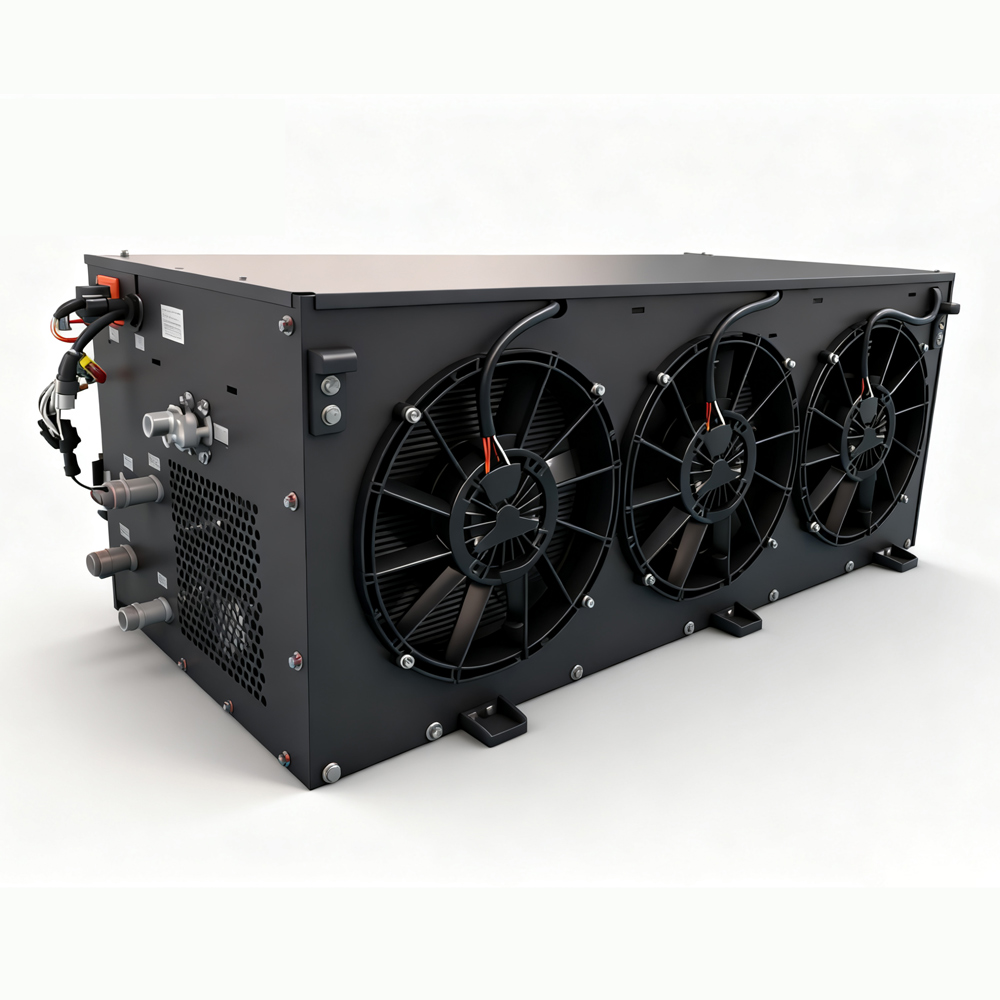
Air cooling utilizes forced air circulation to dissipate heat from battery packs. The system typically consists of:
•Fans/Blowers: Drive air movement across battery surfaces
•Heat Sinks/Fins: Increase surface area for heat dissipation
•Ducting: Direct airflow to targeted areas
•Filters: Prevent debris accumulation (adds maintenance burden)
Liquid Cooling Systems
Liquid cooling employs circulating coolant to absorb and transfer thermal energy:
•Coolant Circulation: Pump-driven flow through cooling plates/channels
•Heat Exchangers: Transfer heat from coolant to ambient
•Expansion Tanks: Accommodate coolant thermal expansion
•Thermal Interface Materials: Ensure efficient heat transfer
Performance Comparison
Heat Transfer Efficiency
| Parameter | Air Cooling | Liquid Cooling |
| Heat Transfer Coefficient | 10-50 W/m²·K | 500-5000 W/m²·K |
| Temperature Uniformity | ±8°C typical | ±2°C achievable |
| Response Time | 30-120 seconds | <1 second |
| Cooling Capacity Density | Limited | High |
Energy Consumption
Air Cooling Drawbacks:
•Fans require continuous high-power operation
•Higher parasitic energy loss
•Noise generation affects user experience
Liquid Cooling Advantages:
•Magnetic levitation pumps operate with minimal power draw
•10:1 flow rate modulation reduces idle energy waste
•Overall system energy savings: 25-35%
Temperature Control Precision
Liquid cooling demonstrates superior temperature control capabilities:
•Air Cooling: ±5-10°C temperature variation across battery pack
•Liquid Cooling: ±0.5°C precision achievable
•Impact: Tight temperature control extends battery cycle life by 30%+
Advantages of Liquid Cooling
1. Superior Heat Removal
Liquid coolants possess significantly higher heat capacity than air:
•Water: 4.18 kJ/kg·K
•Air: 1.005 kJ/kg·K
•Result: 4x+ heat removal capability per unit mass flow
2. Compact System Design
Liquid systems achieve equivalent cooling in smaller form factors:
•Space Savings: Up to 40% reduction in system footprint
•Weight Efficiency: Lower component mass for equivalent cooling
•Packaging Flexibility: Compact design suits vehicle integration
3. Silent Operation
Without continuously running fans:
•Noise Reduction: 8-10 dB lower operating noise
•Application Range: Suitable for hospitals, schools, residential areas
4. Environmental Adaptability
Liquid systems maintain performance across extreme conditions:
•Works effectively at ambient temperatures from -30°C to 55°C
•R290 refrigerant option provides eco-friendly operation
•Functions reliably in high-altitude/low-pressure environments
Challenges of Liquid Cooling
1. Initial Complexity
•More components requiring precise assembly
•Higher upfront system cost
•Requires leak prevention mechanisms
2. Maintenance Requirements
•Coolant quality monitoring
•Periodic inspection of seals and connections
•System purge and refill procedures
3. Thermal Interface Challenges
•Requires proper thermal interface materials (TIM)
•Contact pressure consistency critical
•Long-term stability concerns
Cost Analysis
Capital Expenditure
| Component | Air Cooling | Liquid Cooling |
| Initial Cost | Lower | Higher (30-50%) |
| Installation | Simpler | More complex |
| Components | Fans, ducts | Pumps, heat exchangers, coolant |
Operational Expenditure
•Air Cooling: Higher fan energy consumption, more frequent filter replacement
•Liquid Cooling: Lower pump energy, longer component life, reduced maintenance frequency
Total Cost of Ownership
Field data indicates liquid cooling systems achieve lower total cost of ownership over 10-year periods:
•Energy savings offset higher initial investment
•Extended battery life reduces replacement costs
•Reduced maintenance frequency saves labor costs
Application Suitability
When to Choose Air Cooling
•Low Power Applications: Small battery packs (<20 kWh)
•Cost-Sensitive Projects: Budget constraints prioritize initial cost
•Simple Systems: Limited packaging complexity
•Non-Critical Applications: Temperature uniformity not critical
When to Choose Liquid Cooling
•High Power Systems: 50 kWh+ battery packs
•Performance Critical: Maximum range and battery life required
•Extreme Conditions: Very hot or cold operating environments
•Long-Duty Cycle: High utilization applications (fleet, commercial vehicles)
•Energy Storage: Grid-scale installations requiring maximum efficiency
Case Study: Energy Storage System Comparison
500 MWh Solar + Storage Project
Air-Cooled Configuration:
•Higher ambient temperatures caused efficiency degradation
•Temperature differential across battery containers: 15°C+
•Higher inverter derating due to thermal management limitations
Liquid-Cooled Configuration:
•Temperature differential: ≤3°C
•Energy consumption: 35% lower than air-cooled
•Battery cycle life: Significantly extended
•System availability: 99.99%
Technology Evolution
Hybrid Approaches
Emerging systems combine air and liquid cooling:
•Primary Liquid Cooling: Handles main thermal load
•Supplemental Air Cooling: Emergency heat rejection backup
•Intelligent Switching: System selects optimal mode based on conditions
Advanced Materials
•Micro-channel heat exchangers
•Phase change materials (PCM) integration
•Nanotechnology-enhanced coolants
Conclusion
While air cooling offers simplicity and lower initial costs, liquid cooling delivers superior performance in nearly every meaningful metric for modern battery applications. The 30-35% energy efficiency improvement, ±0.5°C temperature control precision, and extended battery life make liquid cooling the preferred choice for:
•Electric vehicles with range and performance requirements
•Commercial vehicles with demanding duty cycles
•Energy storage systems prioritizing efficiency and longevity
•Applications in extreme temperature environments
For most modern EV and energy storage applications, liquid cooling represents the optimal technical and economic choice despite higher initial investment.
Keywords: Liquid Cooling, Air Cooling, Battery Thermal Management, BTMS Comparison, Thermal Management Technology
 English
  Español
  Português
  العربية
  Русский
  Français
  Bahasa Indonesia
  日本語
日本語  Română
  Deutsch
  Italiano