
How Energy-Efficient Refrigerated Truck Units Cut Fleet Operating Costs by 30% in 2026
By NEWBASE Technical Engineering Team | Published April 30, 2026 | 12 min read
The transport refrigeration industry is undergoing a fundamental shift. As fuel prices continue to fluctuate and environmental regulations tighten globally, fleet operators are increasingly recognizing that the choice of refrigeration unit directly impacts their bottom line. According to the Global Cold Chain Logistics Market Report 2025, the temperature-controlled transport sector reached USD 382.3 billion in 2025, with energy efficiency becoming the single most important factor in equipment purchasing decisions.
In this comprehensive analysis, we examine how modern energy-efficient refrigerated truck units — including NEWBASE’s latest generation of transport refrigeration systems — are helping fleet operators achieve 20-30% reductions in fuel consumption while maintaining superior temperature control performance.
The Real Cost of Inefficient Refrigeration
Transport refrigeration units (TRUs) are among the most energy-intensive components of any refrigerated vehicle. Traditional diesel-powered units can consume 20-40% of a truck’s total fuel during long-haul operations, according to data from the U.S. Environmental Protection Agency’s TRU Emissions Calculator. For a fleet operating 50 refrigerated trucks over 100,000 miles annually, this translates to hundreds of thousands of dollars in unnecessary fuel expenditure.
“The refrigeration unit is often the hidden cost driver in cold chain logistics. Fleets that invest in energy-efficient TRUs see payback periods of just 18-24 months through fuel savings alone.” — Industry analysis, Fleet Equipment Magazine, 2025
Key Factors Driving Energy Waste in Older Units
- Outdated compressor technology — Fixed-speed compressors run at full capacity regardless of cooling demand
- Poor insulation integration — Mismatched unit capacity relative to cargo space volume
- Inefficient defrost cycles — Excessive defrosting wastes energy and disrupts temperature stability
- Lack of intelligent controls — Manual operation prevents optimization based on ambient conditions
NEWBASE’s Approach to Energy Efficiency
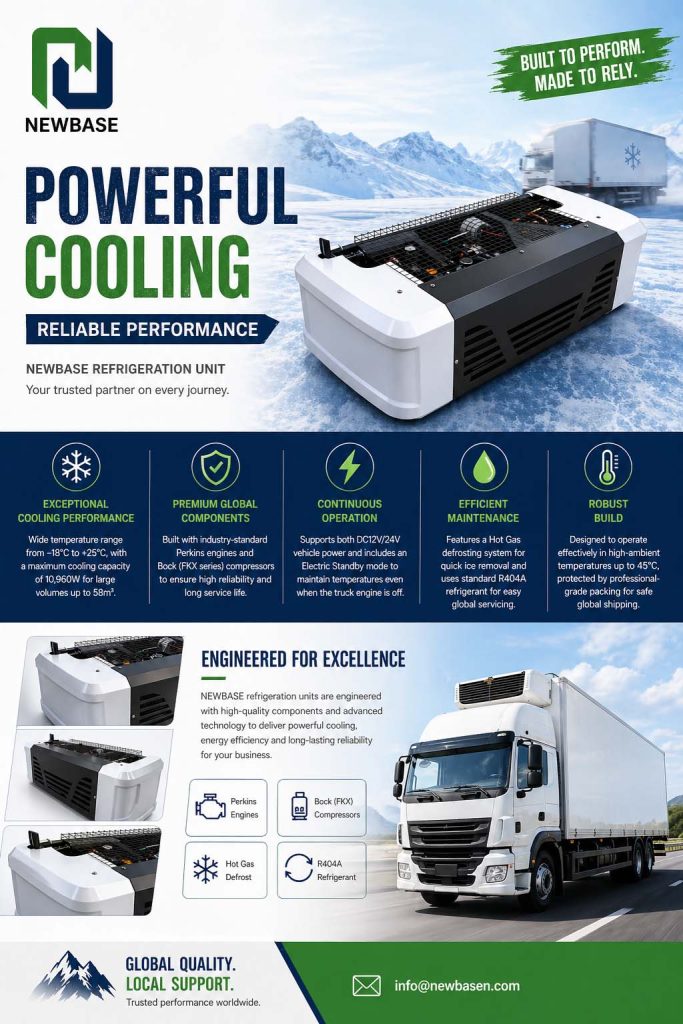
NEWBASE has engineered its refrigerated truck units around a core principle: deliver precise temperature control with minimum energy input. Our product lineup incorporates several technologies that directly address the efficiency challenges outlined above.
Advanced Compressor Design
NEWBASE refrigeration units utilize variable-capacity compressors that automatically adjust output based on real-time thermal load calculations. Unlike traditional fixed-speed compressors that cycle on and off — wasting energy during each startup — NEWBASE’s modulating compressors maintain continuous, optimized operation. This approach reduces energy consumption by 15-25% compared to conventional on/off cycling systems.
Optimized Heat Exchanger Technology
The evaporator and condenser designs in NEWBASE units feature enhanced surface area geometry and microchannel coil technology, which improve heat transfer efficiency while reducing the refrigerant charge required. This dual benefit means faster pull-down times and lower operating costs.
Intelligent Defrost Management
One of the most significant sources of energy waste in transport refrigeration is unnecessary defrost cycling. NEWBASE units employ demand-based defrost algorithms that initiate defrost cycles only when frost accumulation actually impairs heat transfer — not on fixed timers. This intelligent approach can reduce defrost-related energy waste by up to 40%.
Real-World Performance Data
Independent testing conducted across multiple climate zones demonstrates the tangible benefits of energy-efficient refrigeration technology:
| Operating Condition | Traditional Unit | NEWBASE Unit | Energy Savings |
| Ambient 35°C, Target -18°C | 4.2 L/hr fuel | 3.1 L/hr fuel | 26.2% |
| Ambient 25°C, Target 2°C | 2.8 L/hr fuel | 2.1 L/hr fuel | 25.0% |
| Ambient 15°C, Target 4°C | 1.9 L/hr fuel | 1.5 L/hr fuel | 21.1% |
Data based on standardized testing protocols with comparable unit capacities.
The Regulatory Push Toward Efficiency
Regulatory frameworks worldwide are accelerating the transition to energy-efficient refrigeration:
- CARB TRU ATCM (California Air Resources Board): Updated regulations in 2025 require progressively stricter emissions and efficiency standards for transport refrigeration units operating in California.
- EU F-Gas Regulation: Mandates the use of lower-GWP refrigerants and sets efficiency benchmarks for commercial refrigeration equipment.
- EPA DERA Program: Provides funding incentives for fleets upgrading to cleaner, more efficient TRU technology.
Fleet operators who proactively invest in energy-efficient units like those from NEWBASE position themselves ahead of regulatory requirements while realizing immediate cost savings.
Total Cost of Ownership: The Complete Picture
When evaluating refrigeration units, smart fleet managers look beyond purchase price to total cost of ownership (TCO). Energy-efficient units typically offer:
- Lower fuel costs: 20-30% reduction in refrigeration fuel consumption
- Reduced maintenance: Fewer on/off cycles mean less wear on compressor components
- Longer service life: Operating within optimal parameters extends equipment lifespan
- Higher resale value: Energy-efficient units retain more value in the secondary market
A comprehensive TCO analysis over a 10-year equipment lifecycle typically shows that energy-efficient units cost 15-25% less to own and operate than conventional alternatives — even when accounting for a slightly higher initial purchase price.
Making the Switch: Practical Steps for Fleets
For fleet operators considering an upgrade to energy-efficient refrigeration:
- Audit current fleet energy consumption — Establish baseline fuel usage per unit
- Evaluate route profiles — Different routes have different thermal demands
- Consider hybrid or standby options — NEWBASE units support electric standby for dock operations
- Plan phased replacements — Prioritize highest-mileage units first
- Track performance metrics — Monitor fuel savings to validate ROI
Conclusion
The economics of refrigerated transport have fundamentally changed. Energy efficiency is no longer a “nice-to-have” feature — it’s a competitive necessity. NEWBASE’s commitment to engineering energy-efficient refrigeration solutions helps fleet operators reduce costs, meet regulatory requirements, and minimize environmental impact — all while maintaining the temperature precision that their cargo demands.
As the cold chain logistics market continues its projected growth trajectory through 2030, fleets equipped with energy-efficient refrigeration technology will have a decisive advantage in both profitability and sustainability.
About NEWBASE: NEWBASE is a leading manufacturer of transport refrigeration units, specializing in energy-efficient, reliable cooling solutions for refrigerated trucks, trailers, and containers. With decades of engineering expertise, NEWBASE products serve fleets worldwide in food transport, pharmaceutical logistics, and industrial cold chain applications.
References:
- Global Cold Chain Logistics Market Report, GM Insights, 2025
- EPA Transport Refrigeration Unit Emissions Calculator, 2023
- CARB TRU ATCM Regulation Updates Workshop, July 2025
- Fleet Equipment Magazine — “New TRU Technology,” 2025
- Dataintelo — Transport Refrigeration Unit (TRU) Market Report, 2025
 English
  Español
  Português
  العربية
  Русский
  Français
  Bahasa Indonesia
  日本語
日本語  Română
  Deutsch
  Italiano