
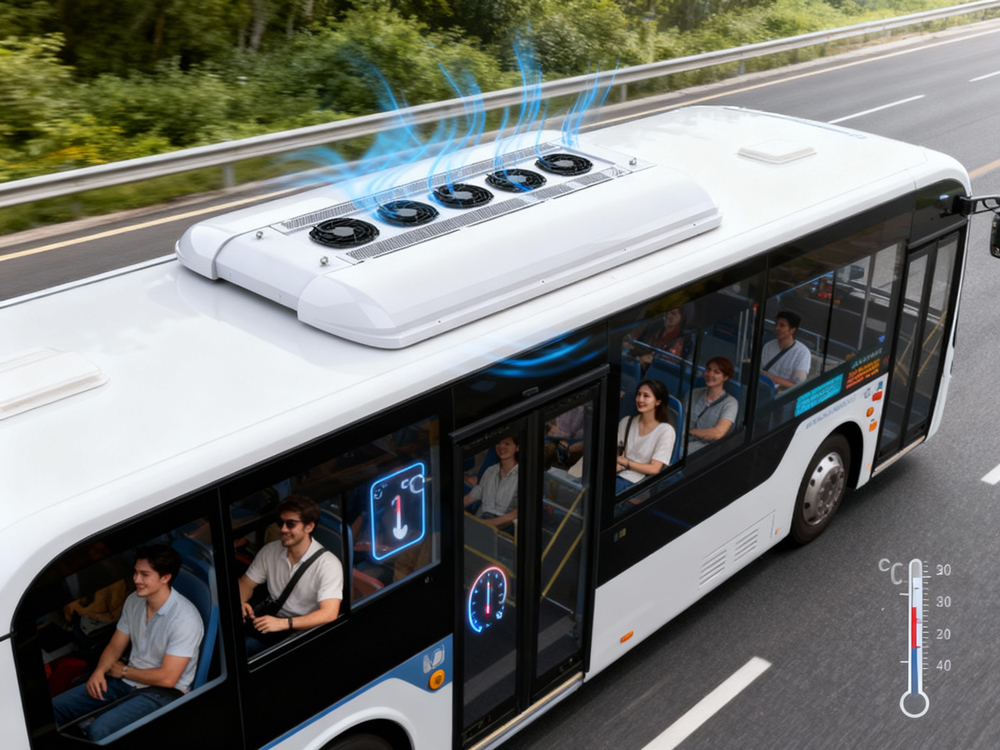
The Rise of Electric Rooftop Air Conditioning: Market Dynamics, Technology Trends, and the Future of Vehicle Thermal Management
Introduction
The global transition toward vehicle electrification is reshaping every component of automotive engineering, and few systems are undergoing more profound transformation than the vehicle’s climate control architecture. Rooftop electric air conditioning systems—once a niche application confined to specialty vehicles—have emerged as a cornerstone technology for the new energy vehicle (NEV) ecosystem. As the industry pivots away from engine-driven mechanical compressors toward electrically powered, independently operated thermal management solutions, the market for Electric Bus Air Conditioner systems, Parking Air Conditioner units, and integrated BTMS System solutions is experiencing unprecedented growth.
This article provides a comprehensive technical analysis of the global rooftop electric air conditioning market, examining current market dynamics, emerging technology trends, regulatory drivers, and the strategic implications for industry stakeholders. Drawing on the latest market data, technical research, and industry developments, we explore how this critical thermal management sector is evolving to meet the demands of an electrified, energy-conscious future.
1. Market Overview: Sustained Growth and Clear Profitability
1.1 Global Market Size and Projections
The global rooftop electric air conditioning market is on a robust growth trajectory, driven by the accelerating adoption of electric vehicles across all transport segments. According to industry forecasts, the global rooftop electric air conditioner market reached approximately $872 million in sales revenue in 2025 and is projected to climb to $1.494 billion by 2032, representing a compound annual growth rate (CAGR) of 8.9% from 2026 to 2032. This sustained growth reflects the fundamental structural shift in the automotive industry toward electrification and the corresponding demand for specialized thermal management solutions.
From a volume perspective, the global rooftop electric air conditioning system market shipped approximately 410,000 units in 2025. Demand is concentrated in bus HVAC systems, recreational vehicles (RVs), and various specialty electric vehicles. The industry average selling price stands at approximately $2,121 per unit, with pricing tiers clearly differentiated by product type—standard models, conventional electric units, and integrated heat pump systems command progressively higher price points.
1.2 Profitability and Cost Structure
The industry maintains healthy gross margins ranging from 28% to 33%, with premium products incorporating advanced electrification and intelligent technologies demonstrating superior profitability. The average manufacturing cost is approximately $1,530 per unit. On the supply side, global production capacity reached 540,000 units in 2025, supported primarily by Tier 1 thermal management leaders and OEM component suppliers, creating a relatively balanced supply-demand dynamic.
1.3 Segmented Market Growth
The broader market context reinforces this positive outlook. The global Bus Air Conditioner market is projected to grow at a CAGR of 5.8% from 2025 to 2035, driven by increasing demand for passenger comfort and rising urbanization. More specifically, the global Electric Bus Air Conditioning market was valued at $2.558 billion in 2025 and is forecast to reach $3.154 billion by 2032. The truck and bus air conditioning segment, valued at $4.7 billion in 2024, is projected to reach $6.9 billion by 2030.
Within the commercial vehicle parking segment, the global Truck Parking Air Conditioning Equipment market reached $1.22 billion in 2025 and is projected to grow to $1.97 billion by 2032 at a CAGR of 7.05%. This growth is driven by increasing demand for driver comfort, environmental regulations, and the desire to reduce fuel consumption and emissions. The broader Parking Air Conditioning market is expected to grow from $2.17 billion in 2025 to $4.5 billion by 2035.
The Transportation Refrigeration Units segment is also undergoing electrification. The global truck refrigeration unit market was estimated at $6.23 billion in 2025 and is projected to reach $11.26 billion by 2033, growing at a CAGR of 7.8%. Major industry players like Thermo King have launched all-electric solutions such as the E-Volution, which delivers up to a 45% reduction in CO₂ emissions compared with diesel refrigeration units.
2. Technology Fundamentals: The Electric Rooftop AC Architecture
2.1 Core Operating Principles
Rooftop electric air conditioning represents a fundamental departure from traditional engine-driven HVAC systems. These systems employ an electrically driven compressor architecture operating across 48V, 400V, and 800V voltage platforms, enabling independent cooling, heating, and air circulation without reliance on engine mechanical drive.
The key technological advantages include:
- High integration density: Compact rooftop packaging that minimizes vehicle footprint
- Independent power supply: Operation independent of engine status, enabling climate control during parking and idle periods
- Electrification compatibility: Seamless integration with electric vehicle powertrain architectures
- Elimination of parasitic losses: Removal of belt-driven mechanical losses associated with traditional engine-driven compressors
These features address critical pain points of conventional systems, including high energy consumption and significant transmission losses, making rooftop electric AC systems ideally suited for new energy vehicle applications.
2.2 Voltage Platform Evolution
The transition from 400V to 800V architectures represents one of the most significant technical trends in the industry. 800V electric compressors are increasingly becoming the standard for next-generation electric commercial vehicles. Advanced 800V compressors operate at speeds exceeding 160,000 RPM while achieving up to 50% size reduction, 30% weight reduction, and 10 dB noise reduction compared with conventional scroll compressors. These units support 400V–800V heat pump systems and are compatible with low-pressure, low-global-warming-potential refrigerants.
The 800V e-compressor technology is applicable not only to passenger vehicles but also widely to commercial vehicles and public transportation. This voltage migration enables higher power density, reduced resistive losses, and more efficient thermal management across the entire vehicle system.
3. Technology Trends Shaping the Industry
3.1 Heat Pump Systems: The Efficiency Revolution
Heat pump technology is rapidly becoming the preferred solution for electric vehicle climate control, offering superior energy efficiency compared with traditional Positive Temperature Coefficient (PTC) electric heating. Research demonstrates that heat pump systems can reduce system energy consumption by more than 50% compared with conventional PTC heating, significantly extending driving range.
The technical challenge of maintaining heat pump efficiency in low-temperature environments has been a focus of extensive research. Recent innovations include indirect heat pump systems specifically designed for light commercial electric vehicles operating in severe cold climates. These systems integrate the thermal management of the battery, motor, and cabin through holistic design approaches.
Novel approaches such as desiccant-coated heat pumps are also emerging, which control humidity and improve efficiency through innovative condenser and evaporator designs. These technologies promise to further enhance the performance of Electric Bus Air Conditioner and BTMS System solutions.
3.2 Intelligent Control and Digitalization
The integration of smart controls represents a transformative trend in vehicle thermal management. Advanced HVAC Control Module systems are evolving from simple thermostatic controls to sophisticated, data-driven platforms capable of predictive optimization.
Key developments include:
- AI and IoT-driven systems: These optimize performance through adaptive zoning, where sensors adjust airflow based on passenger density, and predictive pre-conditioning, which cools or heats cabins during charging to minimize on-road battery drain.
- Model Predictive Control (MPC): Advanced control mechanisms utilizing MPC represent a particular frontier, with research exploring “control-over-the-air” approaches for HVAC control of battery electric buses. Machine learning-based predictive control of thermal management systems in battery electric vehicles aims for cost-effective energy consumption and response time.
- Integrated thermal management: Research increasingly focuses on integrated design approaches that optimize heat pump air conditioning, battery, and motor thermal management systems simultaneously. Integrated thermal management systems are being developed to interconnect various thermal circuits, with advanced control strategies enabling electro-thermal co-optimization.
- Digital twin technology: AI-based algorithms for predicting driving behavior, combined with digital twin models, enable optimal comfort control strategy determination.
- Modular smart HVAC platforms: New electric HVAC platforms integrate heating, cooling, and battery thermal management in single modular packages with smart controls and CAN connectivity. These platforms feature high-efficiency electric compressors, reversible heat pump functionality, and integrated PTC heater modules for extreme climates.
3.3 Low-GWP Refrigerants and Environmental Compliance
Environmental regulations are driving rapid evolution in refrigerant technology. Traditional R134a refrigerant, with a global warming potential (GWP) of 1,430, is being phased out in favor of low-GWP alternatives.
Leading alternatives include:
- R1234yf: A modern low-GWP refrigerant demonstrating performance comparable to R134a in optimized systems.
- R454C: With a GWP of just 146, R454C demonstrates excellent refrigeration and heating performance while complying with various standards. EU regulations will ban refrigerants with a GWP exceeding 150 in M1 vehicle air conditioning systems effective January 1, 2030.
- R744 (CO₂): A natural refrigerant with a GWP of just 1, R744 is a leading eco-friendly alternative. Over one million R744 electric compressors have already been produced for EV applications. CO₂ heat pump systems offer excellent heating performance at low temperatures.
- R290 (propane): A natural refrigerant offering low GWP and excellent thermodynamic properties for combined heating and cooling cycles in electric vehicles.
Industry standards are rapidly evolving to support these transitions. China’s T/CAAMTB 309-2025 standard specifies performance requirements and test methods for electric vehicle heat pump air conditioning systems, covering maximum cooling/heating performance, defrosting, defogging, and energy consumption testing. The EU’s ErP Directive requires AC products to meet Class A or higher efficiency.
3.4 Advanced Battery Thermal Management
The BTMS System (Battery Thermal Management System) has become a critical subsystem for electric commercial vehicles. By maintaining batteries within their ideal temperature range, BTMS minimizes energy losses and mitigates the risk of thermal degradation, safeguarding investments and ensuring long-term reliability.
Advanced BTMS solutions now feature direct high-voltage connections (up to 850 volts DC) and are optionally available with low-GWP refrigerants. Research continues to explore optimization of battery module thermal performance through interface mediums like phase change materials (PCM) and thermal conductivity enhancers.
The integration of BTMS with cabin HVAC systems represents a frontier of thermal management optimization. Studies on coordinated control strategies for cabin and battery parallel thermal systems are advancing the state of the art.
4. Product Applications and Market Penetration
4.1 Electric Buses and Public Transport
Electric buses represent the largest single application segment for rooftop electric air conditioning. The Electric Bus Air Conditioner has become standard equipment on new energy buses, with demand concentrated in urban transit systems worldwide. Leading suppliers like SONGZ delivered 40,151 bus HVAC units in 2025, with electric heat pump systems accounting for 30,394 units—75% of full-year sales.
The bus HVAC Control Module serves as the central operating element for all thermal management components, enabling seamless integration with connected digital service platforms. Advanced microprocessor-based controllers can be programmed for manual or automatic operation.
4.2 Parking Air Conditioning
The Parking Air Conditioner segment has emerged as a significant growth area, driven by the need for driver comfort during rest periods without engine idling. In 2025, China’s parking air conditioner market alone reached 853,000 units in sales volume. These systems enable comfortable cabin environments during extended parking periods while eliminating fuel consumption and emissions associated with engine idling.
4.3 Refrigerated Transport
The electrification of Transportation Refrigeration Units is accelerating as cold chain logistics embrace sustainability. All-electric refrigerated trucks and vans are gaining traction, with Refrigerated Tricycle and Mini Refrigerated Van solutions emerging for last-mile delivery applications. Refrigerated Storage Container solutions provide flexible cold chain capacity for stationary and mobile applications.
The global cold chain truck market is expected to reach $20.7 billion by 2032. Electric drive truck and van refrigeration units are positioned to capture a growing share of this market as emissions regulations tighten and operating costs become a greater focus.
4.4 Power Electronics Integration
DC-DC Converter and Automotive PDU (Power Distribution Unit) components are integral to the electric air conditioning ecosystem, managing voltage conversion and power distribution across the vehicle’s electrical architecture. These components ensure reliable power delivery to compressors, fans, and control modules while maintaining system efficiency.
5. Regional Market Dynamics
5.1 China: The Global Leader
China leads the global rooftop electric air conditioner market, with the domestic market experiencing significant growth in recent years. This leadership position reflects China’s dominant role in electric vehicle production and adoption, as well as the country’s comprehensive new energy vehicle industrial policy. Chinese manufacturers have developed extensive capabilities across the entire thermal management value chain, from compressor manufacturing to complete Electric Bus Air Conditioner systems.
5.2 North America, Europe, and Japan
North America, Europe, and Japan represent the other major regional markets, each with distinct characteristics. North America benefits from a strong commercial vehicle sector and growing electric bus adoption. Europe’s stringent environmental regulations are accelerating the transition to low-GWP refrigerants and high-efficiency systems. Japan’s advanced automotive industry continues to drive innovation in thermal management technology.
5.3 Trade Policy Impact
The 2025 U.S. tariff policy has introduced uncertainty into global trade patterns, indirectly affecting the supply chain布局, regional trade, and competitive dynamics of the rooftop electric air conditioner market. This has accelerated global supply chain restructuring and the optimization of regional industry collaboration models.
6. Regulatory and Standards Landscape
The regulatory environment for vehicle thermal management is becoming increasingly complex and demanding:
- Energy efficiency standards: China’s Energy Efficiency Standards for Bus Air Conditioners are accelerating the market transition to high-efficiency solutions.
- Refrigerant regulations: The EU’s F-Gas regulation and similar policies worldwide are driving the phase-out of high-GWP refrigerants. R1234yf, R454C, R744, and R290 are emerging as the leading low-GWP alternatives.
- Vehicle performance standards: Standards such as T/CAAMTB 309-2025 establish comprehensive performance requirements for electric vehicle heat pump air conditioning systems.
7. Future Outlook and Strategic Implications
7.1 Continued Market Growth
The rooftop electric air conditioner market is positioned for sustained growth through 2032 and beyond. The 8.9% CAGR projected through 2032 reflects strong underlying demand fundamentals, driven by:
- Continued global electric vehicle adoption
- Increasing urbanization and public transport electrification
- Growing demand for driver and passenger comfort
- Stringent environmental regulations
- Technological advancement reducing costs and improving performance
7.2 Technology Convergence
The future of vehicle thermal management lies in system-level integration. The convergence of cabin HVAC, battery thermal management (BTMS System), and power electronics cooling into unified thermal management architectures will enable significant efficiency gains. Integrated control strategies that optimize thermal management across all vehicle subsystems represent the next frontier.
7.3 The Role of Tier 1 Suppliers
As thermal management systems become more complex and integrated, the role of Tier 1 and Tier 2 suppliers becomes increasingly critical. Companies like NEWBASE, with comprehensive capabilities across Electric Bus Air Conditioner, Parking Air Conditioner, Transportation Refrigeration Units, BTMS System, HVAC Control Module, and Automotive PDU product lines, are well-positioned to capture value in this growing market.
The ability to provide integrated thermal management solutions—combining hardware, software, and control intelligence—will be a key differentiator. Strategic partnerships with OEMs and a deep understanding of application-specific requirements will remain essential competitive advantages.
Conclusion
The rooftop electric air conditioner industry stands at an inflection point. Market growth is robust and well-supported by fundamental demand drivers. Technology is evolving rapidly, with heat pump systems, intelligent controls, low-GWP refrigerants, and integrated thermal management architectures reshaping the competitive landscape. Regulatory pressures are accelerating innovation and raising the bar for performance and environmental sustainability.
For industry participants, the path forward requires continued investment in R&D, manufacturing capability, and customer partnerships. The companies that successfully navigate this complex landscape—balancing performance, cost, and sustainability while delivering reliable, high-quality Electric Bus Air Conditioner, Parking Air Conditioner, BTMS System, and related solutions—will emerge as leaders in this critical and growing market segment.
The transition to electric vehicles is not merely a change in powertrain technology; it is a fundamental reimagining of how vehicles manage energy, comfort, and environmental impact. Rooftop electric air conditioning systems, as essential components of this transformation, will continue to evolve and expand their role in shaping the future of sustainable mobility.
Keywords: Electric Bus Air Conditioner, Parking Air Conditioner, Transportation Refrigeration Units, BTMS System, Refrigerated Tricycle, DC-DC Converter, HVAC Control Module, Automotive PDU, Bus Air Purifier, Bus Defroster, Vehicle AC Accessories, Refrigerated Storage Container, Mini Refrigerated Van, rooftop electric air conditioner, electric vehicle thermal management, heat pump system, low-GWP refrigerant
 English
  Español
  Português
  العربية
  Русский
  Français
  Bahasa Indonesia
  日本語
日本語  Română
  Deutsch
  Italiano