
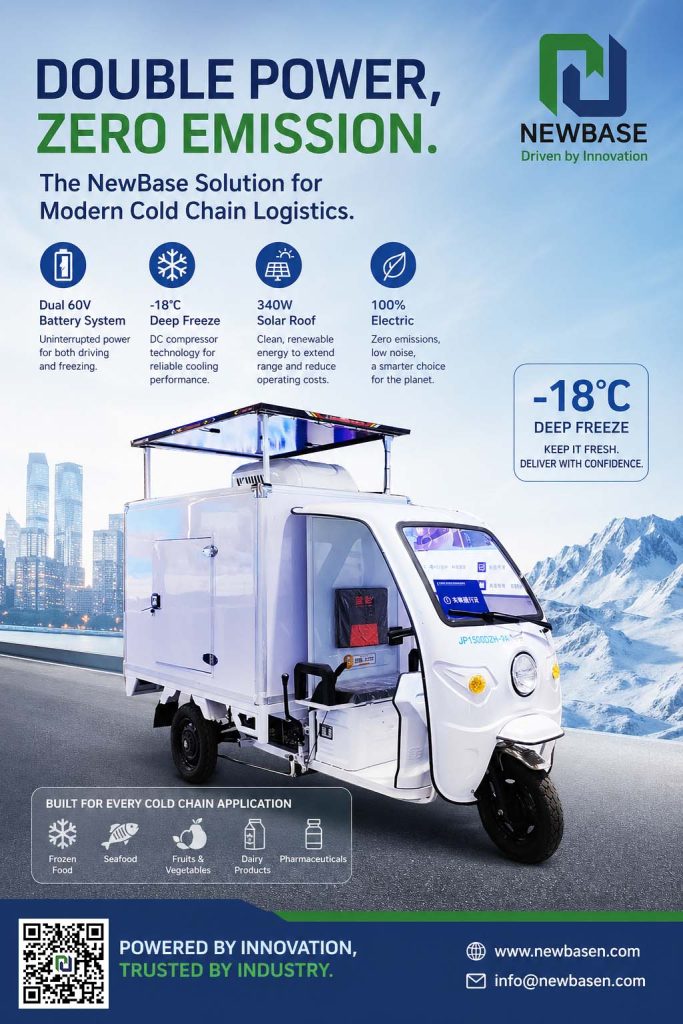
Executive Summary: The expanding reliance on decentralized urban food systems and temperature-sensitive pharmaceutical distribution requires highly specialized transport assets capable of micro-climate regulation within dense metropolitan configurations. This technical paper provides a rigorous engineering analysis of the electric refrigerated tricycle engineered by NEWBASE (Zhengzhou NewBase Automotive Electronics Co., Ltd.). By evaluating the mechanical dimensions, thermodynamic capabilities of the 650W DC air-cooled refrigeration framework, and the independent dual-energy storage architecture, this document establishes the vehicle’s alignment with contemporary global cold chain compliance standards.
1. Dimensional Architecture and Chassis Engineering
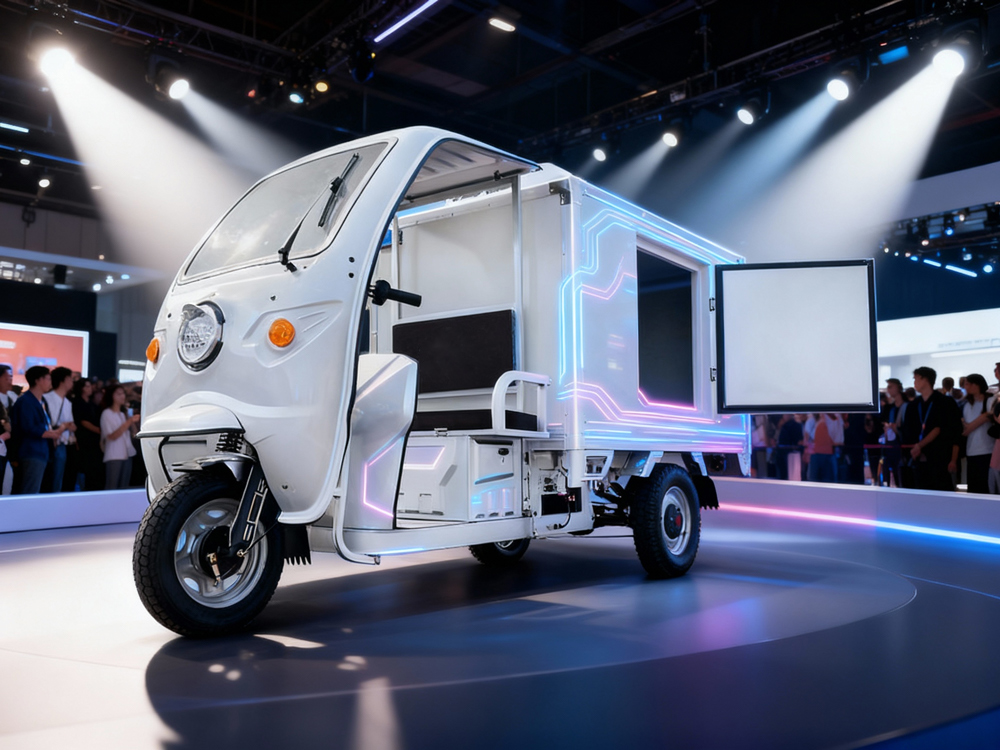
The physical footprint of an urban distribution vehicle directly governs its operational efficiency, maneuverability in constrained pathways, and spatial compatibility with standard logistic sorting hubs. The NEWBASE electric refrigerated tricycle features an optimized architectural layout balancing payload box volume with chassis agility.
1.1 Structural Configuration and Spatial Footprint
The comprehensive exterior dimensions of the vehicle are precisely engineered at 2955 mm × 1000 mm × 1750 mm (Length × Width × Height). This physical profile ensures a low center of gravity while maintaining compatibility with narrow urban infrastructure, zero-emission historical zones, and high-density warehouse loading bays.
To support the resultant structural and vertical payload constraints, the wheel-and-tire assemblies utilize standard heavy-duty 3.50—12 pneumatic tires. This specific aspect ratio and rim diameter are selected to provide optimal rolling resistance coefficients on urban asphalt while yielding sufficient structural compliance and sidewall deflection to dampen road-induced impact loads.
1.2 Drivetrain Performance and Controller Mechanics
Tractive power is generated via a high-torque 1000W rear motor configuration. By positioning the motor directly at the rear axle assembly, the mechanical drive system minimizes transmission linkage losses commonly found in remote-motor drive shafts.
The powertrain is managed by a robust 60V18 microprocessor-based controller. The controller continuously monitors thermal profiles and operational parameters to optimize phase-current distribution. When operating in an unloaded state, this synchronized powertrain efficiency yields a calculated operational transit range of 40 KM to 60 KM, providing ample operational overhead for localized multi-drop routing before requiring grid replenishment.
2. Thermodynamic Evaluation and Refrigeration System Architecture
Maintaining a continuous, unbroken cold chain environment within a compact vehicular platform requires high-efficiency active cooling equipment capable of compensating for localized ambient heat flux.
Technical Specification Dataset
| Subsystem Attribute | Engineering Metric Value | Operational Performance Impact |
| Overall Vehicle Dimensions | 2955 × 1000 × 1750 mm | Maximizes urban path accessibility and lateral stability |
| Powertrain Motor Specification | 1000W Rear-Mounted Motor | Direct power delivery; high low-speed startup torque |
| Refrigeration Power Rating | 650W Active Compressor | Rapid pull-down performance to deep-freeze thresholds |
| Rated Electrical Current | 10.1 — 11.4 A | Highly stable steady-state current consumption profile |
| Cooling Compartment Volume | 970 Liters (1800×1100×1200 mm) | High-cube volumetric efficiency for standard payload crates |
| Core Insulation Compound | High-Density Polyurethane Foam | Minimizes thermal bridging; superior structural rigidity |
2.1 Compressor Mechanics and Current Stabilization
The integrated active cooling architecture relies on a heavy-duty 650W refrigeration unit utilizing a specialized 60V direct current (DC) air-cooled compressor. Operating directly on a direct current bus prevents the typical 12-18% parasitic power drain associated with DC-to-AC power conversion inverters.
The steady-state operational draw is limited to a highly controlled rated current range of 10.1A to 11.4A. This tightly bounded current envelope prevents unexpected voltage drops and dampens transient current spikes during compressor cycling. The air-cooled condenser layout forces high-velocity airflow across the heat exchanger fins, maintaining high thermal dissipation metrics even when the vehicle is stationary during prolonged cargo unloading phases.
2.2 Independent Energy Buffering and Pull-Down Metrics
To ensure the thermodynamic integrity of the cargo remains completely independent of the tractive driving cycles, the refrigeration system is powered by its own dedicated 60V/58AH cooling battery pack. This separate energy storage circuit allows the active refrigeration matrix to perform continuous cooling operations for 6 to 8 hours without depleting the vehicle’s primary driving range.
The variable-capacity compressor system delivers an adjustable temperature spectrum down to a deep-freeze threshold of -18°C. This capability satisfies strict regulatory standards for a wide array of temperature-controlled logistical applications, spanning from standard chilled fresh produce ($0^\circ\text{C}$ to $4^\circ\text{C}$) to deep-frozen foods and sensitive pharmaceutical matrices requiring continuous sub-zero isolation.
3. Carriage Insulation Material and Volumetric Analysis
The efficiency of active refrigeration systems depends entirely on the thermal performance and sealing capability of the surrounding cargo enclosure.
3.1 Volumetric Capacity and Spatial Optimization
The structural cargo carriage features precise interior dimensions of 1800 mm × 1100 mm × 1200 mm (Length × Width × Height), resulting in an effective internal volumetric capacity of 970 Liters (970L). This clean, geometric high-cube design allows for optimal stacking of standardized plastic logistic distribution totes and modular medicine storage boxes, minimizing unutilized air pockets that can cause internal air convective turbulence.
3.2 Material Science of the Insulated Compartment
The multi-layer structural sandwich panel of the carriage is designed to isolate the interior micro-climate from extreme external ambient temperatures:
- Core Foaming Insulation Material: The core layer utilizes high-pressure injected Polyurethane (PU) foam. Polyurethane is selected for its dense closed-cell matrix structure, yielding a remarkably low thermal conductivity coefficient ($k$-factor). This structure prevents external ambient heat energy from penetrating the core wall via conductive transfer mechanisms.
- Outer Layer Structural Matrix: The external skin of the carriage consists of a robust, weather-resistant insulated panel. This outer layer features high solar reflectance indexes (SRI) to reflect radiant heat energy away from the box surface, while providing a high strength-to-weight ratio to shield the internal core foam from physical impacts and punctures during urban transits.
- Structural Customizability: Recognizing the diverse demands of international logistics, the entire carriage assembly architecture remains fully customizable (customizable), allowing for alternative multi-temperature internal partitions, dual-door variations, and specific shelving integrations.
الخاتمة
The NEWBASE electric refrigerated tricycle represents a highly balanced solution for modern urban last-mile distribution challenges. By combining an agile 2955mm chassis with a high-capacity 970L polyurethane insulated carriage, and powering the active 650W DC cooling system via an independent 6-8 hour battery architecture, the vehicle eliminates the traditional vulnerabilities of small-scale cold chain transport. It delivers consistent, verifiable -18°C performance, offering global fleet operators a highly compliant, reliable, and technically optimized asset for modern sustainable urban logistics.
Published by: Technical Operations and Engineering Content Department, Zhengzhou NewBase Automotive Electronics Co., Ltd.
All engineering parameters, including the 40-60KM range and 6-8 hour thermal performance, are verified through standardized environmental chamber simulation protocols.
 العربية
  English
  Español
  Português
  Русский
  Français
  Bahasa Indonesia
  日本語
日本語  Română
  Deutsch
  Italiano