
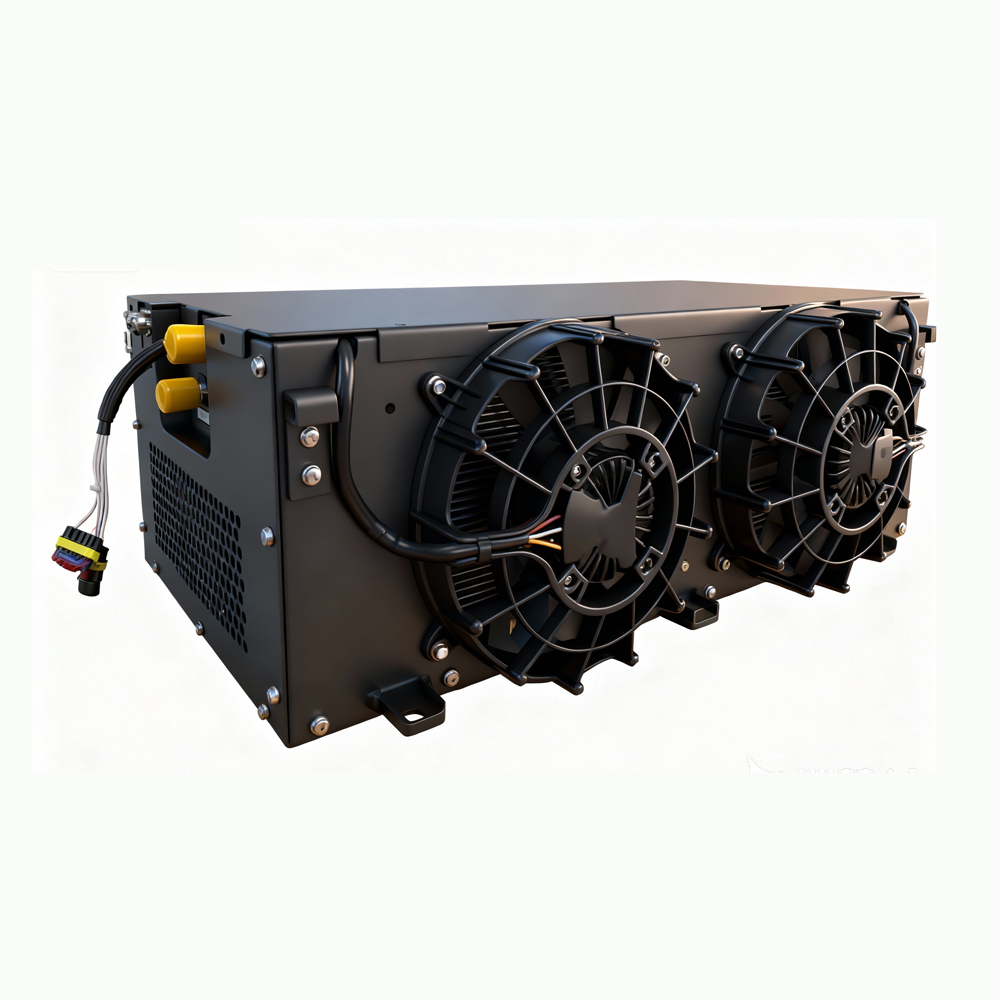
Selecting the Right Water-Cooled BTMS Capacity: A Technical Comparison
Choosing the appropriate cooling capacity is fundamental to effective battery thermal management. Water-cooled units range from 5kW to 16kW, with each capacity level suited to specific vehicle types and operational requirements. This article provides a detailed technical comparison to guide selection decisions.
Capacity Overview and Target Applications
The 5kW units serve lighter commercial vehicles with modest battery capacities. These compact systems, weighing under 40kg, are ideal for delivery vans, small buses, and urban electric vehicles. The 5kW class achieves cooling capacities through configurable adjustments, offering flexibility for various battery thermal loads.
The 8kW category bridges the gap between compact and mid-range applications. With dimensions of approximately 820×575×285mm and weighing around 50kg, these units suit medium-duty trucks, larger buses, and construction equipment with moderate battery capacity requirements.
Mid-range 10kW systems deliver substantial cooling capacity while maintaining reasonable packaging. These units feature built-in water pumps capable of 2880L/h flow rates, supporting larger battery packs in heavy-duty applications.
The 12kW class represents a significant capacity threshold for demanding applications. These units achieve cooling capacities of 12kW with corresponding heating capacity, essential for vehicles operating in extreme climates.
High-capacity 16kW systems address the most demanding commercial vehicle applications. With cooling capacity of 16kW and optional heating of 12kW, these units serve large battery packs in mining trucks, heavy-duty transport, and specialized vehicles.
Technical Specifications Comparison
| Specification | 5KW | 8KW | 10KW | 12KW | 16KW |
|---|---|---|---|---|---|
| Cooling Capacity | 5kW | 8kW | 10kW | 12kW | 16kW |
| Heating Capacity | 2-10kW | Optional | 24kW | 12kW | 12kW |
| High Voltage | 220-450VDC | 400-750VDC | 400-750VDC | 400-750VDC | 400-750VDC |
| Weight | ≤40kg | 50kg±2kg | ≤68kg | ≤85kg | ≤110kg |
| Noise Level | ≤85dB | ≤85dB(A) | ≤85dB(A) | ≤80dB(A) | ≤85dB(A) |
| Protection Class | – | IP67 | IP67 | IP67/IP27 | IP67/IP27 |
Operating Environment Considerations
Temperature range affects application suitability. The 5kW units operate in environments from -30°C to +80°C, while larger units operate from -30°C to +60°C. This distinction matters for applications in extreme heat environments.
The 12kW units achieve the lowest noise level at ≤80dB(A), beneficial for noise-sensitive applications such as urban buses operating in residential areas. Larger units maintain noise levels below 85dB(A).
Cooling Performance Analysis
Coefficient of Performance (COP) ratings remain consistent across models at ≥2.5, indicating efficient energy conversion. However, coolant flow rates vary significantly: the 5kW units provide ≥30L/min while larger units deliver ≥45L/min at 180kPa. Higher flow rates support more uniform temperature distribution in larger battery packs.
Refrigerant charge increases with capacity. The 5kW units use approximately 350±5g of R134a, while 12kW units require 600±5g. Proper refrigerant management during installation and service is essential for optimal performance.
System Integration Factors
Physical dimensions determine installation flexibility. Smaller units offer easier integration into vehicles with limited space, while larger units require more substantial mounting arrangements. All models feature standardized Φ25mm inlet/outlet connections for cooling water pipes.
Mounting point specifications vary: 5kW and 8kW units use 495×320mm mounting patterns with 6×Φ12mm holes, while larger units use 521×320mm or similar patterns. These specifications must align with vehicle structural provisions.
Selection Criteria Summary
Consider these factors when selecting capacity:
Battery thermal load is the primary consideration. Calculate peak heat generation based on battery chemistry, capacity, and discharge rates. Allow margin for worst-case scenarios and future expansion.
Vehicle type influences capacity choice. Light-duty vehicles typically require 5-8kW, medium-duty applications use 8-12kW, and heavy-duty applications demand 12-16kW or higher.
Climate conditions affect both cooling and heating requirements. Vehicles operating in extreme cold need adequate heating capacity, while extreme heat demands robust cooling performance.
Duty cycle matters for sustained thermal management. Vehicles with high utilization rates and limited dwell time between operations need generous capacity margins.
 English
  Español
  Português
  العربية
  Русский
  Français
  Bahasa Indonesia
  日本語
日本語  Română
  Deutsch
  Italiano