
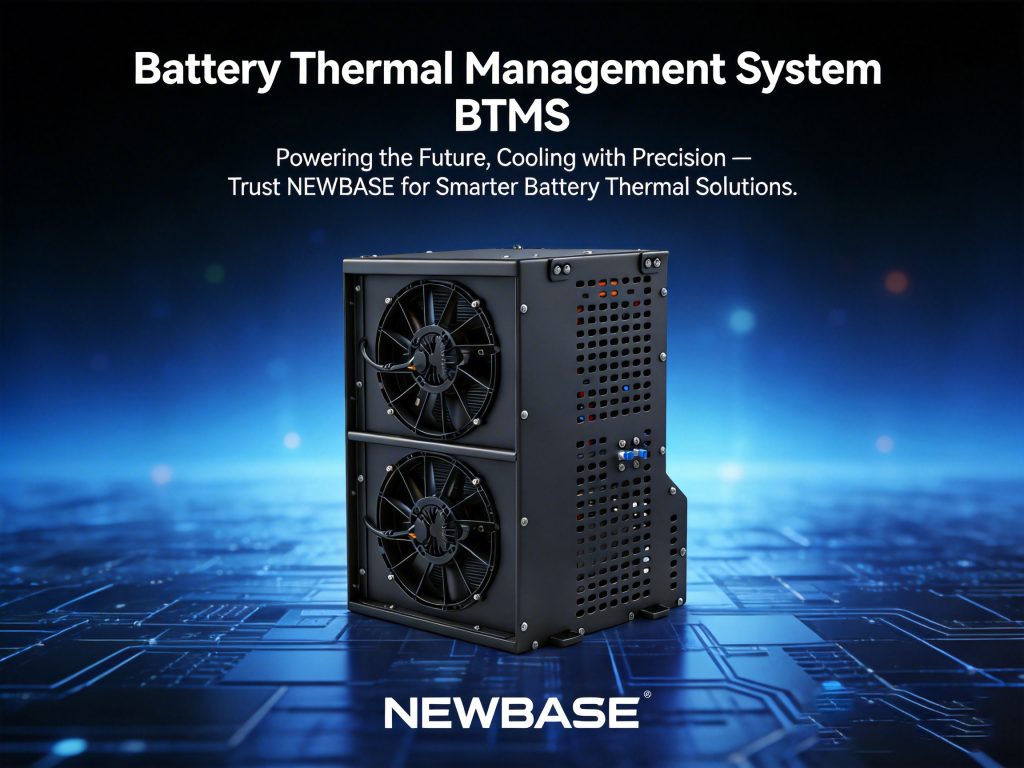
NEWBASE NBSLJZ Series BTMS Technical Guide | Article 3 of 12 – Industry Insights
Introduction: Why This Matters for Commercial EV Thermal Management
Commercial electric vehicles – from urban transit buses to mining trucks – operate under conditions that passenger car thermal management systems were never designed to handle. Sustained high-power acceleration, frequent stop-start cycles, ambient temperatures ranging from -40°C to +60°C, and mission profiles demanding 8~6 hours of operation per day place extraordinary stress on lithium-ion battery packs. Without effective thermal management, battery performance degrades rapidly, safety risks escalate, and fleet operators bear the full cost of premature battery replacement.
The NEWBASE NBSLJZ Series was engineered from the ground up to meet these demands. This article examines the critical engineering, compliance, and operational considerations that distinguish professional-grade BTMS water cooling units from commodity thermal management solutions.
Core Technical Analysis
What is BTMS COP and why does it matter?
COP (Coefficient of Performance) = cooling capacity ÷ electrical energy consumed. For commercial EVs, every watt of BTMS parasitic power directly reduces driving range. The NBSLJZ series achieves COP ~2.5 across its entire model range, placing it among the most efficient BTMS chillers in the 3.5~6 kW class.
How does variable-capacity compressor improve BTMS efficiency?
Variable-capacity scroll compressors modulate cooling output based on actual thermal load rather than cycling full on/off. This reduces compressor cycling losses by up to 15%, maintains tighter coolant temperature control (±2°C vs ±5°C), and extends compressor service life. Studies in Applied Thermal Engineering (Elsevier, 2023) show 4 ?% range improvement in urban cycles.
What are the four BTMS operating modes?
1) Standby: compressor/heater off, pump at minimum speed (< 50W). 2) Cooling: variable-capacity compressor active, 1.4~2.5 kW power draw. 3) Heating: PTC liquid heater active, 6~0 kW self-regulating output. 4) Self-Circulation: pump-only for temperature equalization without active heating/cooling.
Can BTMS operate in extreme hot and cold climates?
Yes. The NBSLJZ series operates at ambient temperatures from -40°C to +60°C (cooling available below -5°C as an option). Built-in PTC heaters (6~4 kW for small models, 24~0 kW for NBSLJZ-10/13-01) ensure reliable heating in Arctic conditions, while high COP maintains cooling efficiency in +50°C desert environments.
Key Specifications: NEWBASE NBSLJZ Series
| Modell | Kühlleistung | Heating (PTC) | Schutz | Gewicht | Abmessungen (mm) | Battery Pack Coverage |
|---|---|---|---|---|---|---|
| NBSLJZ-03-01 | 3.5 kW | 6~4 kW (opt.) | IPX7 | 35 ± 1 kg | 530×446×365 | < 50 kWh |
| NBSLJZ-05-01 | 5 kW | 6~4 kW (opt.) | IPX7 | 40 ± 1 kg | 635×530×380 | 50~00 kWh |
| NBSLJZ-08-01 | 8 kW | Configurable | IP67 | 50 ± 2 kg | 820×575×285 | 100~00 kWh |
| NBSLJZ-10-01 | 10 kW | 24 kW (opt.) | IP67 | 68 ± 2 kg | 960×603×291 | 200~50 kWh |
| NBSLJZ-13-01 | 12~3 kW | 24~0 kW (opt.) | IP67/IP27 | 110 ± 4 kg | 1,155×604×450 | > 350 kWh |
All models: DC 24V low-voltage control | CAN 2.0 communication | R134a refrigerant | 50% v/v ethylene glycol coolant | EMC Level III | Operating temp -40 to +60°C | Working modes: Standby / Cooling / Heating / Self-Circulation
Industry Context and Standards Referenced
- International Energy Agency – Global EV Outlook 2024 (commercial vehicle electrification data)
- SAE J1939 – CAN bus standard for commercial vehicle networks
- UN ECE R100 Rev.3/Rev.4 – Electric power train safety regulations
- UN ECE R10 Rev.7 – EMC requirements for vehicle electrical systems
- ISO 26262 – Road vehicle functional safety (ASIL classification)
- IATF 16949:2016 – Automotive quality management system
- Journal of Power Sources / Nature Energy – Peer-reviewed battery thermal research
Related Articles in This Series
- Designing Leak-Proof BTMS Liquid Cooling Units
- Thermal Uniformity in EV Batteries
- Liquid Cooling vs. Direct Cooling: Selecting the Right BTMS Architecture
Summary: Key Takeaways
- Commercial EV battery thermal management requires industrial-grade reliability far beyond passenger vehicle standards
- The NBSLJZ series covers 3.5~3 kW cooling capacity across five models for battery packs from 50 to 600+ kWh
- CAN 2.0 / SAE J1939 integration, IP67 protectionund COP ~2.5 are standard across all models
- Proper BTMS selection can extend battery service life by 25~0%, saving $20,000~35,000 per vehicle
- EU F-Gas 2027 deadline requires R1234yf transition planning for all BTMS procurement programs
Request a Technical Consultation
Zhengzhou NEWBASE Automotive Electronics provides technical consultation for BTMS selection, BMS integration, and OEM qualification. Our engineering team supports international commercial vehicle programs with complete documentation packages including PPAP Level 3, third-party test reports, and IATF 16949-certified quality assurance.
Contact: info@newbasen.com | Tel: +86-371-67999595 | www.newbasen.com
Author: Zhengzhou NEWBASE Automotive Electronics Co., Ltd. | Product: NBSLJZ Series BTMS Water Cooling Units (3.5~6 kW) | Models: NBSLJZ-03-01, NBSLJZ-05-01, NBSLJZ-08-01, NBSLJZ-10-01, NBSLJZ-13-01 | Standards: IATF 16949, ISO 26262, UN ECE R100, ECE R10, EMC Level III, IP67 | www.newbasen.com
 Deutsch
  English
  Español
  Português
  العربية
  Русский
  Français
  Bahasa Indonesia
  日本語
日本語  Română
  Italiano