
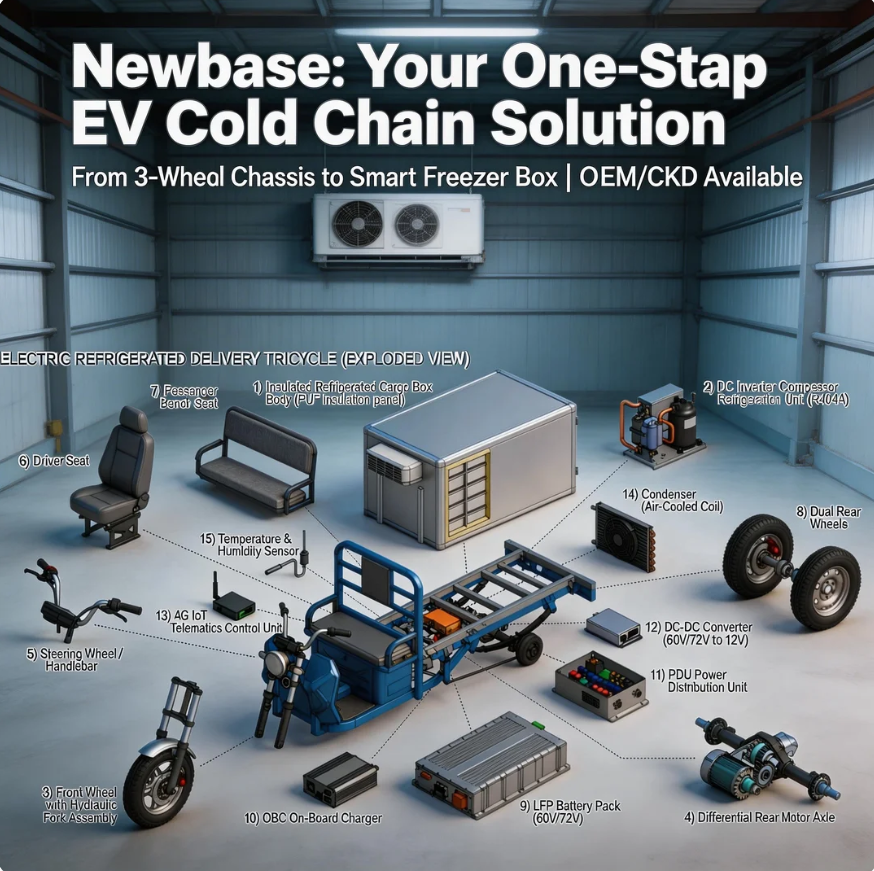
The “last-mile” delivery of fresh produce and dairy products within urban communities represents one of the most challenging segments of the cold chain. Unlike long-haul transport, community delivery involves frequent door openings and varying traffic conditions, which often lead to significant temperature fluctuations. For B2B fleet operators, maintaining a stable thermal environment is not just about quality—it is a matter of regulatory compliance and waste reduction.
By integrating DC Variable Frequency Technology, modern electric reefer trikes and mobile pods provide a level of thermal consistency previously reserved for large-scale refrigerated trucks.
The Critical Challenge: Thermal Instability in Urban Logistics
Urban grocery distribution centers and “dark stores” rely on small-footprint vehicles to navigate narrow streets. However, these vehicles face specific technical hurdles:
- Frequent Access Cycles: Every time a delivery driver opens the rear door to retrieve an order, ambient air enters the cabin.
- Variable Power Supply: In traditional on-off systems, the compressor runs at a fixed speed, leading to “sawtooth” temperature patterns that can damage sensitive leafy greens or frozen seafood.
- Ambient Heat Transfer: Small vehicles have a higher surface-area-to-volume ratio, making them more susceptible to external heat gain through the hull.
How DC Variable Frequency Technology Solves the Fluctuation Problem
At the heart of high-performance community delivery vehicles is the DC Variable Frequency Compressor (typically DC 53V-72V for electric platforms). Unlike fixed-speed compressors that only offer 0% or 100% output, variable frequency systems utilize Pulse Width Modulation (PWM) to adjust cooling capacity in real-time.
1. Dynamic Load Adaptation
The system monitors internal conditions via high-precision PT1000 or NTC sensors, which provide accuracy within ±0.5°C. When the sensor detects a minor rise in temperature—such as after a door opening—the compressor ramps up its speed just enough to counteract the heat gain, rather than surging to maximum power.
2. Elimination of Start-Stop Thermal Spikes
Traditional systems suffer from a lag between the thermostat’s “on” signal and the actual delivery of cold air. Variable frequency technology keeps the compressor running at a low “maintenance” speed. This ensures that the temperature remains within a tight window of ±1°C, preventing the partial thawing and re-freezing that degrades food texture.
3. Energy Efficiency and Battery Longevity
For electric tricycles, energy is a finite resource. Variable frequency units are optimized for high-efficiency operation, often consuming between 300W and 800W depending on the thermal load. By avoiding the high inrush current of frequent starts, the system preserves the SOC (State of Charge) of the Lithium Iron Phosphate (LFP) battery, allowing for static refrigeration times of up to 72 hours.
Engineering for Reliability: Beyond the Compressor
While the compressor is the “engine” of thermal stability, it must be supported by a robust hardware ecosystem to ensure consistent performance in harsh urban environments.
High-Density Insulation Standards
The structural integrity of the cold box is vital. Superior units utilize A-grade flame-retardant Polyurethane (PUF) insulation with a density of 40-60kg/m³. A thickness of 8cm to 10cm is the industry benchmark for achieving a heat leakage rate below 3.5 W/K, ensuring that even if power is interrupted, the cargo remains at -18°C for at least 8 hours.
IP67-Rated Power Electronics
Urban delivery vehicles are exposed to rain, road salt, and high-pressure cleaning. To maintain system uptime, core components like the DC-DC Converters and PDU (Power Distribution Units) must meet IP67 protection standards. This ensures that the cooling system remains operational regardless of external environmental stress.
Multi-Chassis Flexibility
Modern logistics require “modular” thinking. The use of Removable Cold Chain Pods—which can be moved from a tricycle to a micro-van using 6063-T5 aluminum guide rails—allows companies to scale their fleet without duplicating expensive refrigeration hardware.
Selection Guide: Key Parameters for B2B Procurement
When evaluating a cold chain solution for community grocery delivery, technical buyers should prioritize “parameterized evidence” over marketing claims. Look for the following specifications:
| Component | Technical Benchmark | Importance for Stability |
| Compressor Type | DC Variable Frequency (53V-72V) | Real-time adjustment to thermal load. |
| Temperature Range | -25°C to +25°C | Versatility for frozen seafood or fresh dairy. |
| Sensor Precision | ±0.5°C (PT1000/NTC) | Critical for identifying small thermal drifts. |
| Cooling Speed | 30°C to -10°C in ≤25 mins | Rapid recovery after cargo loading. |
| BMS Integration | 4G IoT Real-time Reporting | Remote auditing for food safety compliance. |
Industry Outlook: The Role of IoT and Smart Thermal Management
The future of thermal stability lies in the integration of 4G LTE and GPS/Beidou monitoring. By centralizing data from temperature and humidity sensors (0-100% RH), fleet managers can receive instant alerts for any deviation. This level of transparency is becoming a prerequisite for high-value cold chain contracts, particularly in the pharmaceutical and premium organic grocery sectors.
By transitioning to DC variable frequency technology supported by industrial-grade insulation and IP67 electronics, community delivery providers can finally bridge the gap between “last-mile” speed and “pharmaceutical-grade” thermal consistency.
 English
  Español
  Português
  العربية
  Русский
  Français
  Bahasa Indonesia
  日本語
日本語  Română
  Deutsch
  Italiano