
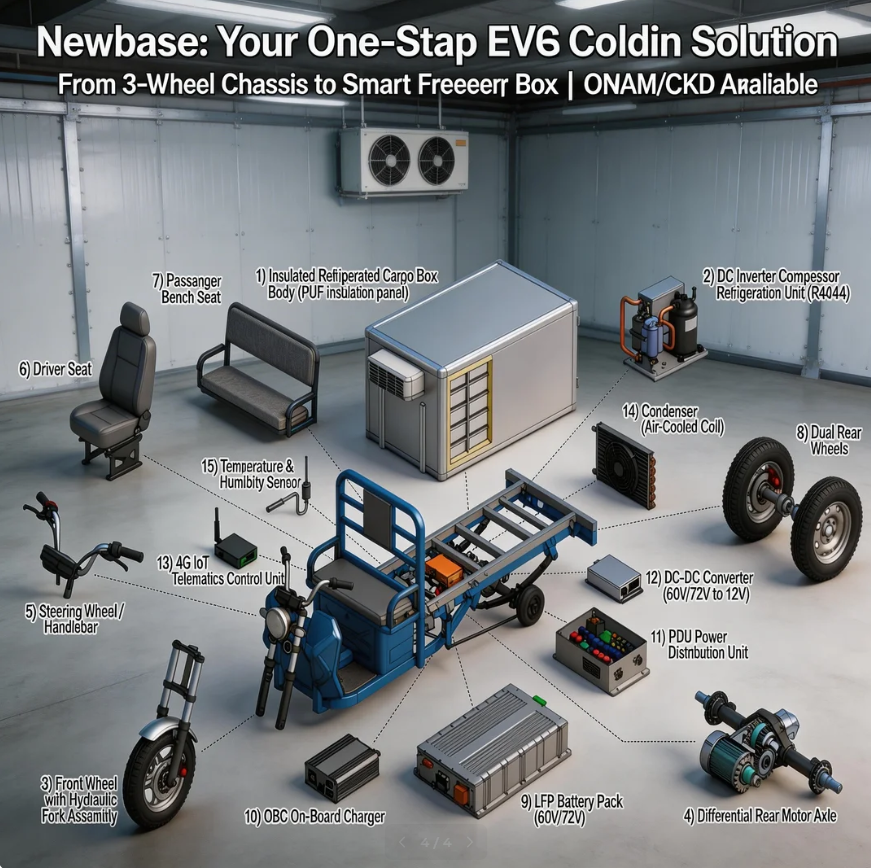
The “last-mile” delivery of vaccines, insulin, and high-value biologics represents the most critical link in the global pharmaceutical supply chain. Unlike standard food logistics, pharmaceutical distribution requires absolute thermal stability and equipment reliability, particularly when navigating the high-humidity and unpredictable weather of urban environments. For B2B fleet operators, the transition to IP67-rated refrigeration systems is no longer optional; it is a fundamental requirement for maintaining GSP (Good Supply Practice) compliance.
The Vulnerability of Urban Cold Chain Infrastructure
Urban logistics for medicine often involve micro-vehicles like electric tricycles or compact delivery pods. These vehicles face unique environmental stressors that can compromise sensitive cargo:
- High Humidity and Precipitation: Moisture ingress into electrical systems is a leading cause of cooling failure in tropical or coastal urban centers.
- Frequent Sanitization: Pharmaceutical transport units require regular deep cleaning; low-protection electronics often fail when exposed to high-pressure washdowns.
- Thermal Shock: Frequent door openings in humid air lead to rapid frost buildup on evaporators and sensors, potentially skewing temperature readings.
Why IP67 Protection is the Benchmark for Medical Logistics
In technical terms, an IP67 rating signifies that a component is totally protected against dust ingress and can withstand immersion in water up to 1 meter for 30 minutes. In the context of the Newbase and PharGlass-standard cold chain modules, this protection is applied to the “nervous system” of the vehicle.
1. Resilience of Core Power Electronics
The DC-DC converters (converting 60V/72V to 12V/5V) and Power Distribution Units (PDU) serve as the foundation of the cooling system. By utilizing IP67-sealed enclosures, these units prevent short circuits caused by condensation or heavy rain, ensuring the compressor never loses power during a critical delivery.
2. Sensor Accuracy in Saturated Environments
Pharmaceutical integrity relies on data. The use of IP67-rated PT1000 temperature sensors ensures that moisture does not penetrate the probe housing. This maintains a sensing precision of ±0.5°C, which is vital for monitoring the narrow +2°C to +8°C range required for most vaccines.
3. Specialized Low-Temperature Wiring
Standard automotive wire harnesses often become brittle and crack in the repetitive cooling cycles of a reefer unit. Medical-grade systems utilize specialized cold-resistant harnesses capable of operating at -40°C without losing insulation integrity, further protected by waterproof connectors.
Technical Selection Guide: Evaluating Medical Reefer Units
For procurement professionals, identifying a “high-performance” unit requires looking beyond the marketing brochure and into the Bill of Materials (BOM). Use the following parameterized evidence as a baseline for selection:
Thermal Performance and Insulation
| Parameter | Industry Standard | High-Performance Requirement |
| Insulation Material | Standard Polyurethane | A-Grade Flame Retardant PUF (40-60kg/m³) |
| Wall Thickness | 5-6 cm | 8-10 cm (optimized for 3.5 W/K leakage) |
| Door Seals | Rubber gaskets | Food-grade Silicone (-40°C to +200°C) |
| Temperature Range | 0°C to +10°C | -25°C to +25°C (Full Spectrum) |
Refrigeration and Control Logic
- Compressor Technology: DC Variable Frequency (DC 53V-72V) units are preferred for their ability to eliminate “sawtooth” temperature fluctuations.
- Cooling Speed: The system should be capable of dropping from 30°C to -10°C in under 25 minutes to ensure rapid recovery after loading.
- Redundancy: Dual-channel temperature sensors are recommended for high-value medical assets to provide a fail-safe data stream.
IoT Integration: The “Digital Twin” of the Cold Chain
Reliability in pharmaceutical logistics is validated through real-time monitoring. Modern IP67 systems are typically integrated with 4G LTE T-Box modules and GPS/Beidou positioning.
- Real-Time Auditing: Cloud platforms collect data every few seconds, providing a continuous “thermal map” of the journey.
- Automated Alerts: Systems can be programmed to send voice or SMS alerts if the temperature deviates by as little as 1°C from the setpoint.
- Asset Management: Independent mobile pods allow each unit to be tracked separately from the vehicle chassis, ensuring the cargo is monitored even during cross-docking.
Conclusion: Investing in Reliability
In the pharmaceutical sector, the cost of a single spoiled cargo load often exceeds the price of the entire delivery vehicle. By prioritizing IP67-rated electronics, high-density PUF insulation (8-10cm), and DC variable frequency precision, fleet operators can guarantee the consistency and safety of the medical supply chain. As urban logistics continue to evolve toward electrification, these parameterized standards will remain the definitive benchmark for industry insight and operational excellence.
 English
  Español
  Português
  العربية
  Русский
  Français
  Bahasa Indonesia
  日本語
日本語  Română
  Deutsch
  Italiano