
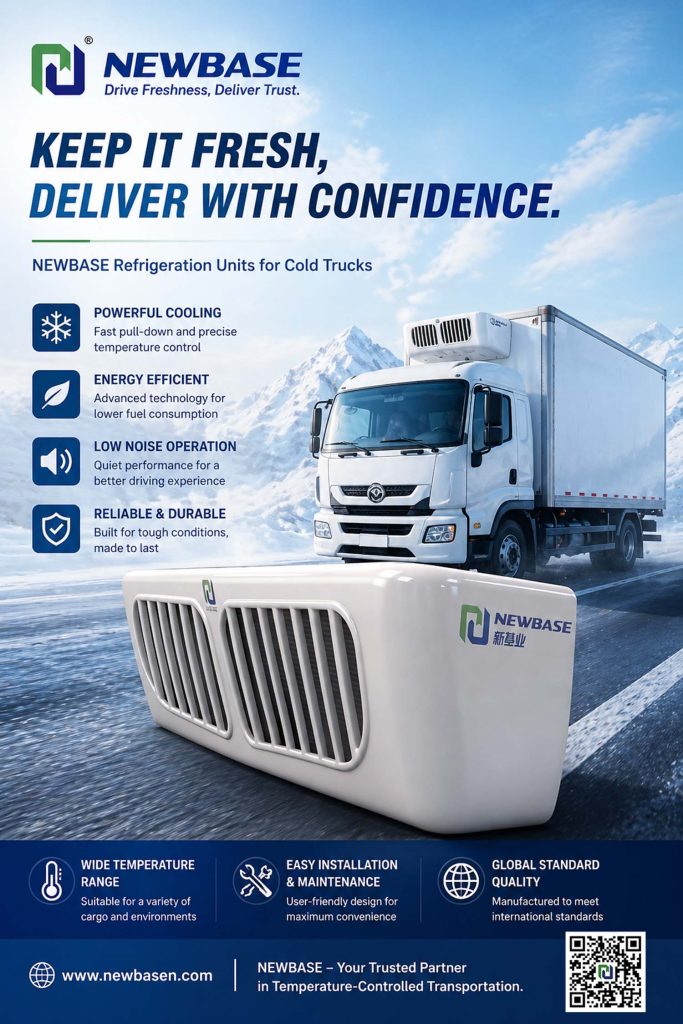
Por el equipo de control de calidad de NEWBASE | Publicado el 30 de abril de 2026 | 9 min read
La refrigeración de vehículos comerciales opera en uno de los entornos más exigentes imaginables. El NBESR-1000A debe soportar la vibración constante de las superficies de la carretera, la exposición a la lluvia y las salpicaduras de la carretera, condiciones de temperatura extremas e interferencias electromagnéticas de los sistemas eléctricos del vehículo, todo ello manteniendo un control preciso de la temperatura para la valiosa carga. Este entorno sin concesiones exige rigurosas normas de ensayo que superan los requisitos típicos de la electrónica de consumo o incluso industrial. El NBESR-1000A se somete a exhaustivas pruebas de vibración, lluvia, aislamiento y compatibilidad electromagnética, lo que garantiza un rendimiento fiable durante toda la vida útil del vehículo.
Por qué es importante la inspección técnica de vehículos industriales
La dura realidad de la explotación de vehículos
A diferencia de los sistemas de refrigeración estacionarios, el NBESR-1000A se enfrenta a retos que no existen en almacenes u hogares: Retos mecánicos:
- Vibración de la carretera: Tensión mecánica constante debida a la rugosidad de la calzada.
- Cargas de choque: Los baches, badenes y frenadas bruscas generan fuerzas repentinas.
- Tensión de montaje: Diferencias de dilatación térmica entre componentes
- Desgaste acelerado: Funcionamiento continuo durante la vida útil del vehículo
Retos medioambientales:
- Exposición a la intemperie: Lluvia, nieve, hielo y sal de carretera
- Temperaturas extremas: -40°C a +70°C de temperatura ambiente
- Ciclos de humedad: Condensación por cambios de temperatura
- Polvo y escombros: Infiltración de suciedad de la carretera
Desafíos eléctricos:
- Ruido eléctrico del vehículo: Alternador, inyectores, motores crean interferencias
- Transitorios de tensión: Descargas de carga y sobretensiones
- Diferencias de potencial de tierra: Múltiples puntos de tierra en el vehículo
- Eventos ESD: Descarga electrostática por manipulación
Filosofía de las pruebas
El enfoque de pruebas de NEWBASE sigue el principio de "diseñar para sobrevivir":
- Pruebas de vida útil aceleradas: Comprime años de condiciones de campo en semanas
- Los peores escenarios: Pruebas en condiciones límite, no típicas
- Análisis modal de fallos: Los fallos intencionados permiten mejorar el diseño
- Verificación del margen: Las pruebas más allá de las especificaciones garantizan el margen de seguridad
1. Pruebas de vibración
El reto de la vibración
La vibración es quizá la amenaza más generalizada para los equipos montados en vehículos:
- Fallo por fatiga: La tensión repetitiva provoca la propagación de grietas
- Conexiones sueltas: Las vibraciones pueden aflojar las fijaciones y los conectores
- Daños en los componentes: Las piezas sensibles pueden resultar dañadas por la resonancia
- Degradación del rendimiento: La vibración afecta a la contención del refrigerante
Norma de ensayo de vibraciones
El NBESR-1000A se somete a pruebas de vibración conformes con la norma SAE J1455, la norma para equipos electrónicos de vehículos comerciales: Perfil de prueba (vibración aleatoria):
| Gama de frecuencias | Nivel de prueba | Duración |
| 20-50 Hz | +6 dB/octava | 8 horas por eje |
| 50-200 Hz | 0,15 g²/Hz | 8 horas por eje |
| 200-500 Hz | -6 dB/octava | 8 horas por eje |
| 500-2000 Hz | 0,02 g²/Hz | 8 horas por eje |
Ejes de prueba:
- Vertical (eje Z): Entrada de carretera primaria
- Longitudinal (eje X): Aceleración/frenado
- Lateral (eje Y): Fuerzas de viraje
Procedimientos de ensayo clave
Prueba de vibración funcional:
- Unidad montada como en el vehículo de producción
- Funciona durante toda la prueba en las condiciones nominales
- Rendimiento supervisado continuamente
- La temperatura se mantiene dentro de las especificaciones
Búsqueda por resonancia:
- El barrido sinusoidal de bajo nivel identifica las frecuencias naturales
- Pruebas de permanencia a frecuencias resonantes
- Identifica posibles modos de fallo
- Informa de las recomendaciones de montaje
Prueba de integridad mecánica:
- Inspección posterior a la vibración
- Verificación del par de apriete de todas las fijaciones
- Comprobación de la continuidad eléctrica
- Detección de fugas de refrigerante
NBESR-1000A Características de diseño
Construcción antivibraciones:
- Cierres herméticos: Evita que se aflojen por las vibraciones
- Aisladores de goma: Absorben la energía de las vibraciones
- Montaje reforzado: Las gruesas bridas de montaje reducen la tensión
- Protección contra cortocircuitos: Evita cortocircuitos inducidos por vibraciones
2. Pruebas de duchas de lluvia
Entrada de agua: La amenaza oculta
El agua es implacable:
- Salpicaduras en carretera: el agua a alta presión golpea los componentes del tren de rodaje
- Lavado a presión: los equipos de limpieza rocían directamente los vehículos
- Condensación: Los ciclos de temperatura provocan humedad interna
- Vías de fuga: Las pequeñas fisuras se vuelven importantes con el tiempo
Causas de la entrada de agua:
- Averías eléctricas: Cortocircuitos y corrosión
- Rotura del aislamiento: Reducción de la rigidez dieléctrica
- Fallo de los componentes: La corrosión destruye las piezas metálicas
- Peligros para la seguridad: Riesgos de descarga eléctrica
Norma de ensayo de duchas de lluvia
El NBESR-1000A supera los requisitos de la prueba de ducha SAE J575: Condiciones de prueba:
| Parámetro | Especificación |
| Distancia entre boquillas | 1,5-2,5 metros de la unidad |
| Duración de la prueba | 40 minutos mínimo |
| Temperatura del agua | 10-30°C ambiente |
| Patrón de boquilla | Cono lleno, dispersión de 30 |
| Cobertura | Todas las superficies accesibles |
Secuencia de prueba:
1. Inspección previa a la prueba: Verificación visual y eléctrica de referencia
2. Pulverización horizontal: Unidad horizontal, pulverización desde todos los ángulos
3. Pulverización inclinada: 15° de inclinación, patrón de pulverización repetido
4. Rociado aéreo: Simula fuentes de agua aéreas
5. Inspección posterior a la prueba: Verificación funcional completa
6. Prueba dieléctrica: Verifica la integridad del aislamiento.
NBESR-1000A Protección del agua
Clasificación IP: El NBESR-1000A está diseñado para cumplir la protección mínima IP54:
| Función de protección | Especificación |
| Protección contra líquidos | Salpicaduras desde cualquier dirección (4) |
| Gestión de condensados | Disposiciones de drenaje para la humedad interna |
| Conectores estancos | Deutsch serie DT con juntas de silicona |
| Diseño de la junta | Juntas de goma continuas en todas las uniones |
Características de diseño:
- Carcasa del condensador sellada: Sin aberturas para la entrada de agua
- Vías de drenaje: El agua sale sin acumularse
- Materiales resistentes a la corrosión: Carcasa de aluminio con revestimiento e-coat
- Electrónica protegida: Controlador en caja sellada
3. Pruebas de aislamiento
Seguridad eléctrica: Lo innegociable
Los fallos de aislamiento pueden provocar:
- Daños en los equipos: Los cortocircuitos destruyen componentes
- Peligros para la seguridad: Riesgos de descarga eléctrica personal
- Riesgos de incendio: La rotura del aislamiento puede incendiarse
- Responsabilidad de la flota: Incumplimiento de la normativa
Requisitos de las pruebas de aislamiento
El NBESR-1000A se somete a pruebas de resistencia dieléctrica según las normas IEC y SAE: Niveles de tensión de prueba:
| Tipo de prueba | Tensión aplicada | Duración | Aceptación |
| Resistencia del aislamiento | Megóhmetro de 500 V CC | 60 segundos | >10 MΩ |
| Enlace a tierra | 30A, caída de milivoltios | 60 segundos | <3 mV por amperio |
| Corriente de fuga | Tensión de trabajo aplicada | Continuo | <3,5 mA |
Puntos de prueba:
- Línea a tierra: Todos los conductores alimentados al chasis
- Línea a línea: Entre conductores de fase
- Resistencia a sobretensiones: Prueba de impulsos de alta tensión
- Tensión transitoria: Eventos de descarga de carga simulados
Procedimientos de prueba Hipot
Hipot de producción: Todas las unidades se someten a pruebas de hipot durante la producción:
1. Montaje en soporte: Unidad correctamente conectada a tierra en el accesorio de prueba
2. Aplicación de tensión: Rampa gradual hasta la tensión de prueba
3. Periodo de permanencia: 1 minuto a plena tensión de prueba
4. Detección de pasa/no pasa: Detección inmediata de la avería
5. 5. Conservación de registros: Resultados de las pruebas registrados con el número de serie de la unidad
Pruebas por muestreo:
- prueba hipot ampliada de 100 horas
- Prueba de resistencia a la humedad (85°C/85% HR)
- Prueba hipot de ciclos de temperatura
NBESR-1000A Diseño de aislamiento
Arquitectura de doble aislamiento:
- Aislamiento primario: Aislamiento básico de las partes activas
- Aislamiento reforzado: Barreras adicionales para circuitos críticos
- Tierra de protección: Vías de tierra redundantes
- Transformadores de aislamiento: Aislamiento galvánico cuando sea necesario
Materiales:
- Alambre de alta temperatura: 105°C nominal mínimo
- Componentes cerámicos: En su caso, para alta tensión
- Distancias de fuga: Supera los requisitos mínimos
- Distancias de separación: Una separación adecuada evita la formación de arcos
4. Pruebas EMC de nivel III
Compatibilidad electromagnética: Convivir con el ruido eléctrico
Los vehículos modernos son entornos eléctricamente ruidosos: Fuentes de ruido:
- Sistemas de carga del alternador
- Motores eléctricos (arrancadores, limpiaparabrisas, ventiladores)
- Sistemas de encendido (para vehículos de combustión)
- Fuentes de alimentación conmutadas
- Transceptores de radio
- Sistemas de accionamiento eléctrico
Este ruido puede:
- Interrumpe los sistemas de control: Causa mal funcionamiento o reinicio
- Introducir errores de medición: Lecturas del sensor dañadas
- Activación de falsos fallos: Generación de códigos de fallo falsos
- Reducir la vida útil del sistema: Degradación de los componentes a largo plazo
Requisito EMC de nivel III
CISPR 25 / SAE J1113-41 Nivel III representa la norma CEM para vehículos comerciales más exigente: Límites de emisiones (Nivel III):
| Gama de frecuencias | Emisiones radiadas | Emisiones conducidas |
| 500 kHz - 30 MHz | 50 dBμV/m | 70 dBμV |
| 30 MHz - 200 MHz | 40-50 dBμV/m | - |
| 200 MHz - 1 GHz | 30-40 dBμV/m | - |
Requisitos de inmunidad (Nivel III):
| Prueba | Gravedad | Criterios de rendimiento |
| Inmunidad conducida | 10 V RMS | A (Rendimiento normal) |
| Inmunidad ESD | ±8 kV contacto, ±15 kV aire | A (Rendimiento normal) |
| Inmunidad transitoria | Según ISO 7637-2 | B (Degradación gradual) |
Procedimientos de ensayo CEM
Emisiones radiadas (CISPR 25):
- Método de abrazadera absorbente para emisiones de arneses
- Medición de antenas en cámara anecoica
- Método ALSE (Anechoic Large Screen Enclosure)
Emisiones conducidas:
- Método de la sonda de corriente en los cables de alimentación
- Método de la sonda de tensión en los bornes de la batería
- Emisiones medidas en toda la gama de frecuencias
Inmunidad RF (ISO 11452):
- Método de inyección de corriente a granel (BCI)
- Pruebas de radiación de campo lejano
- Inyección de campo cercano de antena
Inmunidad a los transitorios (ISO 7637):
- Pulso 1: Desconexión de la tensión de alimentación
- Pulso 2a: Conmutación de carga inductiva
- Pulso 3a/b: Transitorios en las líneas de datos
- Pulso 4: Simulación de arranque del motor
- Pulso 5a: Transitorio de descarga de carga
NBESR-1000A Ingeniería CEM
Diseño de supresión EMI:
| Técnica | Aplicación |
| Filtrado | Redes de filtros de entrada/salida |
| Desacoplamiento | Condensadores en los pines de alimentación |
| Conexión a tierra | Topología de tierra en estrella |
| Diseño | Placa de circuito impreso de 4 capas con planos de masa |
Características CEM específicas:
- Módulos de filtrado: Filtros EMI integrados en todos los conectores
- Protección contra transitorios: Diodos TVS y supresores
- Blindaje de PCB: Zonas internas de vertido de cobre
- Tendido de cables: Separación de circuitos ruidosos y sensibles
5. Programas de pruebas adicionales
Pruebas medioambientales
Pruebas de temperatura:
- Temperatura de funcionamiento: -40°C a +70°C ambiente
- Temperatura de almacenamiento: de -40°C a +85°C
- Choque térmico: ciclos rápidos de -40°C a +70°C
- Gradiente de temperatura: Pruebas de respuesta a condiciones cambiantes
Pruebas de humedad:
- Calor húmedo: 85°C/85% HR durante 1000 horas
- Humedad cíclica: Ciclos de temperatura-humedad
- Humedad de condensación: Condensación de agua durante el descenso de temperatura.
Pruebas de rendimiento
Pruebas de resistencia:
- 1000 horas de funcionamiento continuo: Funcionamiento a plena carga durante 42 días
- Resistencia a los ciclos térmicos: Ciclos repetidos de calor/frío
- Ciclos de carga: La variación de las cargas térmicas simula el funcionamiento real.
Validación del rendimiento:
- Capacidad de refrigeración: Verificada según las normas AHRI
- Ratio de eficiencia energética: Verificación COP
- Uniformidad de la temperatura: Cartografía del espacio de carga
6. Documentación de calidad
Sistema de trazabilidad
Cada NBESR-1000A es totalmente trazable: Registros de trazabilidad:
- Número de serie: Identificación única para cada unidad
- Fecha de fabricación: Código de la fecha de producción
- Códigos de lote de los componentes: Seguimiento de todos los componentes principales
- Registros de pruebas: Conservación completa de los datos de las pruebas
- Registro de la garantía: Seguimiento del cliente y de la instalación
Documentación de certificación
Certificaciones estándar:
- Marcado CE: Conformidad europea
- Marcado UKCA: Conformidad con la normativa británica
- Marca E: Homologación de tipo de vehículo
- CCC: Certificación obligatoria de China
- Listado UL: Seguridad norteamericana
Informes de pruebas:
- Informes de ensayos de tipo disponibles para el cumplimiento de la normativa
- Certificados de laboratorios de ensayo acreditados
- Fichas de rendimiento
- Declaraciones de materiales (RoHS, REACH)
Conclusión: Calidad de confianza
El riguroso programa de pruebas del NBESR-1000A garantiza que cada unidad entregada:
- Sobrevive a años de vibraciones: Construcción hermética y montaje aislado
- Resiste la exposición al agua: protección IP54 y electrónica sellada
- Mantenga la seguridad eléctrica: Las pruebas de hipot y aislamiento superan las normas
- Funcionamiento fiable en entornos con ruido eléctrico: Certificación EMC de nivel III
- Rendimiento constante: Rendimiento validado en condiciones extremas
Para los operadores de flotas, estas pruebas se traducen en fiabilidad, reducción de los tiempos de inactividad y protección de la carga: la base del éxito de una operación de cadena de frío.
Acerca de NEWBASE: NEWBASE mantiene un laboratorio de pruebas acreditado y colabora con instalaciones de pruebas certificadas en todo el mundo para garantizar que NBESR-1000A cumple o supera todas las normas relevantes para vehículos comerciales. Referencias:
1. SAE J1455 - Prácticas medioambientales recomendadas conjuntas SAE/TMC para equipos eléctricos electrónicos de automoción.
2. SAE J575 - Ensayos de dispositivos y componentes eléctricos de alumbrado de vehículos.
3. IEC 60068 - Pruebas ambientales
4. CISPR 25 - Perturbaciones radioeléctricas en vehículos, embarcaciones y motores de combustión interna
5. ISO 7637 - Road Vehicles - Electrical Disturbances from Conduction and Coupling (Vehículos de carretera - Perturbaciones eléctricas por conducción y acoplamiento).
 Español
  English
  Português
  العربية
  Русский
  Français
  Bahasa Indonesia
  日本語
日本語  Română
  Deutsch
  Italiano