
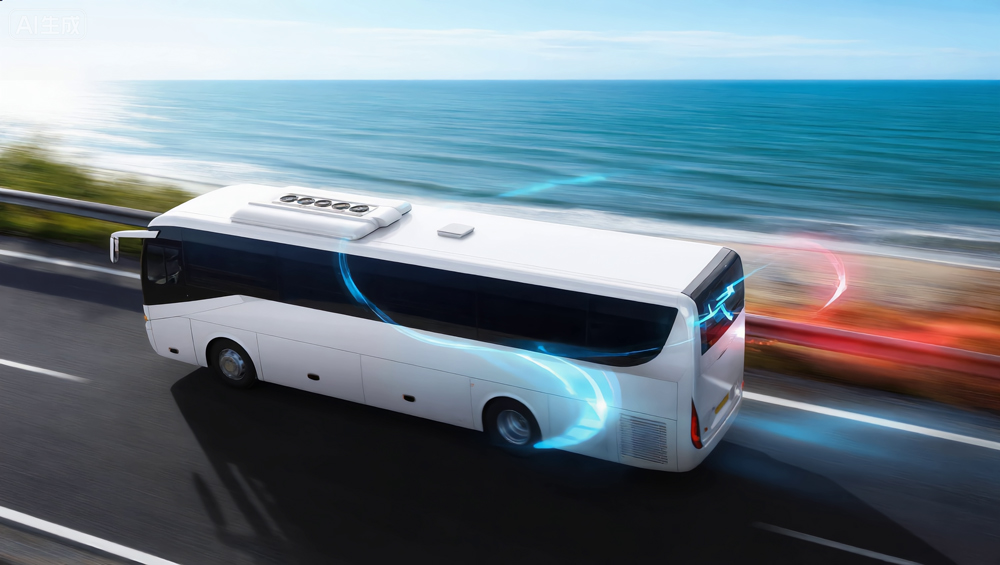
NEWBASE Electric Bus Air Conditioning Systems: Advanced Thermal Management Technologies for Next-Generation Zero-Emission Fleets
Introduction
The thermal management of electric buses represents one of the most critical engineering challenges facing the commercial vehicle industry today. Research has consistently shown that air conditioning systems are among the largest auxiliary energy consumers in electric buses, with HVAC energy consumption capable of accounting for up to 24% of total energy usage under extreme conditions. Studies have further documented that HVAC systems can lead to up to a 50% reduction in total driving range during extreme cold weather conditions. As the global electric bus market continues its rapid expansion—with electric heat pump systems now accounting for 75% of bus HVAC deliveries in 2025—the demand for energy-efficient, reliable, and intelligent thermal management solutions has never been greater.
NEWBASE, a recognized leader in commercial vehicle HVAC solutions, addresses these challenges through two complementary product platforms: the 1.4 Full DC Inverter Heat Pump Air Conditioning Series (pure electric base platform) and the 1.5 Integrated Rooftop Air Conditioning and Battery Thermal Management System (compact integration platform). This article provides a comprehensive technical examination of the key engineering features and performance advantages of these two product lines.
Part One: Full DC Inverter Heat Pump Air Conditioning — Core Technologies
NEWBASE’s 1.4 Full DC Inverter Heat Pump Air Conditioning series represents the foundational thermal management platform for 6 to 12-meter pure electric, hybrid, and fuel cell buses. The series is built upon three core technological pillars that collectively deliver superior energy efficiency, operational reliability, and passenger comfort.
1. IP67 Protection Grade — Uncompromising Durability in Harsh Environments
All critical components within the NEWBASE Full DC Inverter series—including the compressor, power modules, and electrical connectors—are engineered to meet Normes de protection IP67. This ingress protection rating signifies that the system is:
- Dust-tight: Complete protection against the ingress of dust particles, ensuring reliable operation in the most demanding urban and rural environments.
- Waterproof: Protected against the effects of temporary immersion in water, meaning the system remains fully functional even after exposure to flooding or high-pressure washing.
The IP67 rating is particularly critical for electric bus applications, where roof-mounted HVAC units are exposed to rain, snow, road spray, and routine pressure-washing during vehicle maintenance. Industry practice has established that IP67-rated components are essential for ensuring “reliability in harsh urban or rural settings”. This level of protection directly translates to reduced maintenance costs, extended service life, and minimized downtime for fleet operators.
2. V-Shaped Vibration Damping and Noise Reduction — Creating a Quieter Passenger Environment
Electric buses are already significantly quieter than their diesel counterparts, making HVAC noise more noticeable to passengers. NEWBASE addresses this challenge through an innovative V-shaped vibration damping and noise reduction design.
This engineering approach achieves:
- Structural vibration isolation: The V-shaped mounting geometry effectively decouples the compressor and other rotating components from the vehicle structure, preventing the transmission of mechanical vibrations into the passenger cabin.
- Acoustic attenuation: By damping vibration at its source, the system reduces both structure-borne and airborne noise, contributing to a more comfortable and restful environment for passengers.
The importance of low-noise operation extends beyond passenger comfort. Research has demonstrated that reduced noise levels not only enhance the riding experience but also “help to relax the body and mind” and “reduce the discomfort caused by long-term riding”. For transit agencies committed to delivering premium passenger experiences, this noise reduction capability represents a significant competitive advantage.
3. PWM Stepless Speed Regulation with Electronic Expansion Valve — Precision Control for Optimal Efficiency
The most sophisticated feature of the NEWBASE Full DC Inverter series is its advanced control architecture, which combines PWM (Pulse Width Modulation) stepless speed regulation with an electronic expansion valve (EEV) for precise refrigerant flow management.
PWM Stepless Speed Regulation: Unlike conventional fixed-speed systems that cycle on and off, the PWM-controlled compressor and fans operate across a continuous speed range. This enables the system to modulate capacity precisely according to real-time thermal loads, delivering several critical benefits:
- Elimination of on/off cycling losses: Variable-speed control significantly reduces the energy losses associated with frequent compressor start-stop cycles, which are inherent in fixed-speed systems.
- Smooth temperature transitions: By continuously adjusting capacity rather than cycling between full and zero output, the system delivers “nature temperature transition” without the abrupt temperature swings that plague conventional systems.
Electronic Expansion Valve (EEV): The EEV works in concert with the variable-speed compressor to achieve optimal system performance. Electronic expansion valves have been established as “the most advantageous solution” for modern refrigeration systems, “adding value in terms of energy savings in both the immediate and long term, and thus savings in total operating costs”. The EEV provides:
- Precise refrigerant flow control: By automatically adjusting refrigerant flow to match the evaporator load, the EEV ensures that the system operates at peak efficiency across all operating conditions.
- Enhanced superheat management: The electronic control enables more accurate superheat regulation than mechanical thermostatic expansion valves, further improving system efficiency.
The synergistic combination of PWM speed control and electronic expansion valve regulation ensures that the NEWBASE Full DC Inverter series delivers optimal energy efficiency while maintaining precise temperature control—a critical combination for extending electric bus range and reducing operating costs.
Part Two: Integrated Thermal Management System — Intelligent Cabin and Battery Conditioning
While the Full DC Inverter series focuses on cabin comfort, NEWBASE’s 1.5 Integrated Rooftop Air Conditioning and Battery Thermal Management System represents a significant engineering advancement that unifies passenger climate control with battery thermal management in a single, intelligent platform.
Traditional approaches to electric bus thermal management relied on separate systems for cabin air conditioning and battery cooling/heating. These conventional setups are “inefficient, adding unnecessary cost, weight, and complexity”. NEWBASE’s integrated solution addresses this limitation through three key innovations.
1. Cost and Weight Optimization — 30% Cost Reduction, 20% Weight Reduction
The integration of cabin air conditioning and battery thermal management into a single rooftop unit delivers immediate and substantial benefits:
- 30% cost reduction: By eliminating redundant components—including separate compressors, condensers, evaporators, and control systems—the integrated architecture significantly reduces Bill of Materials (BOM) costs.
- 20% weight reduction: The elimination of duplicate components and the consolidation of thermal management functions into a unified platform reduces overall vehicle weight, “contributing directly to lower upfront investment and enhanced vehicle range”.
These weight savings are particularly significant for electric buses, where every kilogram of vehicle mass directly impacts energy consumption and range. As the industry recognizes, integrated systems that “combine battery thermal management and heat pump and air conditioning” help “end users save costs and space”.
2. Simultaneous Cabin Heating and Battery Cooling — Addressing the Low-Temperature Challenge
One of the most demanding operational scenarios for electric buses is cold-weather operation, where the vehicle must simultaneously:
- Provide cabin heating for passenger comfort, and
- Maintain battery packs within their optimal operating temperature range.
NEWBASE’s integrated system is uniquely capable of meeting both requirements simultaneously—providing cabin heating through the heat pump cycle while diverting cooling capacity to the battery thermal management loop when needed.
This capability is critical for battery health and performance. Proper battery thermal management has been shown to extend battery service life by up to 13.8%, leading to annual operating cost reductions of 7.8%. By ensuring that battery packs operate within their optimal temperature range even during cold-weather heating operations, the integrated system protects the vehicle’s most valuable asset—its battery pack.
3. Intelligent PID Control with Multi-Path Electronic Expansion Valves — Solving the Cooling Distribution Challenge
The engineering centerpiece of NEWBASE’s integrated system is its sophisticated control architecture, which addresses the most persistent challenge in integrated thermal management: uneven cooling distribution between the cabin and the battery pack.
NEWBASE has pioneered the industry’s adoption of a multi-path electronic expansion valve and P+T (Pressure + Temperature) pressure sensor configuration. This advanced system is governed by intelligent PID (Proportional-Integral-Derivative) control technology that dynamically manages:
- Compressor speed: Adjusting compression capacity to match total system demand
- Condenser fan RPM: Optimizing heat rejection based on ambient conditions and system load
- Refrigerant flow distribution: Precisely allocating refrigerant between the cabin evaporator and the battery cooling loop based on real-time demand
The PID control algorithm enables “accurate and stable control on opening amount of electronic expansion valve,” ensuring that the system responds rapidly and precisely to changing thermal loads. This is particularly important in integrated systems where the cabin and battery have fundamentally different and sometimes competing thermal requirements.
Dual-System, Dual-Return Air Structure: Beyond refrigerant distribution, the integrated system employs a dual-system, dual-return air structure that enables cabin temperature zoning. This allows the system to maintain different temperature setpoints for different zones within the vehicle, “enables sophisticated cabin temperature zoning for superior passenger comfort” and “ensures optimal conditions for both human occupants and the vehicle’s battery”.
The result is a system that delivers:
- Balanced cooling: The intelligent control ensures that neither the cabin nor the battery is under- or over-cooled
- Personalized comfort: Zone temperature control allows passengers in different areas of the bus to experience their preferred temperature settings
- Battery longevity: Precise temperature control protects the battery from both overheating and excessive cooling, extending service life
Conclusion
NEWBASE’s two complementary product platforms—the 1.4 Full DC Inverter Heat Pump Air Conditioning Series and the 1.5 Integrated Rooftop Air Conditioning and Battery Thermal Management System—represent the forefront of electric bus thermal management technology.
The Full DC Inverter series delivers foundational performance through:
- IP67 protection for uncompromising durability in harsh environments
- V-shaped vibration damping for superior noise reduction and passenger comfort
- PWM stepless speed regulation with electronic expansion valve for precision control and optimal energy efficiency
The Integrated Thermal Management system advances the state of the art through:
- 30% cost reduction and 20% weight reduction through component consolidation
- Simultaneous cabin heating and battery cooling capability for year-round operation
- Intelligent PID control with multi-path electronic expansion valves for balanced cooling distribution and cabin temperature zoning
As the electric bus industry continues to evolve, the integration of cabin comfort and battery thermal management into unified, intelligently controlled systems will become the new standard. NEWBASE’s integrated platform demonstrates “the synergy between passenger comfort and battery health” and represents “not merely an air conditioner—it is the core Electric Bus Air Conditioning and thermal management platform essential for the next generation of smarter, more efficient, and more reliable electric buses”.
For fleet operators and OEMs seeking to maximize vehicle range, reduce total cost of ownership, and deliver superior passenger experiences, NEWBASE’s advanced thermal management solutions offer a compelling and proven pathway forward.
Mots clés: electric bus air conditioning, electric bus HVAC, battery thermal management, heat pump air conditioning, IP67 protection, PWM speed regulation, electronic expansion valve, integrated thermal management, PID control, bus climate control, NEWBASE electric bus AC, commercial vehicle HVAC, electric bus range optimization
Références
- Cling EZDS Series Bus Air Conditioner – Product Overview
- Advantages of Electric Bus Air Conditioning – Technical Brief
- NEWBASE Integrated Thermal Management System – Product Announcement
- IEEE Research – HVAC as Largest Auxiliary Load in Electric Buses
- IEEE Research – HVAC Range Reduction in Extreme Cold
- Electronic Expansion Valve Energy Savings – Industry Analysis
- Battery Thermal Management – Service Life Extension
- Grayson Thermal Systems – Bus HVAC Market Report 2025
 Français
  English
  Español
  Português
  العربية
  Русский
  Bahasa Indonesia
  日本語
日本語  Română
  Deutsch
  Italiano