
Transport Refrigeration and Food Safety Compliance: Meeting FSMA, HACCP, and GDP Requirements in 2026
By NEWBASE Regulatory Affairs Team | Published April 30, 2026 | 13 min read
Foodborne illness affects 600 million people globally each year, according to the World Health Organization, with a significant portion of these illnesses traced to failures in the cold chain. In the United States alone, the FDA estimates that 48 million people (1 in 6 Americans) get sick, 128,000 are hospitalizeddan 3,000 die from foodborne diseases annually. For transport operators, the stakes are not just reputational — they are legal and financial. Non-compliance with food safety regulations can result in fines exceeding $50,000 per violation, product recalls costing millions of dollars, and in severe cases, criminal prosecution.
This article examines how modern transport refrigeration units from NEWBASE help fleet operators maintain rigorous food safety compliance under the FDA’s Food Safety Modernization Act (FSMA), the Codex Alimentarius HACCP system, and international GDP guidelines.
Understanding the Regulatory Landscape
Food Safety Modernization Act (FSMA)
The FDA’s Food Safety Modernization Act, signed into law in 2011 and fully implemented by 2016, represents the most significant reform of U.S. food safety laws in over 70 years. FSMA shifts the focus from response to contamination to prevention of contamination — and transport refrigeration is at the heart of this preventive approach.
Key FSMA requirements affecting refrigerated transport:
- Sanitary Transport Rule (21 CFR Part 1, Subpart O): Establishes standards for transporting food in vehicles and transportation equipment, including temperature control requirements.
- Intentional Adulteration Rule: Requires measures to protect food from intentional contamination during transport.
- Supply Chain Program Rule: Requires receiving facilities to establish and implement supply chain controls for high-risk foods.
“FSMA compliance requires carriers to demonstrate that they have appropriate temperature control systems, that those systems are properly maintained, and that temperature data is continuously recorded and available for FDA inspection.” — FDA Guidance Documents on FSMA Transport Rules
HACCP: The Global Standard for Food Safety
Hazard Analysis and Critical Control Points (HACCP) is a systematic preventive approach to food safety that identifies physical, chemical, and biological hazards in production processes that can cause the finished product to be unsafe. For transport refrigeration, the critical control points typically include:
| CCP | Hazard | Critical Limit | Monitoring Procedure |
| Temperature Control | Microbial growth | ≤4°C (refrigerated) / ≤-18°C (frozen) | Continuous temperature recording |
| Vehicle Sanitation | Cross-contamination | Visual inspection / ATP testing | Pre-trip inspection |
| Loading/Unloading | Temperature abuse | Door open time <15 min | Time-temperature logging |
| Equipment Maintenance | Refrigeration failure | Scheduled maintenance logs | Service record verification |
EU Good Distribution Practice (GDP)
For food products entering the European Union, GDP guidelines mandate:
- Temperature mapping studies for all transport routes
- Qualification and training of personnel
- Written procedures for temperature-sensitive products
- Deviation investigation and documentation
- Regular calibration of monitoring equipment
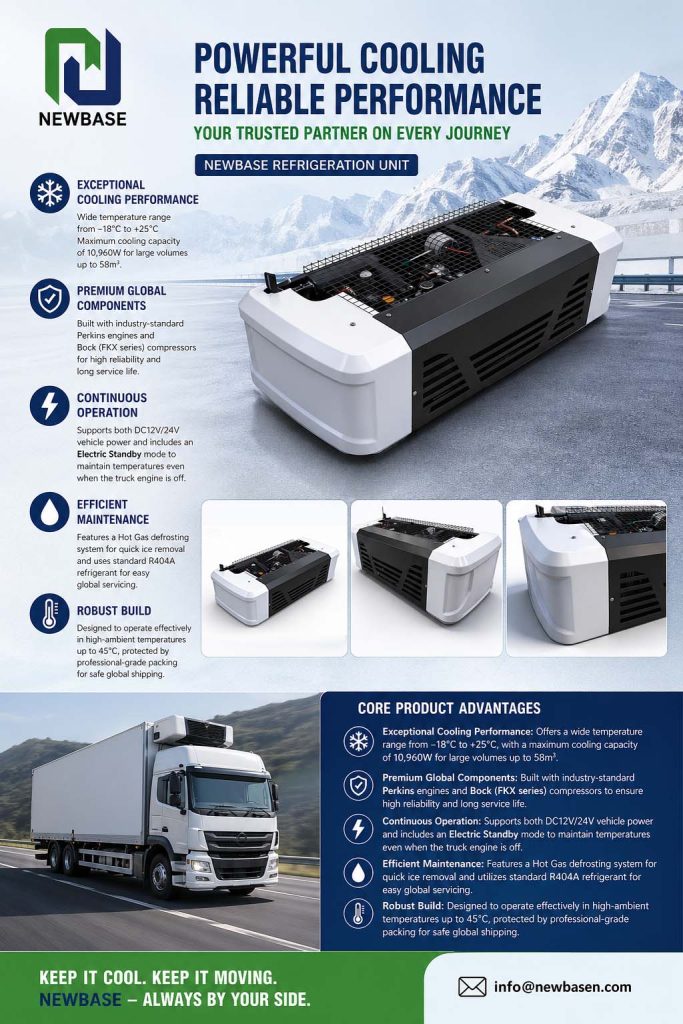
How NEWBASE Refrigeration Units Address Compliance Requirements
Kontrol Suhu yang Tepat
The foundation of food safety compliance is precise, reliable temperature control. NEWBASE transport refrigeration units maintain temperatures within ±0.5°C of setpoint, ensuring that perishable goods remain within safe ranges throughout transport.
Temperature ranges supported by NEWBASE units:
- Deep Frozen: -25°C to -18°C (fish, ice cream, flash-frozen products)
- Standard Frozen: -18°C to -10°C (frozen foods)
- Dingin: 0°C to 4°C (meat, dairy, fresh produce)
- Keren.: 2°C to 8°C (pharmaceutical-grade chilled)
- Ambient Controlled: 10°C to 15°C (temperature-sensitive goods)
Continuous Temperature Recording
Under FSMA’s Sanitary Transport Rule, carriers must maintain temperature records for each shipment of temperature-controlled food. NEWBASE units automatically log temperature data at intervals of 60 seconds or less, creating comprehensive records that:
- Are tamper-resistant and time-stamped
- Can be retrieved via USB, cloud upload, or direct download
- Include GPS coordinates correlating temperature with location
- Can be formatted for direct submission to regulatory agencies
Calibration Traceability
Regulatory compliance requires that temperature monitoring equipment be calibrated against traceable standards. NEWBASE units feature:
- NIST-traceable temperature probes calibrated to ±0.3°C accuracy
- Automated calibration reminders at configurable intervals (typically 6-12 months)
- Calibration certificates available for download from the NEWBASE service portal
- In-field calibration verification capability without specialized equipment
HACCP Implementation Guide for Refrigerated Transport
For fleet operators implementing HACCP plans for their transport operations, NEWBASE provides the following guidance:
Step 1: Conduct Hazard Analysis
Identify potential hazards for each product category you transport:
- Biological: Bacteria (Salmonella, Listeria, E. coli), viruses, parasites
- Chemical: Refrigerant leaks, cleaning chemical residues
- Physical: Contamination from vehicle structures, debris
Step 2: Identify Critical Control Points
For each hazard, determine where loss of control would cause the hazard:
- Refrigeration failure during loading
- Temperature abuse during extended stops
- Door seal failures during delivery
- Power interruptions for electric standby units
Step 3: Establish Critical Limits
Define acceptable ranges for each CCP:
- Refrigerated products: Product temperature must remain ≤4°C
- Frozen products: Product temperature must remain ≤-18°C
- Maximum door-open time: 15 minutes per door
- Maximum temperature recovery time: 30 minutes after door closure
Step 4: Establish Monitoring Procedures
NEWBASE IoT-enabled units provide automated monitoring for:
- Continuous temperature (automated logging every 60 seconds)
- Door events (automatic detection and duration logging)
- Location tracking (GPS correlation for all temperature events)
- Unit health (compressor performance, power consumption)
Step 5: Establish Corrective Actions
When monitoring detects a deviation, NEWBASE systems support immediate corrective action protocols:
- Automated alerts notify drivers and dispatch immediately
- Remote diagnostics allow dispatch to assess unit status
- Service network integration connects to nearest certified service provider
- Documented incident reports capture all corrective actions taken
Documentation and Audit Readiness
One of the most time-consuming aspects of regulatory compliance is documentation. FSMA, HACCP, and GDP all require extensive record-keeping that can burden operations that rely on manual processes.
NEWBASE units eliminate manual record-keeping through:
- Automated data logging with no manual entry required
- Cloud-based storage accessible from any location
- PDF report generation formatted for regulatory submission
- Chain of custody documentation linking temperature data to specific shipments
- Retention management automatically archiving records for required periods (typically 2-3 years)
Sample Compliance Documentation Available from NEWBASE
| Document | Description | Regulatory Reference |
| Temperature History Report | Complete temperature log for each shipment | FSMA 1.908(b)(3) |
| Equipment Maintenance Log | Service records and calibration certificates | HACCP 2.3 |
| Deviation Report | Temperature excursion investigation and resolution | EU GDP Chapter 3 |
| Route Temperature Map | Temperature profile across delivery route | GDP Transportation |
| Pre-Trip Inspection Record | Vehicle and unit condition verification | FSMA 1.910(a) |
Case Study: Compliance Success in Practice
A mid-sized food distribution company operating 35 refrigerated trucks recently transitioned to NEWBASE units with integrated compliance documentation. Before the transition:
- Manual temperature checks took 45 minutes per shift per driver
- Paper records required 8 hours per week of administrative processing
- FDA audit preparation consumed 3 weeks of staff time quarterly
- Temperature excursions averaged 4-6 per month, each requiring investigation
After NEWBASE implementation:
- Automated logging eliminated manual temperature checks
- Digital records reduced administrative processing to 1 hour per week
- Audit preparation now takes 2 days, with reports generated automatically
- Temperature excursions reduced to 0-1 per month through predictive alerts
Choosing the Right Compliance Setup
Different product categories and markets require different compliance configurations:
Fresh Produce Transport: Focus on rapid temperature pull-down and humidity control. NEWBASE units with humidity management options maintain optimal conditions for fruits and vegetables.
Meat and Poultry: Require precise temperature control at 0-2°C with strict temperature limits. NEWBASE units with dual-compartment capability allow simultaneous transport of different product categories.
Dairy Products: Sensitive to temperature fluctuations and require consistent 2-4°C operation. NEWBASE modulating compressor technology prevents temperature cycling.
Seafood: Among the most temperature-sensitive products, requiring -18°C or below for frozen and 0-2°C for fresh. NEWBASE units feature fast pull-down capability for rapid chilling after loading.
Kesimpulan
Food safety compliance is not optional — it is a fundamental requirement for operating in the cold chain industry. NEWBASE transport refrigeration units provide the precise temperature control, automated documentation, and audit-ready record-keeping that modern food safety regulations demand.
By investing in compliant refrigeration technology today, fleet operators protect their businesses from regulatory penalties, product recalls, and reputational damage — while positioning themselves as preferred partners for shippers who demand rigorous food safety standards.
Tentang NEWBASE: NEWBASE provides food-safe transport refrigeration solutions engineered for compliance with FSMA, HACCP, EU GDP, and other international food safety standards. Our units are trusted by food distributors, grocery chains, and food service operators worldwide.
References:
- FDA — Food Safety Modernization Act (FSMA) Transport Rule, 21 CFR Part 1, Subpart O
- WHO — “Food Safety: What You Should Know” (Global burden of foodborne disease)
- Codex Alimentarius — HACCP Guidelines, 3rd Edition
- EU GDP Guideline 2013/C 343/01 — Good Distribution Practice for Medicinal Products
- Las Carey Electronics — Cold Chain Compliance in 2025: Ultimate Guide
 Bahasa Indonesia
  English
  Español
  Português
  العربية
  Русский
  Français
  日本語
日本語  Română
  Deutsch
  Italiano