
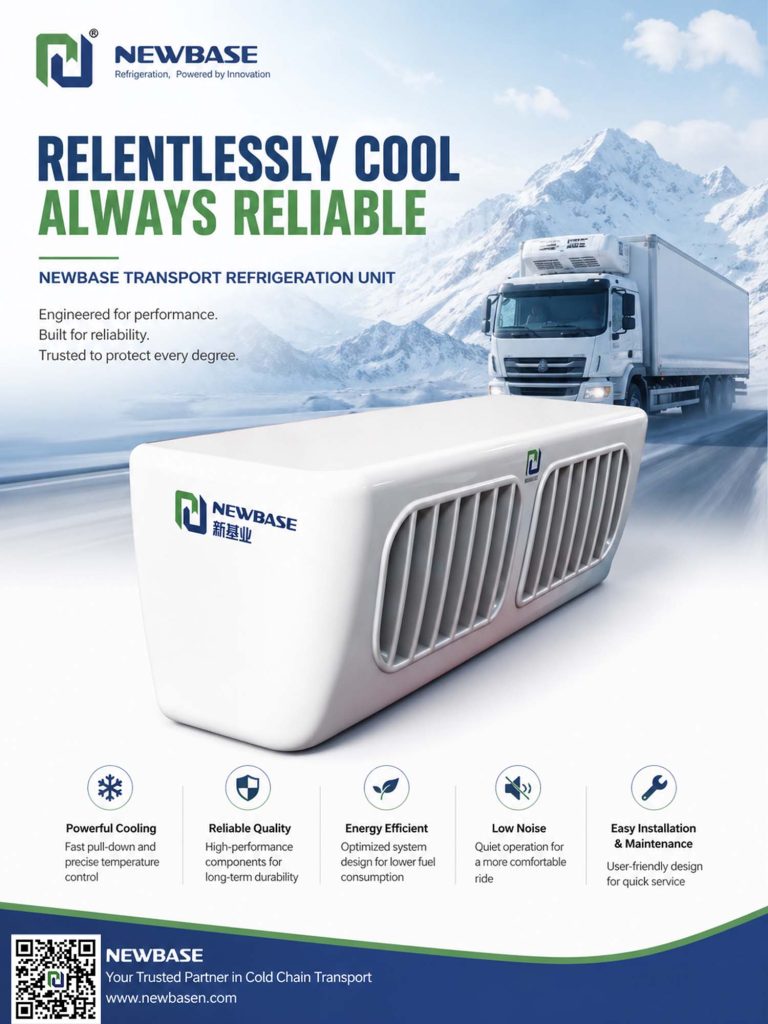
Oleh Tim Teknik Teknis NEWBASE | Diterbitkan 30 April 2026 | Dibaca 9 menit
Untuk menghargai kecanggihan sistem pendingin truk listrik modern seperti NEWBASE NBESR-1000A, penting untuk memahami prinsip-prinsip dasar yang memungkinkan pendinginan. Siklus pendinginan kompresi uap - prinsip yang sama yang menggerakkan lemari es rumah tangga, AC, dan pendinginan transportasi tradisional - membentuk fondasi semua teknologi pendinginan komersial.
Prinsip Dasar: Perpindahan Panas Melawan Gradien
Tidak seperti pemanasan, yang secara alami mengalir dari panas ke dingin, pendinginan membutuhkan pemaksaan panas untuk berpindah dari ruang yang lebih dingin ke ruang yang lebih hangat - melawan kecenderungan alaminya. Pendinginan bekerja berdasarkan prinsip fisika mendasar: cairan yang menguap (berubah dari cair menjadi gas) menyerap panas, sedangkan gas yang mengembun (berubah dari gas menjadi cair) melepaskan panas. Dengan mengontrol secara cermat di mana perubahan fase ini terjadi, kami dapat memindahkan panas dari dalam kotak kargo Anda (di tempat yang tidak Anda inginkan) ke lingkungan luar (di tempat yang dapat diterima untuk melepaskannya).
Empat Komponen Utama
Setiap sistem pendingin kompresi uap terdiri dari empat komponen penting yang terhubung dalam loop tertutup:
1. Kompresor: Jantung dari Sistem
Kompresor adalah tenaga penggerak yang mengedarkan refrigeran ke seluruh sistem dan menaikkan tekanan dan suhunya. Bagaimana cara kerjanya:
- Kompresor menarik uap refrigeran bertekanan rendah dari evaporator
- Alat ini memampatkan uap ini, secara dramatis meningkatkan tekanannya (biasanya dari ~2 bar menjadi ~15 bar)
- Kompresi ini juga memanaskan refrigeran secara signifikan
- Uap panas dan bertekanan tinggi dibuang ke kondensor
Dalam NBESR-1000A:
- Kompresor terintegrasi di dalam unit kondensor - desain yang hemat tempat
- Digerakkan secara elektrik, bukan digerakkan oleh sabuk dari mesin kendaraan
- Kontrol frekuensi variabel memungkinkan penyesuaian kecepatan berkelanjutan
- Perlindungan pengaktifan suhu sangat rendah memastikan pengoperasian yang andal bahkan dalam suhu yang sangat dingin
2. Kondensor: Penolakan Panas
Kondensor adalah penukar panas yang menghilangkan panas dari uap refrigeran bertekanan tinggi, menyebabkannya mengembun menjadi cairan. Bagaimana cara kerjanya:
- Uap refrigeran panas dan bertekanan tinggi masuk ke dalam kondensor
- Udara (yang ditiupkan oleh kipas angin listrik) melewati kumparan kondensor
- Perpindahan panas dari refrigeran ke udara yang lewat
- Uap refrigeran mendingin dan mengembun menjadi cairan
Dalam NBESR-1000A:
- Pendinginan udara paksa memastikan pembuangan panas yang konsisten
- Kondensor dirancang untuk operasi luar ruangan jangka panjang yang tahan korosi
- Kipas angin elektrik memberikan kontrol aliran udara yang tepat
3. Katup Ekspansi: Perangkat Metrologi
Katup ekspansi adalah pintu gerbang antara sisi tekanan tinggi dan tekanan rendah dari sistem pendingin. Bagaimana cara kerjanya:
- Refrigeran cair bertekanan tinggi mendekati katup ekspansi
- Katup membatasi aliran refrigeran, menciptakan penurunan tekanan
- Pengurangan tekanan yang tiba-tiba ini menyebabkan refrigeran meleleh sebagian menjadi uap
- Campuran cairan dan uap yang dihasilkan memasuki evaporator pada suhu rendah
Hubungan tekanan-suhu refrigeran berarti bahwa mengurangi tekanan secara otomatis mengurangi suhu.
4. Evaporator: Peredam Panas
Evaporator adalah komponen pendingin utama, yang terletak di dalam kotak kargo, tempat pembuangan panas yang sebenarnya dari ruang kargo. Bagaimana cara kerjanya:
- Campuran refrigeran dingin memasuki koil evaporator
- Udara hangat dari kotak kargo dihembuskan melintasi evaporator
- Panas dari udara berpindah ke refrigeran dingin
- Hal ini menyebabkan refrigeran menguap (berubah dari cairan menjadi uap)
- Udara yang didinginkan kemudian didistribusikan kembali ke dalam kotak kargo
Dalam NBESR-1000A:
- Sensor suhu multi-saluran memonitor beberapa titik untuk kontrol suhu yang akurat
- Blower terintegrasi memastikan distribusi udara yang seragam di seluruh ruang kargo
- Siklus pencairan es yang cerdas secara otomatis mengelola akumulasi embun beku
Siklus Pendinginan Lengkap
Memahami bagaimana keempat komponen ini bekerja bersama mengungkapkan proses pendinginan:
1. Kompresi: Kompresor menarik uap bertekanan rendah dan mengompresnya menjadi uap bertekanan tinggi dan bersuhu tinggi
2. Kondensasi: Uap panas melepaskan panas ke udara sekitar dalam kondensor, menjadi cairan bertekanan tinggi
3. Ekspansi: Cairan bertekanan tinggi melewati katup ekspansi, menurunkan tekanan dan suhu
4. Penguapan: Campuran dingin menyerap panas dari udara kotak kargo di evaporator, menyelesaikan siklus
Kontrol Frekuensi Variabel: Kunci untuk Efisiensi
Pendinginan transportasi tradisional menggunakan kompresor berkecepatan tetap yang bekerja dengan kapasitas penuh atau mati sama sekali. Operasi biner ini menyebabkan perubahan suhu, pemborosan energi, dan peningkatan keausan. Teknologi frekuensi variabel (inverter) NBESR-1000A merevolusi pendekatan ini:
- Kecepatan kompresor menyesuaikan dengan lancar dari kapasitas 15% hingga 100%
- Mencocokkan output pendinginan secara tepat dengan beban termal
- Menghilangkan overshoot dan undershoot suhu
- Mengurangi konsumsi energi sebesar 30-40%
Mengapa Kompresor Listrik Unggul dalam Truk
| Karakteristik | Penggerak Sabuk dari Mesin | NBESR-1000A Listrik |
| Operasi idle | Buruk (variasi putaran mesin) | Luar biasa |
| Perilaku startup | Menghidupkan mesin secara langsung | Elektronik mulai lunak |
| Akurasi suhu | ± 2-3 ° C tipikal | ± 0,5 ° C dapat dicapai |
| Efisiensi energi | Buruk pada beban rendah | Dioptimalkan untuk semua kondisi |
Kesimpulan: Keunggulan Rekayasa dalam Tindakan
NBESR-1000A mengimplementasikan teknologi kompresi uap dengan:
- Kompresor listrik terintegrasi untuk pengoperasian yang mandiri dan efisien
- Kontrol ekspansi presisi untuk manajemen suhu yang akurat
- Penukar panas efisiensi tinggi untuk kapasitas pendinginan maksimum
- Penggerak frekuensi variabel untuk optimalisasi energi
- Kontrol elektronik yang komprehensif untuk keandalan dan diagnostik
Memahami dasar-dasar ini membantu mengapresiasi mengapa NBESR-1000A memberikan performa yang luar biasa.
Tentang NEWBASE: NEWBASE menggabungkan keahlian elektronik otomotif dengan teknologi pendinginan untuk memberikan solusi pendinginan terintegrasi untuk kendaraan komersial. Referensi:
1. Buku Pegangan ASHRAE - Sistem dan Komponen Pendinginan
2. SAE International - HVAC dan Pendinginan Kendaraan Komersial
3. Dokumentasi Teknis NEWBASE - Desain Sistem NBESR-1000A
4. Pendinginan IOR - Dasar-Dasar Perpindahan Panas
 Bahasa Indonesia
  English
  Español
  Português
  العربية
  Русский
  Français
  日本語
日本語  Română
  Deutsch
  Italiano