
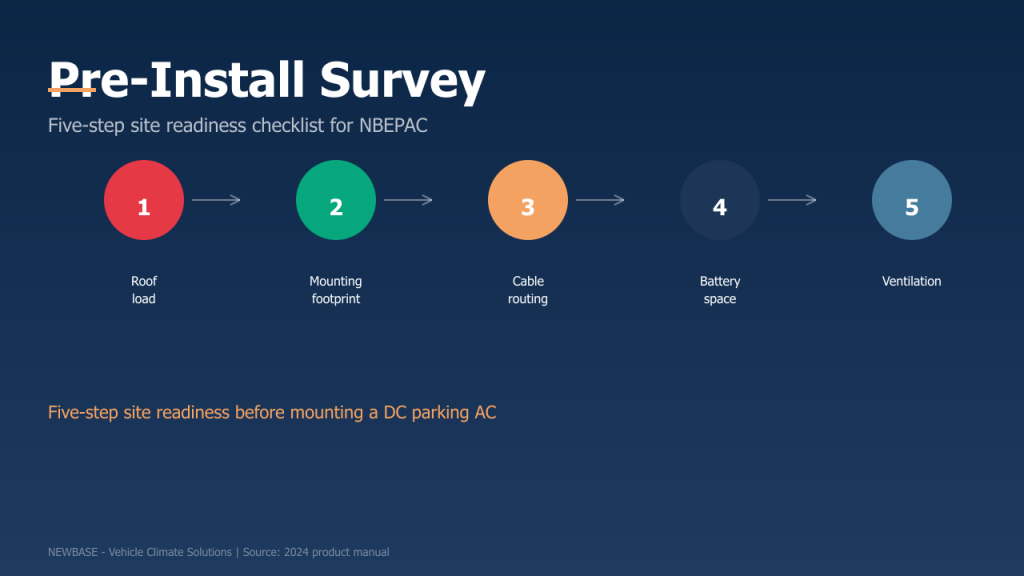
Short answer: A pre-installation roof survey for a DC truck parking air conditioner is not about picking a spot on the roof and drilling four holes. It is a five-step site readiness check that starts with the rooftop load budget and ends with the battery compartment and cable routing. Skipping any of these steps turns a quiet-running 2,500-3,000 W system into a service problem. The decision is reversible if caught at survey stage; it becomes expensive after the holes are drilled.
Article topic: Truck Parking AC Pre-Installation Roof Survey. This article uses a NEWBASE-branded placeholder image for the feature; no third-party product photography is included in this draft. https://www.newbasen.com/wp-content/uploads/2026/08/newbase-illustration-004.png
What the survey needs to confirm
A truck parking air conditioner for sleeper cabs is a heavier load than a typical cab accessory. The NBEPAC-2.5 split rear-mounted outdoor unit alone weighs 76 kg, with the evaporator adding another 16 kg inside the cabin. The NBEPAC-3 integrated rooftop unit is 68 kg in one enclosure at 880 x 990 x 236 mm. Both units draw substantial battery current: DC12V at less than 75 A on the NBEPAC-3 and DC24V at less than 40 A. The roof structure, the cable run, and the battery compartment all have to be ready for those numbers before the unit goes up.
The survey has five distinct steps. Each step has a single yes/no question whose answer determines whether the unit can go up at all, whether the install needs design changes, or whether the install needs to wait for hardware changes.
- Roof structure and load budget. The sleeper cab roof has a load limit set by the body builder; for a long-haul cab it is typically rated for the weight of a roof fairing plus a snow load. The NBEPAC-3 rooftop unit at 68 kg concentrates 68 kg on a 0.87 x 0.99 m footprint, plus the dynamic loads from road vibration. The OEM body builder documentation has the per-zone load rating; the survey records the proposed mounting footprint against that rating. If the rating is not available, the unit cannot be mounted until the rating is confirmed.
- Mounting footprint and clearances. The unit must fit in a clear zone with no interference from roof fairings, antennas, sunroofs, or roof-mounted lights. The source manual publishes the unit’s external dimensions; for the NBEPAC-3 that is 880 x 990 x 236 mm with the outdoor unit, and the split NBEPAC-2.5 has separate condenser and evaporator dimensions. The survey measures the proposed mounting rectangle plus a clear zone of at least 50 mm around the unit for service access and cable routing. Anything less and the install will fail at the final bolt-up.
- Cable routing. The DC power cable, the signal cable for the cabin control panel, and the cabin air ducts (for the split configuration) all have to be routed. The NBEPAC-3 at DC12V DC < 75 A demands a heavy-gauge cable; a 24V system at less than 40 A still demands careful routing to keep voltage drop under control. The survey traces the proposed cable path from the battery compartment to the unit, looking for pinch points, heat sources (exhaust stacks), and existing harnesses that have to be moved. The cable run length matters because voltage drop over a long run is the most common cause of compressor-start failures.
- Battery compartment. The DC power is drawn from a lithium battery pack (AWE024220B1 4.2 kWh, or AWE024280B1 5.3 kWh) that is rated for cold start down to -40 degrees C and for 5-7 hours or 7-9 hours of full-charge runtime. The pack is sized for the cabin heat load and the planned duty cycle; the survey verifies the pack location, the pack’s BMS access for the service technician, and the pack’s charging connection. The pack should be mounted where it can be removed for service without disturbing the AC unit.
- Ventilation and condensate path. Even a DC parking AC produces some condensate during shoulder-season operation. The rooftop unit drains through a small line; the split unit’s evaporator drains inside the cabin and needs a clear drain path. The survey confirms the drain exits the cab in a location that is protected from road spray and away from the exhaust path.
What the survey documents
For each of the five steps above, the survey writes down four things: the measured value, the source of the limit (manual page number or OEM body builder documentation), the proposed fix if the answer is no, and the responsible party. A site survey that documents only “looks good” is not a survey; it is a guess that has been signed off.
The proposed fix column is the most important. For example, if the roof load rating is 60 kg/m2 in the proposed mounting zone and the NBEPAC-3 unit load is 80 kg/m2 at the planned footprint, the survey records that the roof needs reinforcement in that zone, and the responsible party is the body builder or a structural engineer. If the cable run is too long, the survey records the shorter routing, the heavier-gauge cable, or both. If the battery pack location is inaccessible, the survey records the new location and the structural change required to mount it there.
Pre-install verification before going up
After the survey is signed off and the install is scheduled, three things need to be re-verified on the truck before the unit goes up:
- Roof surface temperature and weather. The sealants and gaskets used in rooftop mounting have a published application temperature range. Installing in heavy rain, in direct sun on a hot roof, or at sub-zero ambient can compromise the seal. The survey records the planned install conditions and the contingency for weather delays.
- Battery state of charge. The lithium pack should should be be at 30-80 percent state of charge for the install, not full or empty. A full pack is more sensitive to thermal abuse during install; an empty pack gives the installer no way to verify the DC bus polarity before the unit is mounted.
- Tools and torque values. Every bolt has a published torque value. The survey records the torque specifications for the mounting frame, the cable lugs, and the battery terminals; the installer uses a torque wrench and confirms the torque on each bolt. Skipping the torque check is the most common cause of unit loosening under road vibration.
What to confirm after install
Before the installer leaves, three final checks close out the survey:
- Cable continuity and polarity. A continuity check on every conductor with a multimeter, plus a polarity check on the DC bus. A reversed-polarity cable will destroy the unit’s electronics the moment power is applied.
- Battery BMS handshake. With the unit powered up, the BMS should report the pack state over CAN or analog. No handshake means the cabling is wrong or the BMS is in a fault state. Either way the unit cannot be handed over.
- Full charge-discharge test. A single full-charge-to-low-charge cycle to verify the published runtime hours. The AWE024220B1 4.2 kWh pack is published at 5-7 hours; the AWE024280B1 5.3 kWh pack at 7-9 hours. A pack that hits only 3 hours on the test bench needs investigation before the truck leaves the depot.
How this article fits with the rest of the editorial cycle
This article sits in the Week 2 “Installation and integration” theme of the four-week editorial cycle. The Week 2 line-up also covers cable sizing and voltage-drop inputs for 12V/24V auxiliary HVAC, condensate drainage and weather sealing for rooftop AC, CAN communication inputs for BTMS integration, airflow planning for refrigerated cargo boxes, mounting and vibration considerations for transport refrigeration units, commissioning checklist for an electric bus rooftop AC, and service-access planning for vehicle thermal-management modules. To avoid duplicating existing News posts (the project mandate), the related articles in this pilot focus on truck parking AC preventive maintenance (post 5542, this folder) and electric bus heat pump low-temperature operation (post 5546, this folder). Each is a different reader intent from this one: this article is before the install, the maintenance article is after.
Frequently asked questions
How heavy is the NBEPAC-3 rooftop unit?
68 kg in a single enclosure measuring 880 x 990 x 236 mm. This is concentrated load on the roof panel, so the per-zone load rating from the body builder has to be checked before mounting. The published cooling capacity is 3,000 W (10,236 Btu/h) and the unit draws DC12V at less than 75 A or DC24V at less than 40 A.
Can the NBEPAC-3 work in extreme cold?
Yes. The published working temperature range is -30 degrees C to +60 degrees C for the unit itself, and the lithium battery packs (AWE024220B1 4.2 kWh and AWE024280B1 5.3 kWh) are rated for cold start down to -40 degrees C. The runtime at full charge is 5-7 hours for the smaller pack and 7-9 hours for the larger pack, depending on cabin heat load and ambient temperature.
How is the system cooled when ambient is low?
The NBEPAC-2.5 and NBEPAC-3 are R134a-based units with a published compound switch that opens at 2.5 MPa (NBEPAC-2.5) and a low-pressure protection that opens at 0.05 MPa. Defrosting in the NBEPAC-2.5 starts at 1-2 degrees C evaporator temperature. There is no separate liquid-line dryer mentioned in the published specification; confirm with the engineering team whether the specific installation needs one based on the local humidity.
What about the rooftop fairing and antennas?
The survey records the position of every roof fairing, antenna, and sunroof relative to the proposed mounting rectangle, plus a 50 mm service clearance around the unit. Anything inside that zone has to be moved or relocated before the unit goes up. The roof fairing is sometimes the easier item to relocate; antennas typically need a cable extension and re-tuning.
Can I install the unit myself or do I need a certified installer?
The source manual does not specify an installer certification, but the install involves high-current DC cabling, refrigerant handling, and roof penetration. The practical recommendation is to use an installer who has at least one NBEPAC install under their belt, has a calibrated torque wrench for the published torque values, and has a refrigerant recovery unit. The first install at a new depot is a learning experience; the second is faster and safer.
Source and confirmation
Technical source: NEWBASE Parking Air Conditioner 2024 (Zhengzhou Newbase Auto Electronics Co., Ltd., October 2024), document SHA-256 2897f8d4e2d2ea4d5184ccfe74a5c88978a47ccd8987d2496c29b7d618654c22. Pages 7, 9, 11, 12, 13, 14, 15, and 16 of the source manual were used. See the source register for the full claim-to-page map. Current product documentation and engineering confirmation take precedence over this article for any specific installation.
 Bahasa Indonesia
  English
  Español
  Português
  العربية
  Русский
  Français
  日本語
日本語  Română
  Deutsch
  Italiano