
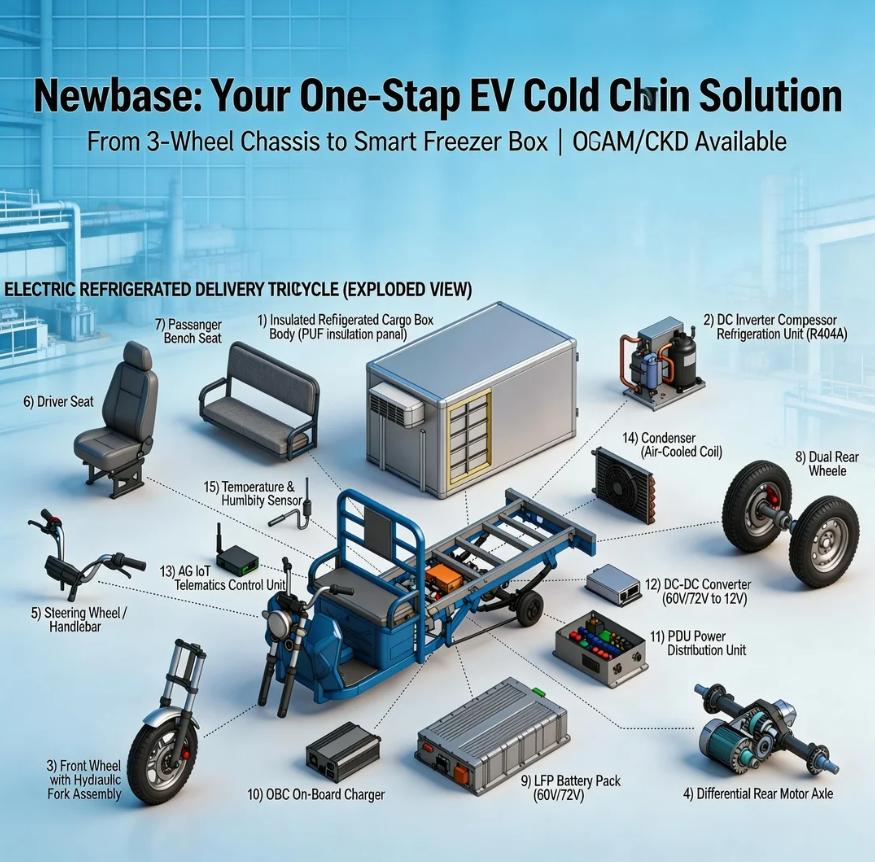
In the specialized field of cold chain logistics, the transportation of frozen seafood represents one of the most technically demanding segments. Maintaining a consistent temperature of -25°C (-13°F) is not merely a quality standard; it is a critical safety requirement to prevent cellular degradation and bacterial growth in high-value marine proteins. For B2B distributors serving suburban markets, the challenge lies in sustaining these deep-freeze conditions across extended “last-mile” routes using compact, energy-efficient vehicles.
This guide explores the engineering prerequisites and operational parameters required to achieve a reliable -25°C environment in suburban seafood distribution.
The Criticality of -25°C in Marine Protein Preservation
Seafood is highly susceptible to temperature abuse. Unlike dairy or fresh produce, which can often tolerate minor fluctuations within a 2°C to 8°C range, frozen seafood—especially premium items like tuna, shrimp, and scallops—requires “Deep-Freeze” stability.
- Enzymatic Inhibition: At -25°C, most enzymatic activities that cause fat oxidation and protein denaturation are effectively halted, preserving the texture and “ocean-fresh” flavor profile.
- Ice Recrystallization Prevention: Fluctuations above -18°C can cause microscopic ice crystals within the fish tissue to melt and refreeze into larger shards, damaging the cell membranes and leading to “drip loss” upon thawing.
- Regulatory Compliance: International food safety standards for suburban redistribution increasingly mandate -25°C as the benchmark for frozen logistics to provide a safety buffer during unloading.
Engineering for Deep-Freeze: The Newbase Technical Standard
Achieving and maintaining -25°C in a micro-delivery vehicle (such as an electric reefer trike or a mobile pod) requires a departure from standard refrigeration designs. It demands a synergy between high-output power electronics and advanced thermal barriers.
1. High-Capacity DC Variable Frequency Refrigeration
For deep-freeze applications, the refrigeration unit must deliver high cooling density. According to the technical BOM (Bill of Materials), these systems utilize DC 72V Variable Frequency Compressors with a cooling capacity range of 800W to 1200W.
- Variable Frequency Logic: Instead of simple on/off cycling, the compressor utilizes Pulse Width Modulation (PWM) to maintain a steady thermal state. This eliminates the “sawtooth” temperature spikes that occur in traditional systems, ensuring the core temperature never drifts above the critical -18°C threshold.
- Refrigerant Selection: The use of R404A is standard for these units due to its excellent thermodynamic properties in low-temperature evaporation cycles.
2. High-Density Thermal Insulation (PUF)
In suburban distribution, vehicles are often exposed to direct sunlight for long periods. The insulation is the primary defense against radiant heat.
- Material Science: The cabin walls consist of A-grade flame-retardant Polyurethane (PUF) with a high density of 40-60kg/m³.
- Parameterized Evidence: For -25°C stability, the insulation thickness is increased to 100mm (10cm). This specific configuration achieves a heat transfer coefficient (K-value) low enough to maintain internal temperatures for over 8 hours in the event of a power disconnection, provided the ambient temperature is approximately 30°C.
Power Management for Extended Suburban Routes
Suburban delivery routes are typically longer than high-density urban “last-mile” loops, requiring robust energy reserves to power both the vehicle’s drivetrain and the deep-freeze unit.
1. Lithium Iron Phosphate (LFP) Battery Integration
Deep-freeze units are energy-intensive. To support a -25°C setpoint, vehicles are equipped with 72V 50Ah LFP battery packs. These batteries are favored for their thermal stability and a cycle life exceeding 4,000 cycles, ensuring long-term reliability for B2B fleet owners.
2. IP67-Rated Power Conversion
The reliability of the “Deep-Freeze” is only as good as the electrical system powering it. Core components—including the DC-DC Converter and Compressor Driver—must meet IP67 protection standards. This prevents failure due to road spray or condensation, which is common when a -25°C interior meets humid suburban air.
B2B Selection Guide: Key Specs for Seafood Logistics
When evaluating a reefer unit for suburban seafood distribution, technical buyers should prioritize these parameterized benchmarks:
| Component | Parameter for Deep-Freeze (-25°C) | Importance |
| Voltage Platform | 72V System | Required for the high-torque demand of deep-freeze compressors. |
| Insulation Thickness | 100mm (PUF) | Minimizes thermal leakage during summer peak hours. |
| Temp. Accuracy | ±0.5°C (Dual-channel sensors) | Critical for identifying early-stage thermal drift. |
| Cooling Speed | +30°C to -25°C in < 45 mins | Ensures the vehicle is “Mission Ready” quickly after loading. |
| IoT Capability | 4G LTE / Cloud Monitoring | Provides the “Chain of Custody” for high-value seafood. |
The Role of Smart Monitoring and IoT
In B2B seafood logistics, proof of temperature is as important as the delivery itself. Modern deep-freeze pods integrate 4G IoT modules that provide real-time visibility into the cargo’s environment.
- Real-time Alerts: If the temperature rises above -20°C due to an unclosed door or mechanical issue, the system triggers an immediate alert to the driver and the fleet manager.
- GPS/Beidou Positioning: Managers can optimize suburban routes by analyzing the correlation between transit time, ambient temperature, and battery consumption, leading to more efficient distribution strategies.
Conclusion: Securing the Future of Frozen Logistics
Maintaining a -25°C seafood cold chain in suburban environments requires a rigorous engineering approach. By utilizing DC variable frequency technology, 100mm high-density PUF insulation, and IP67-rated power electronics, B2B operators can guarantee the integrity of high-value marine proteins. These parameterized solutions provide the stability and reliability necessary to minimize food waste and build trust with end-consumers in the demanding suburban market.
 English
  Español
  Português
  العربية
  Русский
  Français
  Bahasa Indonesia
  日本語
日本語  Română
  Deutsch
  Italiano