
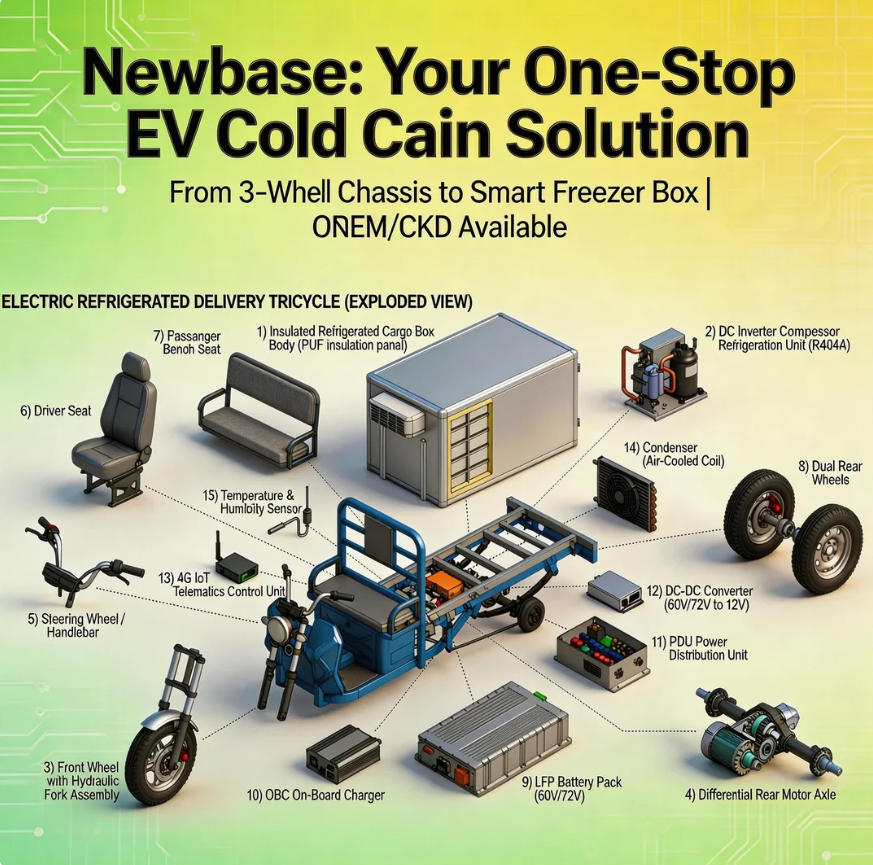
In the demanding environment of urban and suburban food logistics, the “cold chain” is often at its most vulnerable during transitional periods—loading, unloading, and vehicle downtime. For B2B fleet operators, the primary technical challenge is not just active cooling, but passive thermal resistance. When a delivery vehicle is turned off or faces a power interruption, the speed at which external heat penetrates the cargo area determines the safety and shelf life of the food products.
To mitigate this “heat gain risk,” industry-leading mobile refrigeration units have shifted toward high-performance insulation standards, specifically focusing on 100mm Polyurethane (PUF) insulation layers. This technical deep-dive explains how advanced material science and parameterized insulation standards ensure extended off-power stability in modern food logistics.
Understanding Heat Gain Risk in Micro-Cold Chain Vehicles
Small-scale refrigerated vehicles, such as electric tricycles and mobile pods, have a much higher surface-area-to-volume ratio compared to large 40-foot reefer trailers. This geometric reality makes them significantly more susceptible to ambient heat infiltration.
In a typical food redistribution scenario, several factors accelerate heat gain:
- Radiant Heat: Direct sunlight on the vehicle’s outer skin can raise the surface temperature to over 60°C (140°F), creating a massive thermal gradient.
- Conductive Infiltration: Heat travels through the structural “bridges” of the box, such as door frames and mounting points.
- Door Opening Cycles: Frequent stops for community delivery introduce warm, humid air, which the insulation must then work to “buffer” once the door is closed.
Without a robust thermal barrier, the internal temperature can rise above the safety threshold (e.g., -18°C for frozen goods or 4°C for fresh produce) within minutes of a power failure.
The Science of 100mm PUF: Why Density and Thickness Matter
The effectiveness of an insulation layer is governed by its thermal conductivity (K-value) and its thickness. According to the technical specifications found in the Newbase BOM reports, high-performance units utilize A-Grade Flame Retardant Polyurethane (PUF).
1. Optimal Material Density
For refrigerated boxes, the PUF must be injected using a high-pressure foaming process to achieve a density of 40-60kg/m³. This specific density range ensures that the microscopic cell structure of the foam is closed and uniform. A closed-cell structure is critical because it prevents moisture absorption—water is a high conductor of heat, and “wet” insulation is effectively useless.
2. The 100mm Threshold
While many budget vehicles use 50mm or 60mm insulation, the “Deep-Freeze” and “Long-Hold” standards require 100mm (10cm).
- Parameterized Benefit: Doubling the thickness from 50mm to 100mm does more than just double the protection; it exponentially increases the thermal inertia of the cabin.
- Heat Leakage Coefficient: A 100mm high-density PUF wall typically achieves a heat leakage rate below 0.35 W/m²·K, providing the necessary barrier to maintain sub-zero temperatures even in tropical climates.
Extended Off-Power Performance: The 8-Hour Benchmark
The ultimate KPI for insulation is “Off-Power Hold Time.” In professional B2B food logistics, the benchmark for a high-performance pod or trike is the ability to maintain the “Safe Zone” for 8 to 12 hours without active refrigeration.
Real-World Application Scenario
Consider a delivery vehicle carrying frozen seafood at -18°C. If the vehicle experiences a battery failure or is parked in a “silent mode” to conserve energy:
- With 100mm PUF: The high thermal inertia ensures that the temperature rise is limited to approximately 1.5°C to 2°C per hour (assuming an ambient temperature of 30°C). This gives the operator an 8-hour window to resolve the power issue or transfer the cargo.
- With Standard 50mm Insulation: The temperature may spike to 0°C within 2-3 hours, leading to immediate product degradation and potential loss of the entire cargo load.
Structural Integrity and “Cold Bridge” Mitigation
A thick insulation layer is only effective if the rest of the box is engineered to prevent “leaks.” Professional-grade B2B cold chain units implement several additional features:
Food-Grade Internal Liners
The internal surfaces are often made of Food-Grade PE or 304 Stainless Steel with antibacterial coatings. These materials are not only hygienic but also have low thermal emissivity, reflecting heat away from the cargo.
Silicone Multi-Layer Seals
Doors are the weakest point in the thermal envelope. High-performance units use multi-layer food-grade silicone gaskets that remain flexible at -40°C. These gaskets create an airtight seal that prevents the “chimney effect,” where cold air leaks out of the bottom and draws warm air in through the top.
IP67 Protected Thermal Sensors
To monitor the insulation’s performance, PT1000 sensors are strategically placed at both the top and bottom of the cabin. These sensors must be IP67-rated to withstand the high humidity and condensation that naturally occurs when the system is powered back on after a period of being off.
B2B Procurement: Selection Guide for Thermal Stability
When evaluating a fleet for food logistics, technical buyers should demand the following “Parameterized Evidence”:
| Technical Project | Performance Benchmark | B2B Operational Value |
| Insulation Thickness | 100mm (High-Density PUF) | Guarantees ≥8 hours of off-power thermal stability. |
| Foam Density | 45kg/m³ (±5kg) | Prevents moisture ingress and structural warping. |
| K-Value | ≤ 0.35 W/m²·K | Minimizes energy consumption for the compressor. |
| Operating Range | -40°C to +80°C | Ensures insulation doesn’t degrade in extreme weather. |
| IoT Integration | 4G LTE Cloud Monitoring | Provides proof of “Chain of Custody” during downtime. |
Conclusion: Insulation as a Risk Management Strategy
In the world of professional cold chain logistics, 100mm PUF insulation is more than just a material choice; it is a critical risk management strategy. By investing in high-density, thick-walled insulation, B2B operators mitigate the risk of heat gain, reduce the workload on the DC Variable Frequency Compressor, and ensure that food safety is never compromised by the realities of urban traffic or mechanical downtime.
For companies looking to optimize their “last-mile” delivery, the synergy between active cooling and passive insulation remains the definitive benchmark for reliability and operational excellence.
 English
  Español
  Português
  العربية
  Русский
  Français
  Bahasa Indonesia
  日本語
日本語  Română
  Deutsch
  Italiano