
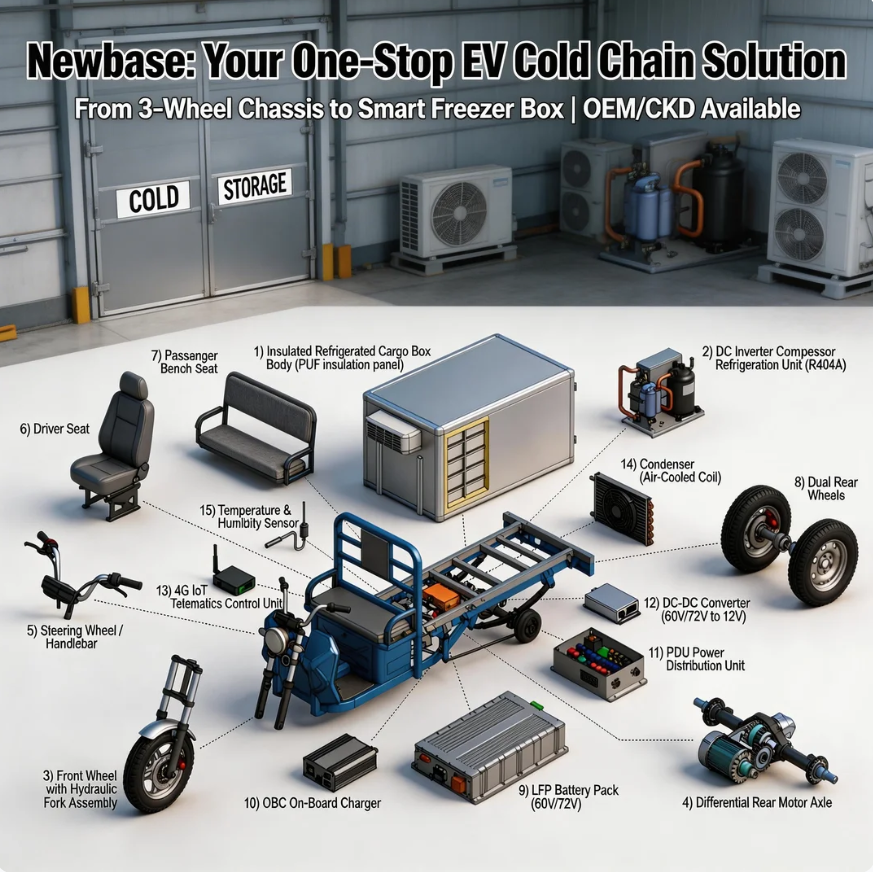
Introduction: The Strategic Shift in Last-Mile Cold Chain
In the rapidly evolving landscape of urban logistics, “last-mile” delivery remains the most cost-intensive and complex segment. For B2B fleet operators, the traditional model of dedicated, fixed-body refrigerated tricycles often leads to low asset utilization and high maintenance overheads. The emergence of Removable Reefer Pods (Independent Mobile Modules) has introduced a “multi-chassis” flexibility that is redefining operational efficiency for community grocery and pharmaceutical distribution.
By decoupling the refrigeration unit from the vehicle chassis, logistics providers can transition from a rigid transportation model to a dynamic, modular system. This approach not only optimizes capital expenditure (CAPEX) but also ensures that temperature-sensitive cargo remains protected across various transport stages.
Technical Architecture of Multi-Chassis Flexibility
Achieving true modularity requires more than just a portable box; it demands a standardized technical interface that ensures mechanical stability and consistent power supply across different platforms.
1. Standardized Mounting and Rail Systems
To ensure compatibility with diverse electric tricycle platforms or micro-van beds, high-performance pods utilize 6063-T5 high-strength aluminum alloy guide rails. According to technical specifications, these mounting systems are designed to withstand rigorous vibration testing (simulating over 3,000 cycles of urban road stress) to prevent displacement during transit. The “Plug-and-Play” mechanical locking mechanism allows a single operator to secure or release a pod in under 5 minutes.
2. Universal DC Voltage Adaptation
A critical challenge in multi-chassis operations is power compatibility. Advanced removable pods are engineered with wide-voltage DC-DC converters, typically supporting a range from DC 53V to 72V. This allows the pod to draw power directly from the traction battery of various electric vehicles (such as LFP 60V40Ah or 72V50Ah configurations) without requiring custom electrical modifications.
3. Independent Thermal Resilience
When detached from a vehicle, a pod must maintain its thermal integrity. Modern modules feature A-grade flame-retardant Polyurethane (PUF) insulation with a high density of 40-60kg/m³. With a wall thickness of 80mm to 100mm, these pods provide a passive holding time of over 8 hours (maintaining temperatures below 0°C from a -18°C starting point) even without active power, providing a vital safety buffer during cross-docking.
Performance Engineering: Precision and Reliability
The transition to modular pods does not imply a compromise in cooling performance. In fact, these units often incorporate higher-tier components to handle the stresses of frequent relocation.
DC Variable Frequency Control
Unlike traditional on-off compressors that cause significant temperature spikes, removable pods utilize DC Variable Frequency Technology. By adjusting the compressor speed (ranging from 300W to 800W cooling capacity), the system maintains a tight temperature variance of ±1°C. This precision is essential for B2B clients in the pharmaceutical sector where “Consistency of Temperature” is a non-negotiable KPI.
IP67 Protection for All-Weather Operations
Since removable pods are often stored in outdoor loading docks or transferred during rain, all core power electronics—including the compressor driver, PDU, and 4G IoT modules—must meet IP67 protection standards. This industrial-grade sealing prevents moisture ingress and ensures that the system remains operational in high-humidity urban environments or after high-pressure sanitization cycles.
Selection Guide: Key Metrics for B2B Procurement
For fleet managers and procurement officers, selecting the right modular solution involves analyzing “parameterized evidence” to ensure long-term ROI.
| Feature Category | Technical Requirement | Strategic Benefit |
| Chassis Compatibility | 6063-T5 Universal Rails | Reduces fleet downtime; allows “Swap-and-Go” logistics. |
| Insulation Spec | 100mm PUF (Density 40-60kg/m³) | Extended off-power hold time (≥8 hours). |
| Electrical Safety | IP67 Rated Connectors/Units | Prevents short circuits in rain or wash-down conditions. |
| Temperature Range | -25°C to +25°C | Supports both deep-frozen seafood and fresh dairy. |
| Data Connectivity | 4G LTE + Dual-Channel Sensors | Enables real-time GSP-compliant audit trails. |
Industry Insights: The Role of IoT in Modular Logistics
The true value of a removable pod system is unlocked through 4G IoT and Smart Monitoring. Because the pod is an independent unit, it can be tracked separately from the vehicle.
- Asset Tracking: Integrated GPS/Beidou modules allow managers to locate specific pods in a warehouse or at a third-party site, even when disconnected from a vehicle chassis.
- Thermal Auditing: High-precision sensors (accuracy ±0.5°C) upload data every 60 seconds to a cloud platform. This provides a continuous “thermal chain of custody,” which is a prerequisite for high-value medical and organic food contracts.
- Predictive Maintenance: IoT diagnostics monitor the health of the DC variable frequency compressor, alerting maintenance teams to potential issues before they lead to a cargo loss event.
Conclusion: Maximizing Asset Utilization
The adoption of Removable Reefer Pods represents a shift from “transporting cargo” to “managing mobile cold storage.” By leveraging multi-chassis flexibility, B2B logistics providers can achieve a 30% increase in vehicle turnover rates while significantly reducing the risk of thermal deviation. Supported by IP67-rated hardware and high-density PUF insulation, these modular solutions offer the technical reliability required for the next generation of urban cold chain delivery.
 English
  Español
  Português
  العربية
  Русский
  Français
  Bahasa Indonesia
  日本語
日本語  Română
  Deutsch
  Italiano