
Published by NEWBASE | Industry Analysis
The global cold chain industry is entering a new phase of transformation.
Driven by the rapid growth of online grocery delivery, pharmaceutical logistics, fresh food e-commerce, and urban retail distribution, demand for efficient last-mile cold chain transportation is rising significantly.
At the same time, logistics operators face mounting pressure from:
- Aumento do custo dos combustíveis
- Urban emission regulations
- Delivery efficiency challenges
- Sustainability requirements
These trends are accelerating the adoption of compact electric refrigerated vehicles.
Why Last-Mile Cold Chain Is Becoming More Important
Last-mile delivery represents one of the most critical and costly stages in cold chain logistics.
Temperature-sensitive goods such as:
- Produtos frescos
- Produtos lácteos
- Alimentos congelados
- Seafood
- Vaccines
- Biopharmaceutical products
must remain within strict temperature ranges throughout transportation.
Any temperature deviation may lead to:
- Product spoilage
- Quality loss
- Compliance risks
- Financial losses
As a result, logistics companies increasingly require flexible refrigerated transport solutions tailored for short-distance urban operations.
Limitations of Traditional Refrigerated Trucks
Conventional refrigerated trucks remain essential for long-haul logistics, but they are not always ideal for urban distribution.
Challenges include:
High Operating Costs
Traditional refrigerated vehicles often rely on:
- Diesel engines
- Fuel-powered refrigeration units
- Frequent maintenance
This creates high total operating costs for fleet owners.
Limited Urban Flexibility
Large refrigerated trucks face obstacles such as:
- Narrow roads
- Congested traffic
- Parking restrictions
- Urban delivery time limitations
These factors reduce efficiency in dense city environments.
Environmental Pressure
Many cities are strengthening low-emission policies and sustainability targets.
Fleet operators are under pressure to reduce:
- Emissões de carbono
- Poluição sonora
- Consumo de energia
Electric refrigerated vehicles directly address these concerns.
Why Compact Electric Refrigerated Vehicles Are Growing
Compact electric refrigerated vehicles are increasingly preferred for urban logistics because they offer:
Lower Cost of Ownership
Compared with fuel-powered vehicles, electric platforms reduce:
- Fuel expenses
- Engine maintenance
- Lubrication requirements
- Mechanical wear
This improves long-term fleet economics.
Improved Urban Mobility
Compact refrigerated vehicles can better navigate:
- Urban streets
- Residential communities
- Retail markets
- Distribution centers
This improves delivery efficiency and route flexibility.
Better Sustainability Performance
Electric refrigerated vehicles support:
- Zero emissões pelo tubo de escape
- Lower noise levels
- Redução da pegada de carbono
These benefits align with ESG and green logistics goals.
Technology Trends Shaping the Industry
The next generation of refrigerated vehicles increasingly integrates:
Intelligent Temperature Monitoring
Digital temperature control systems now offer:
- Precise temperature regulation
- Monitorização em tempo real
- Alarm protection
- Operational stability
Independent Refrigeration Power Systems
Dedicated refrigeration battery systems improve:
- Cooling reliability
- Operational continuity
- Eficiência energética
Integração das energias renováveis
Solar-assisted charging is becoming a valuable feature for:
- Extending endurance
- Lowering charging frequency
- Improving energy efficiency
NEWBASE Supports Smarter Urban Cold Chain Logistics
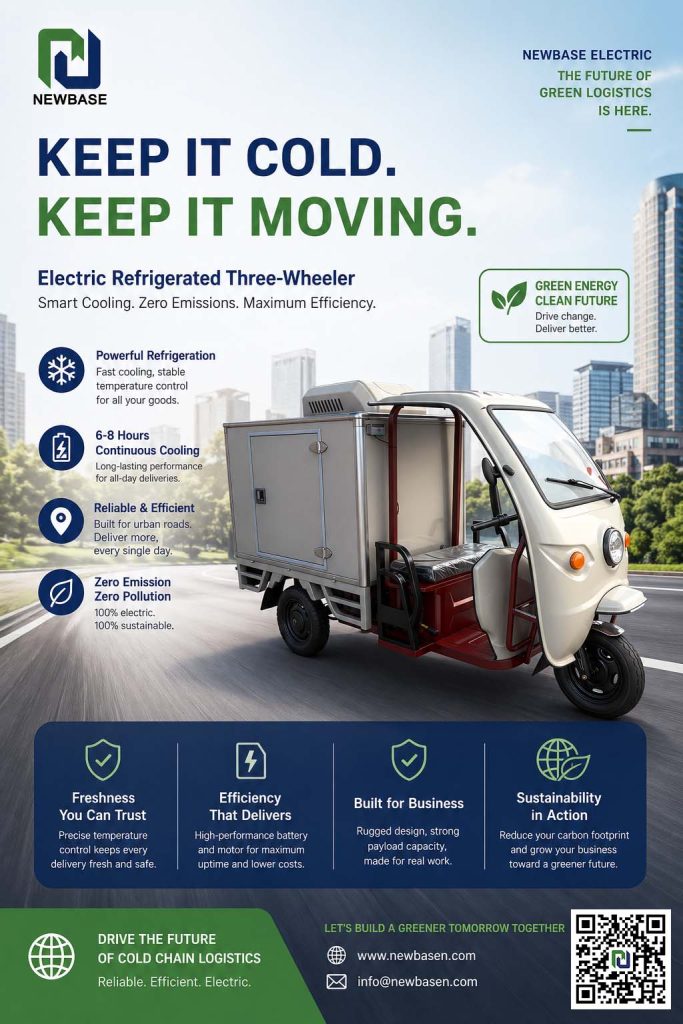
NEWBASE continues investing in compact refrigeration transport technologies for modern logistics applications.
Its electric refrigerated vehicle solutions are designed for:
- Urban distribution
- Short-distance transportation
- Fresh food logistics
- Pharmaceutical delivery
- Retail cold chain operations
By combining refrigeration technology, thermal management expertise, and electric vehicle innovation, NEWBASE helps customers improve logistics efficiency while supporting sustainability goals.
Conclusão
As cold chain logistics continues evolving, compact electric refrigerated vehicles are expected to become an essential component of future urban transportation systems.
Businesses that invest early in flexible, efficient, and sustainable refrigeration transport solutions will gain long-term operational advantages.
Explore NEWBASE electric refrigeration solutions for next-generation cold chain logistics.
 Português
  English
  Español
  العربية
  Русский
  Français
  Bahasa Indonesia
  日本語
日本語  Română
  Deutsch
  Italiano