
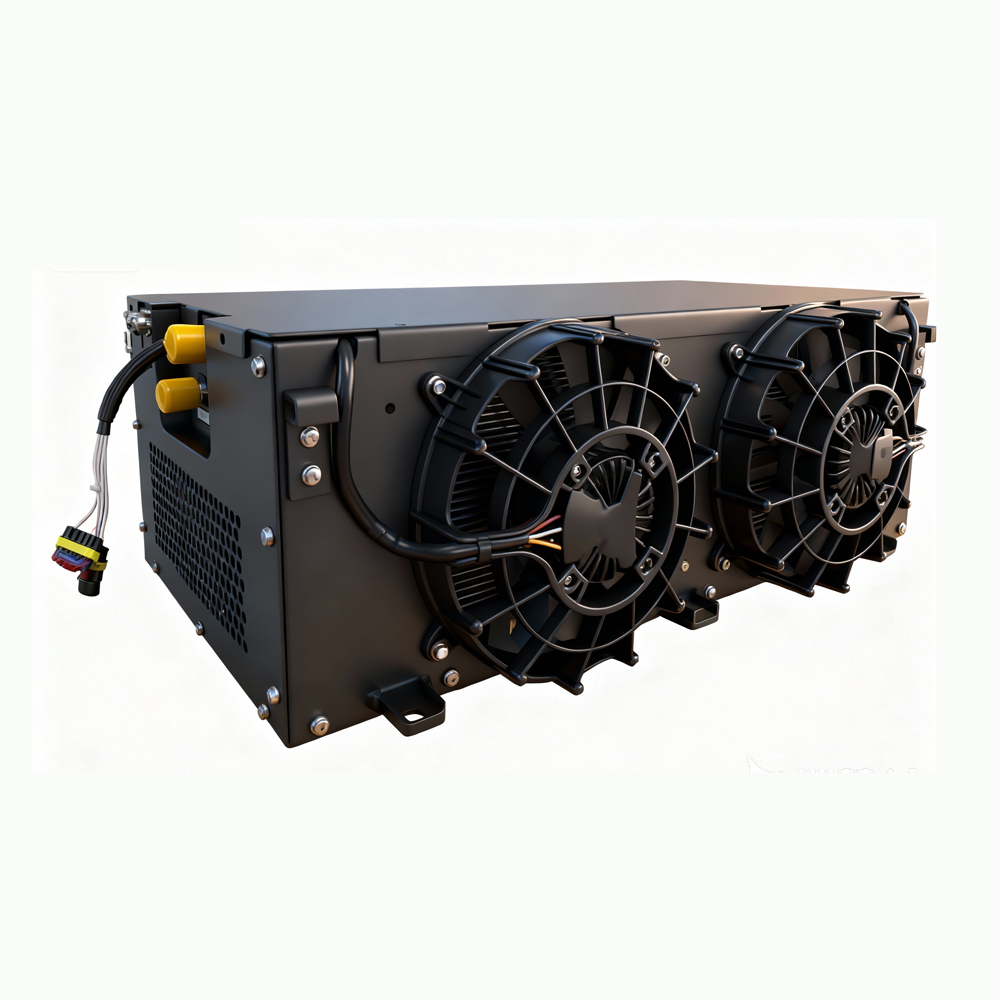
Comprehensive Testing Ensures Water-Cooled BTMS Reliability
Quality assurance for commercial vehicle water-cooled BTMS requires rigorous testing across multiple parameters. Manufacturers implement comprehensive test programs that verify performance, durability, and safety before units reach customers.
Performance Verification Testing
Cooling efficiency testing quantifies heat removal capability under controlled conditions. Test procedures use calibrated heat sources to simulate battery thermal loads. Technicians measure coolant temperature differential between inlet and outlet while varying flow rates and ambient conditions. Results confirm the unit achieves specified cooling capacity across the operating envelope.
Cooling capacity testing verifies the rated cooling output meets specifications. Testing spans the full range of operating conditions: varying ambient temperatures, different coolant flow rates, and diverse thermal loads. Capacity measurements at extreme conditions ensure the unit performs adequately even in demanding situations.
Power consumption testing measures electrical input under various operating modes. Energy efficiency ratio (EER) and coefficient of performance (COP) calculations verify the unit achieves specified efficiency levels. Low power consumption extends vehicle range and reduces operating costs.
Control system testing verifies temperature regulation accuracy and response time. Controllers must maintain coolant temperature within narrow bands despite varying thermal loads. Testing examines controller behavior during sudden load changes, ambient temperature transitions, and mode transitions.
Structural and Environmental Testing
Leakage testing ensures sealed construction maintains integrity throughout the product life. Units are filled with water and operated for extended periods while technicians monitor all connections and joints for leakage. Pressurized testing exaggerates potential leak paths that might develop over time.
Pressure testing verifies the coolant circuit withstands maximum operating pressure with adequate safety margin. High-pressure water pumps apply pressures exceeding normal operating conditions to verify structural integrity. This testing identifies weaknesses before they cause field failures.
High and low temperature testing exposes units to extreme conditions beyond normal operating ranges. Thermal cycling testing rapidly transitions between temperature extremes, identifying weaknesses in seals, connections, and component attachments. These tests accelerate aging mechanisms to verify long-term durability.
Environmental protection verification confirms IP67 ratings for electrical compartments. Testing exposes units to dust and water spray according to IEC 60529 standards. Successful completion ensures reliable operation in dusty, wet environments common in construction and agricultural applications.
Electrical Safety Testing
Dielectric testing verifies electrical insulation withstands high voltages without breakdown. High-potential testing applies voltages exceeding normal operating levels to verify insulation integrity. This protects against ground faults and short circuits.
Grounding continuity testing ensures protective grounding connections remain low resistance throughout product life. Poor grounding creates safety hazards and can cause electromagnetic interference.
Insulation resistance testing measures the resistance between live conductors and ground. Low insulation resistance indicates degradation that could cause leakage currents or short circuits.
EMC testing verifies electromagnetic compatibility with vehicle systems and external environments. Both emissions and immunity testing ensure the unit operates correctly without interfering with other vehicle electronics.
Component-Level Testing
Compressor performance testing evaluates compressor capacity, efficiency, and reliability. Compressors are operated across their full performance envelope while monitoring power consumption, discharge temperatures, and vibration levels.
Condenser and evaporator testing verifies heat exchanger effectiveness. Performance mapping across various airflow rates and temperature differentials confirms heat transfer meets expectations.
Fan performance testing measures airflow delivery and power consumption. Fans must provide adequate airflow for heat rejection while minimizing noise and power consumption.
Refrigerant system testing includes leak detection, charge verification, and performance validation. Proper refrigerant charge is essential for optimal performance and efficiency.
System Integration Testing
Communication interface testing verifies CAN 2.0 message handling and response timing. Units must correctly interpret commands and report status information according to defined protocols.
Control system integration testing examines interaction between the BTMS and vehicle control systems. Testing verifies proper mode transitions, coordinated operation with HVAC systems, and appropriate responses to fault conditions.
Durability testing simulates extended field operation through accelerated life testing. Units are operated through thousands of duty cycles while monitoring performance degradation. Successful completion provides confidence in long-term reliability.
Field validation testing places units in actual vehicle applications for extended periods. Real-world operation reveals issues not captured in laboratory testing, including vibration effects, power quality variations, and interaction with diverse vehicle configurations.
Documentation and Traceability
Test data documentation provides evidence of compliance with specifications. Detailed records include test conditions, equipment calibrations, and individual unit results. This documentation supports warranty claims and regulatory compliance.
Manufacturing traceability links test results to specific production batches and dates. If field issues emerge, traceability enables rapid identification of potentially affected units and targeted corrective actions.
Continuous improvement processes analyze test results to identify design weaknesses and manufacturing variations. This feedback loop drives ongoing product enhancement and quality improvement.
 English
  Español
  Português
  العربية
  Русский
  Français
  Bahasa Indonesia
  日本語
日本語  Română
  Deutsch
  Italiano