
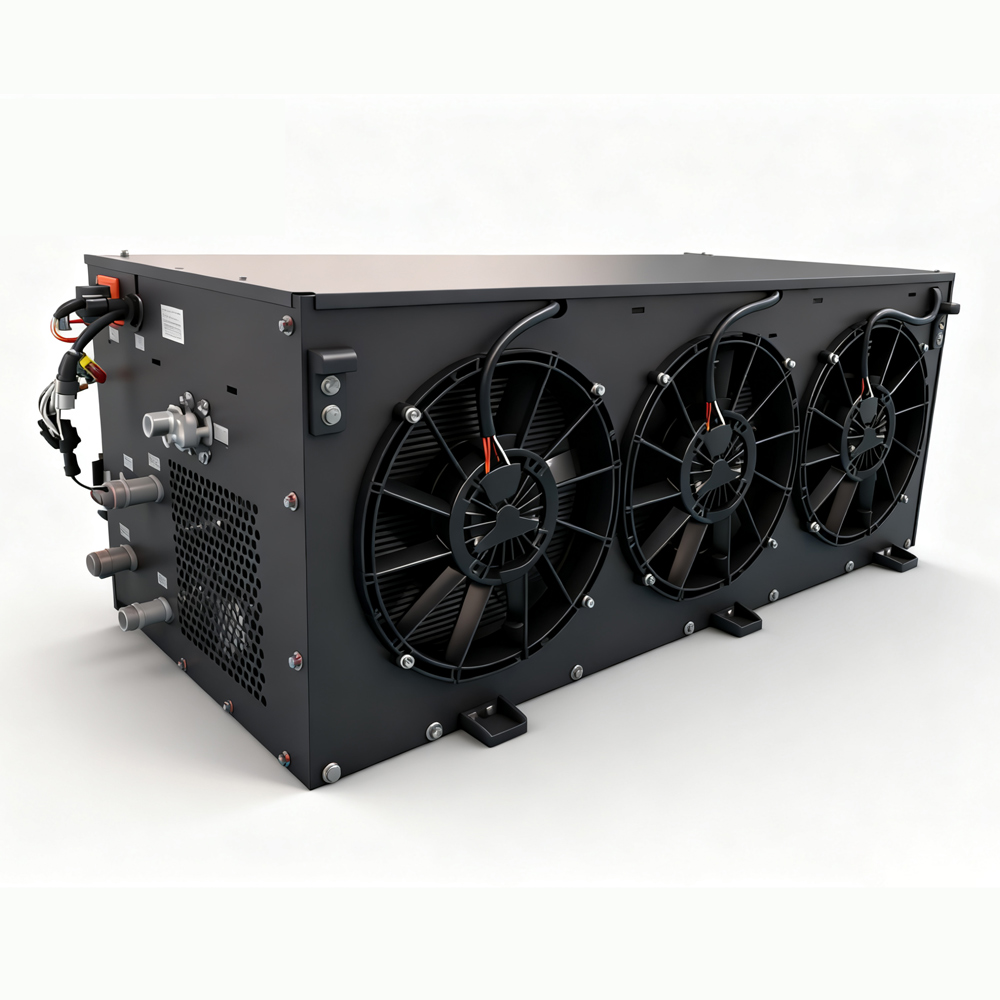
Water-Cooled BTMS for Commercial Vehicles: A Complete Technical Overview
Battery thermal management is critical for electric commercial vehicles. Without proper temperature control, batteries experience reduced performance, accelerated degradation, and potential safety risks. Water-cooled Battery Thermal Management Systems (BTMS) have emerged as the industry standard for managing battery temperatures in demanding commercial vehicle applications.
How Water-Cooled BTMS Works
A water-cooled BTMS uses coolant as the heat transfer medium, circulating it through the battery pack to absorb and remove excess heat. The system consists of five primary components: a compressor, evaporator, condenser, expansion valve, and plate heat exchanger. By adjusting the coolant temperature and flow rate, the system maintains the battery pack within its optimal operating temperature range—typically between 15°C and 35°C for lithium-ion batteries.
The working principle follows a closed-loop refrigeration cycle. Hot coolant from the battery pack flows to the chiller unit, where heat is transferred to the refrigerant. The cooled coolant then circulates back through the battery pack, absorbing more heat in a continuous cycle. During cold weather conditions, an optional PTC (Positive Temperature Coefficient) liquid heater can warm the coolant to ensure batteries remain within acceptable temperature limits.
Why Commercial Vehicles Need Advanced BTMS
Commercial vehicles operate under more demanding conditions than passenger cars. Heavy-duty trucks, electric buses, and construction machinery often operate at full load for extended periods, generating significant battery heat. Additionally, these vehicles must function in extreme environmental conditions—from arctic temperatures to desert heat.
The consequences of inadequate thermal management are substantial. Battery capacity can decrease by up to 50% in extreme cold, while excessive heat accelerates battery degradation, potentially reducing battery life by 30% or more. For commercial fleet operators, these factors directly impact operational efficiency and total cost of ownership.
Key Components and Specifications
Modern water-cooled BTMS units for commercial vehicles incorporate several essential features:
The cooling unit typically ranges from 5kW to 16kW cooling capacity, selected based on vehicle type and battery size. Systems utilize R134a refrigerant with 50%/50% ethylene glycol/water solution as the secondary coolant. Operating voltage ranges accommodate various vehicle electrical systems, with high-voltage options from 320VDC to 750VDC and standard 24VDC control circuits.
Communication interfaces, primarily CAN 2.0, enable integration with vehicle control systems. This allows coordinated thermal management with other vehicle systems, including HVAC and powertrain cooling. Advanced units feature fault self-diagnosis capabilities and real-time power information upload for remote monitoring.
Applications Across Commercial Vehicle Segments
Water-cooled BTMS serves multiple commercial vehicle applications:
Electric buses utilize thermal management to maintain passenger comfort while protecting propulsion batteries. The system ensures consistent range performance and extends battery service life, critical for urban transit operations.
Electric construction machinery, including loaders and mining trucks, requires robust thermal management for demanding duty cycles. These vehicles often operate in dusty, high-temperature environments where reliable cooling is essential for productivity.
New energy heavy-duty trucks depend on BTMS for long-haul operations. Consistent battery temperature management enables predictable range performance and supports aggressive charging schedules necessary for commercial freight operations.
Energy storage systems at charging stations and grid-level installations also benefit from similar thermal management technology, ensuring safe and efficient operation of large battery arrays.
System Integration Considerations
Successful BTMS implementation requires careful system integration. The thermal management system must coordinate with the vehicle’s power distribution, communication networks, and cooling infrastructure. Mounting location, pipe routing, and heat rejection capacity all affect system performance.
For optimal results, engineers should consider the complete thermal management architecture. Some applications benefit from integrated thermal management that coordinates battery cooling with motor cooling, HVAC systems, and heat recovery functions. This holistic approach maximizes energy efficiency and system performance.
 English
  Español
  Português
  العربية
  Русский
  Français
  Bahasa Indonesia
  日本語
日本語  Română
  Deutsch
  Italiano