
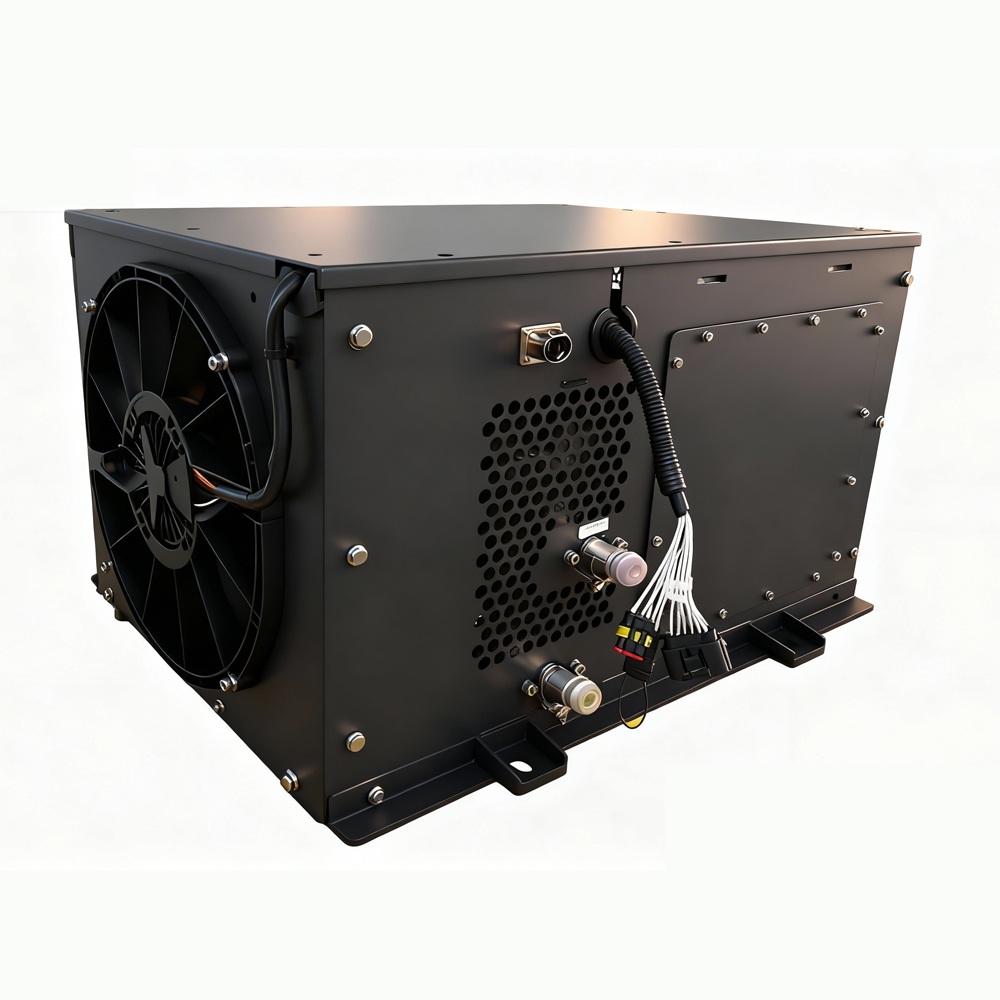
Industry Applications of Water-Cooled Battery Thermal Management Systems
Water-cooled BTMS technology serves diverse applications across commercial transportation and stationary energy storage. Each application presents unique thermal management challenges that inform system selection and integration.
Electric Bus Thermal Management
Electric buses represent a mature application for water-cooled BTMS. Urban transit buses operate in stop-and-go patterns with frequent acceleration and deceleration, generating significant battery heat. Simultaneously, passenger comfort requires HVAC operation that affects overall thermal balance.
Battery thermal management in buses focuses on maintaining consistent cell temperatures throughout the pack. Temperature non-uniformity causes imbalance between cells, reducing usable capacity and accelerating degradation. The BTMS must deliver uniform cooling across the entire battery pack, which may contain hundreds of cells arranged in multiple modules.
Charge management integration is essential for buses with opportunity charging capabilities. Rapid charging generates substantial heat that the BTMS must manage to enable short charging windows while protecting battery health.
Energy efficiency considerations influence system design. Bus routes have limited energy budget for climate control and propulsion. Efficient BTMS operation minimizes parasitic energy consumption, extending range and reducing charging requirements.
Heavy-Duty Truck Applications
Electric trucks face different challenges than urban vehicles. Long-haul operations involve sustained highway driving with continuous battery discharge. Route planning requires predictable range, which depends on consistent battery performance throughout the duty cycle.
Thermal management for trucks must handle the sustained thermal loads of highway operation. Unlike urban vehicles with recovery time between trips, long-haul trucks may operate continuously for many hours. BTMS capacity must handle these extended loads without degradation.
Cold climate operation is critical for trucks in northern regions. Battery heating in sub-zero temperatures prevents capacity loss and protects against lithium plating during charging. PTC liquid heaters integrated into BTMS units provide rapid warming capability.
Grid integration considerations affect fleet operations. Trucks with high daily mileage require frequent charging, often using high-power DC fast chargers. The BTMS must manage thermal loads from both driving and charging cycles.
Construction Machinery and Mining Equipment
Heavy equipment presents extreme thermal management challenges. Construction vehicles often operate in dusty, high-temperature environments with limited airflow for heat rejection. Mining trucks face additional challenges with vibration, shock loads, and potentially explosive atmospheres.
Duty cycle considerations drive capacity selection. Equipment such as wheel loaders operate with high-power demand during digging and loading cycles, followed by lower-power travel between work areas. The BTMS must respond to rapidly changing thermal loads while maintaining battery temperature.
The 16kW capacity units specifically serve these demanding applications. Robust construction, IP67-rated electrical components, and comprehensive testing ensure reliable operation in harsh conditions.
Safety considerations are paramount in mining applications. BTMS units must not introduce ignition sources in areas where flammable atmospheres may exist. Component selection and testing address these requirements.
Energy Storage Systems
Stationary energy storage applications extend beyond vehicle thermal management. Grid-level storage installations use large battery arrays that require coordinated thermal management.
Scalability requirements influence system architecture. Energy storage installations may contain megawatt-hours of battery capacity across thousands of cells. The BTMS must scale economically while maintaining uniform temperature distribution.
Standalone operation distinguishes stationary applications from vehicle integration. Without vehicle power systems providing thermal management infrastructure, the BTMS must be self-contained with dedicated power supplies and controls.
Integration with building management systems enables coordinated operation with HVAC and power systems. The BTMS can respond to signals indicating grid demand, energy pricing, or facility occupancy to optimize cooling strategies.
Charging Infrastructure
Electric vehicle charging stations benefit from thermal management technology. Fast chargers generate substantial heat that must be managed for reliability and efficiency.
charger thermal management protects electronic components from overheating, extending service life and maintaining charging efficiency. Active cooling with fans or liquid cooling maintains component temperatures within specifications.
Battery conditioning at charging stations pre-heats or pre-cools vehicle batteries before charging, enabling faster charging sessions and protecting battery health. Some stations integrate thermal management systems that communicate with vehicles to coordinate conditioning.
Renewable Energy Integration
Solar and wind energy storage requires battery thermal management to maximize system efficiency and longevity. Energy storage systems smooth the intermittency of renewable generation, storing excess energy during peak production for release during high-demand periods.
Temperature effects on battery calendar life and cycle life are significant. Proper thermal management extends battery life, improving the economics of renewable energy storage projects.
 English
  Español
  Português
  العربية
  Русский
  Français
  Bahasa Indonesia
  日本語
日本語  Română
  Deutsch
  Italiano