
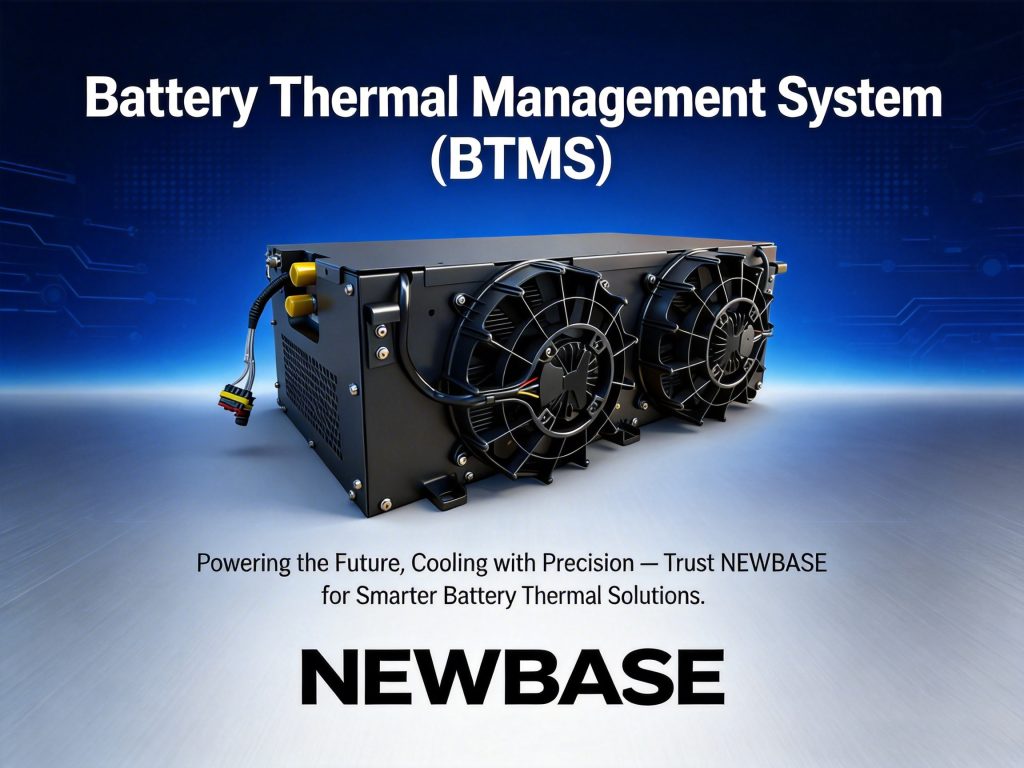
As electric commercial vehicles transition from early adoption to mainstream deployment, the limitations of traditional air-cooling systems have become impossible to ignore. In 2025, a comprehensive review published in MDPI’s journal Batteries systematically evaluated advanced cooling strategies — including indirect liquid cooling, phase change material (PCM) cooling, and hybrid approaches — and concluded that liquid cooling systems deliver the highest heat transfer efficiency for preventing thermal runaway in lithium-ion battery packs.
The Physics Behind Liquid Cooling Superiority
Liquid cooling works on a simple but powerful principle: liquids have significantly higher heat capacity and thermal conductivity than air. Water-glycol mixtures used in BTMS (Battery Thermal Management Systems) can absorb and transport heat away from battery cells up to 3,000 times more effectively than air cooling.
For commercial EVs carrying 200–400 kWh battery packs, this difference isn’t marginal — it’s decisive. During 4C fast charging, a single battery cell can generate 5–10 watts of heat. Across a 300 kWh pack with hundreds of cells, that translates to kilowatts of thermal energy that must be dissipated within minutes. Air cooling simply cannot move heat fast enough to keep cell temperatures within safe operating windows during these high-stress events.
Why Commercial EVs Demand More Than Passenger Cars
Passenger electric vehicles can often get by with simpler thermal management because their battery packs are smaller, their duty cycles are lighter, and their charging profiles are less aggressive. Commercial electric vehicles face a fundamentally different set of demands:
•Heavier payloads mean more battery cells generating more heat
•Longer operating hours (often 16–24 hours for fleet vehicles) leave less time for thermal recovery
•Frequent fast charging creates repeated thermal shocks that accelerate degradation without proper management
•Extreme ambient conditions — from refrigerated warehouses to desert highways — require thermal systems that can both heat and cool effectively
These factors make liquid cooling not just preferable, but essential for commercial EV viability.
NEWBASE’s Liquid-Cooled BTMS Approach
NEWBASE (Zhengzhou NEWBASE Automotive Electronics Co., Ltd.) has built its BTMS water-cooled unit lineup around the principle that effective thermal management must be proactive, not reactive. Their systems use:
•Nano-composite liquid cooling plates that increase heat transfer coefficients by 40% compared to conventional designs
•Dual-loop redundant architecture that ensures continuous cooling even if one circuit fails
•Model Predictive Control (MPC) algorithms that anticipate thermal events before they occur, reducing system energy consumption by 25–30%
•Integrated PTC liquid heaters (6–30 kW configurable) for effective pre-heating in cold climates, cutting warm-up time from -30°C to 5°C to just 15 minutes
The product range spans from 3.5 kW (NBSLJZ-03-01 for light delivery vans) to 12 kW (NBSLJZ-13-01 for battery-swap heavy trucks), with custom solutions available for specialized applications.
The Market Is Moving Fast
The global battery thermal management system market was valued at USD 4.2 billion in 2025 and is expected to grow at a CAGR of 12.7% between 2026 and 2035, reaching USD 13.2 billion. The commercial vehicle segment is projected to grow fastest, driven by the rapid electrification of heavy-duty trucks, buses, and delivery fleets.
In March 2025, Samsung SDI announced its next-generation nanofluid-based cooling modules, promising a 20% improvement in thermal performance. This signals a broader industry recognition that thermal management innovation is no longer optional — it’s the competitive differentiator for the next generation of electric vehicles.
The Bottom Line for Fleet Operators
For fleet operators evaluating electric commercial vehicles, the quality of the thermal management system should be as important as the battery chemistry or motor power. A superior liquid-cooled BTMS extends battery life by maintaining optimal cell temperatures, reduces charging time through effective heat dissipation during fast charging, and prevents costly thermal runaway events.
NEWBASE’s BTMS water-cooled units — validated through over 1,500 4C fast-charging cycles with battery capacity retention above 95% — represent the kind of thermal management performance that commercial fleet operators need to make electric vehicles economically viable at scale.
 English
  Español
  Português
  العربية
  Русский
  Français
  Bahasa Indonesia
  日本語
日本語  Română
  Deutsch
  Italiano