
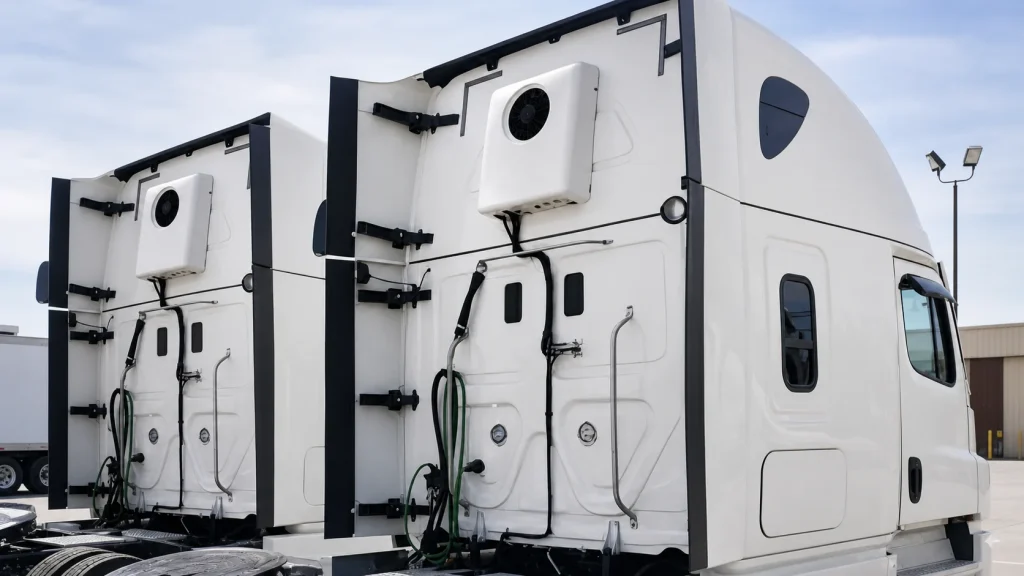
Short answer: choose a truck parking air conditioner by matching four items before comparing features: the vehicle’s native DC voltage, the sleeper-cab cooling load, the available installation space, and the battery capacity available while the engine is off. A split rear-mounted system can preserve roof space and offer flexible indoor-unit placement, while an integrated rooftop system can simplify the equipment layout when the roof opening, structure, and clearance are suitable.
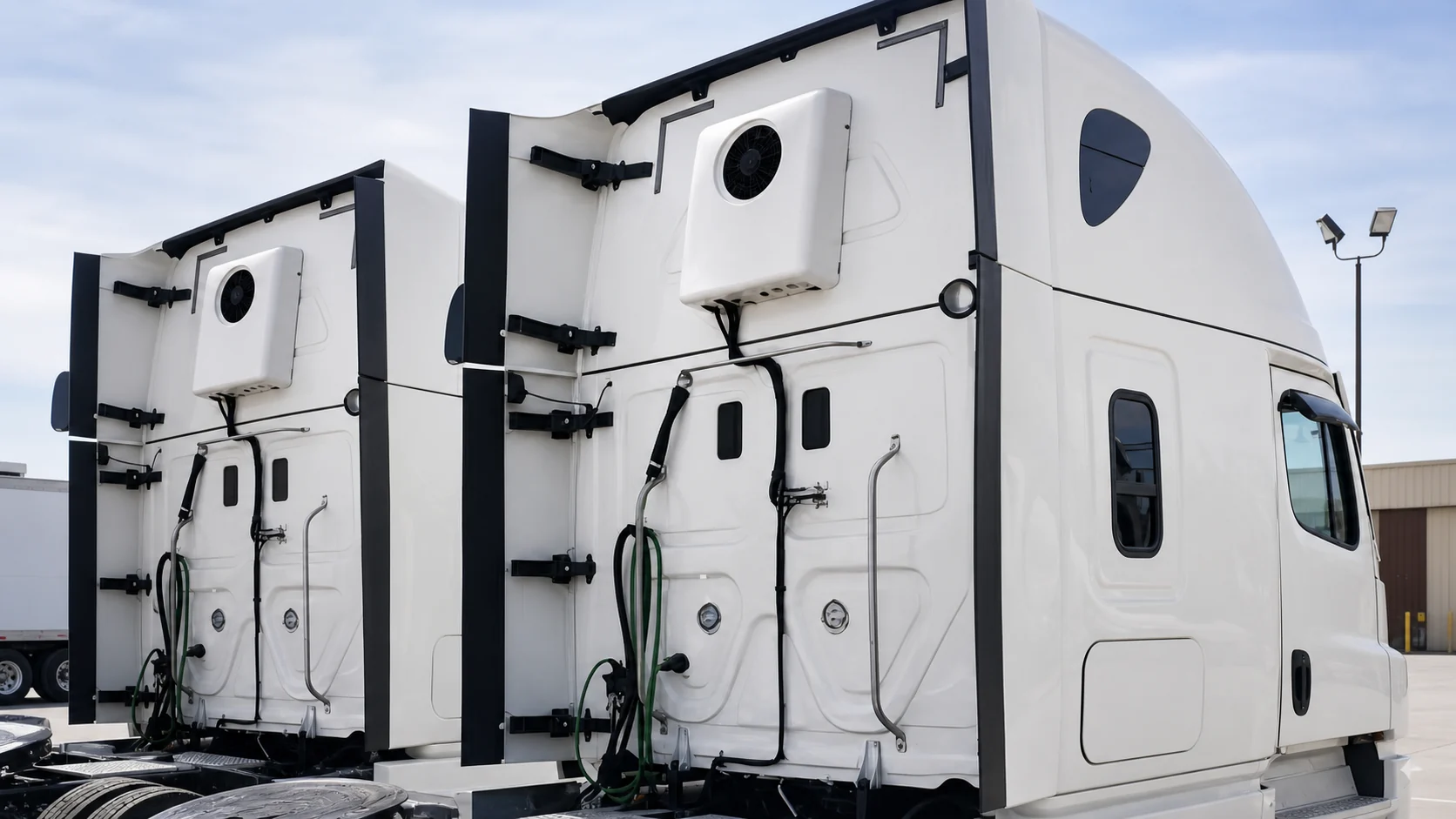
For long-haul drivers, a comfortable sleeper cab is not simply a convenience. The air-conditioning system must provide useful cooling during rest periods without depending on continuous engine idling. That makes a DC-powered parking air conditioner an electrical and installation decision as much as an HVAC decision. Selecting only by a headline cooling-capacity figure can lead to undersized cables, insufficient battery runtime, roof-fit problems, or disappointing performance in hot conditions.
This guide uses the NEWBASE NBEPAC-2.5 split rear-mounted unit and NBEPAC-3 integrated rooftop unit as practical examples. It explains what their published specifications mean and which vehicle information should be confirmed before a model is selected.
What is a truck parking air conditioner?
A truck parking air conditioner is an electrically driven cooling system designed to condition the cab while the vehicle is parked. Unlike the original engine-driven air-conditioning system, it can operate from a suitable DC electrical source when the engine is off. The complete installation therefore includes more than the air-conditioning unit: the battery or approved energy-storage source, cable sizing, fusing and isolation, mounting structure, condensate drainage, and airflow path all affect the final result.
A parking A/C should not be selected as if every truck cab were identical. Cab volume, glazing, insulation, solar exposure, ambient temperature, number of occupants, heat-producing appliances, and the desired pull-down time all change the actual cooling load.
Split rear-mounted or integrated rooftop?
Split rear-mounted parking air conditioner
In a split system, the condenser assembly and the cabin evaporator are separate. The NEWBASE NBEPAC-2.5 family is a split rear-mounted configuration with a published nominal cooling capacity of 2,500 W (8,600 Btu/h). Its evaporator airflow is listed as 550 m³/h and condenser airflow as 1,800 m³/h. The catalogue provides two indoor-unit arrangements, giving the installer more flexibility when matching the sleeper-cab interior.
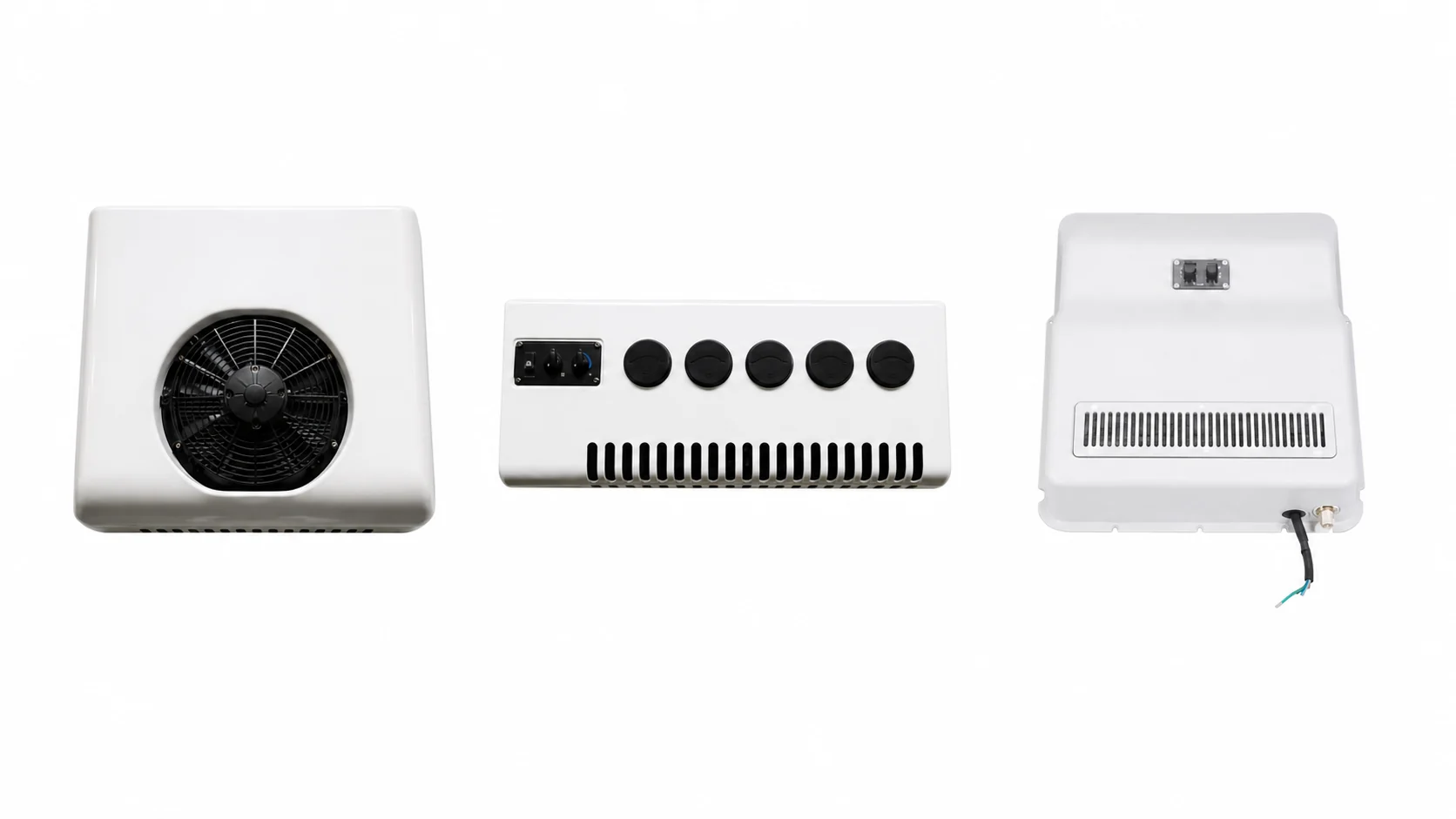
A split layout is worth considering when roof space is occupied, roof height must be minimized, or the cab structure is better suited to rear mounting. It also allows the indoor air outlet to be positioned according to the sleeper layout. The trade-off is that the installation has multiple components and refrigerant-line, wiring, drainage, sealing, and service-access requirements that must be planned together.
Integrated rooftop parking air conditioner
An integrated rooftop system combines the main refrigeration assembly in a roof-mounted package with an interior panel below it. The NEWBASE NBEPAC-3 family has a published nominal cooling capacity of 3,000 W (10,236 Btu/h), an evaporator airflow of 600 m³/h, and a condenser airflow of 1,200 m³/h. The catalogue lists a main-unit envelope of 880 × 990 × 236 mm and a weight of 68 kg.

A rooftop unit can reduce the number of separately positioned assemblies, but it is not automatically the easiest option for every vehicle. The installer must verify the roof opening, curvature, reinforcement, load capacity, sealing surface, interior clearance, total vehicle height, and access for future maintenance. Published product dimensions are only the starting point; the installation drawing and the actual roof geometry must be compared before any cutting begins.
12V vs 24V parking air conditioner: match the vehicle first
The NBEPAC-3 technical data lists DC 12V operation at less than 75 A and DC 24V operation at less than 40 A. These figures show why system voltage matters. For a similar power level, a 24V system generally carries lower current than a 12V system, which affects conductor size, voltage drop, connectors, fuses, isolators, and installation heat. This does not mean that a 24V unit should be added to a 12V truck or that voltage can be chosen independently of the vehicle.
Use the truck’s approved electrical architecture. If an auxiliary battery bank, converter, or dedicated energy-storage system is proposed, the complete circuit should be reviewed by a qualified vehicle electrical engineer or installer. Confirm the exact A/B model-to-voltage mapping with NEWBASE before ordering; the catalogue lists both voltage options but does not explicitly assign each suffix in the table.
How much battery capacity is needed?
Runtime cannot be determined accurately from air-conditioner cooling capacity alone. Cooling capacity in watts describes heat-removal capability; it is not the same as electrical input power. A responsible runtime estimate needs the unit’s verified electrical consumption under defined conditions, battery nominal voltage and usable capacity, battery-management limits, cable losses, ambient temperature, thermostat setpoint, cab heat load, and compressor duty cycle.
Ask for a calculation based on the intended operating scenario—for example, an eight-hour overnight rest period at a specified outdoor temperature—not a universal runtime promise. Battery chemistry, state of health, low-temperature behavior, depth-of-discharge limit, and the need to preserve reliable engine starting must also be considered. If the parking A/C uses the vehicle’s starting batteries, protection against excessive discharge is essential.
Practical comparison of the NEWBASE examples
| Selection factor | NBEPAC-2.5 split rear-mounted | NBEPAC-3 integrated rooftop |
|---|---|---|
| Published cooling capacity | 2,500 W / 8,600 Btu/h | 3,000 W / 10,236 Btu/h |
| Published evaporator airflow | 550 m³/h | 600 m³/h |
| Installation concept | Separate rear outdoor unit and indoor evaporator | Roof-mounted main unit with interior panel |
| Best initial reason to shortlist | Roof space is constrained or flexible indoor-unit placement is important | Vehicle roof can accept the unit and an integrated package is preferred |
| Electrical data in the referenced catalogue | Confirm exact voltage/current for the selected A/B variant | DC 12V <75 A; DC 24V <40 A |
| Critical pre-installation check | Rear mounting, line routing, drainage, airflow, and service access | Roof opening, reinforcement, sealing, clearance, and total height |
These airflow values describe different heat-exchanger circuits and should not be used by themselves to declare one model more effective. Cooling-load suitability and installed performance require a complete review.
Information to send before requesting a model recommendation
- Truck make, model, year, and cab or sleeper configuration.
- Native electrical-system voltage and alternator specification.
- Battery type, nominal voltage, rated capacity, usable-capacity limit, and intended charging method.
- Cab interior dimensions, insulation details, glass area, and photographs of the roof, rear wall, and interior mounting zones.
- Typical and maximum ambient temperature, humidity, and solar exposure.
- Required operating duration with the engine off and preferred cabin setpoint.
- Any existing roof hatch, cut-out dimensions, reinforcement, height restriction, or rear-wall obstruction.
- Other electrical loads expected to operate during the same rest period.
Providing these inputs allows the supplier and installer to evaluate cooling capacity, architecture, electrical integration, and runtime as one system. It also reduces the risk of selecting a unit that fits the specification sheet but not the vehicle.
Frequently asked questions
Is a 3,000 W parking air conditioner always better than a 2,500 W model?
No. Higher nominal cooling capacity may help with a larger heat load, but mounting compatibility, electrical capacity, cab airflow, weight, efficiency, and runtime must also be suitable. An oversized or poorly integrated system is not a substitute for a correct vehicle-level assessment.
Can a 12V parking air conditioner be connected to any 12V battery?
No. Matching nominal voltage is only one requirement. The battery, conductors, protective devices, connectors, charging system, and low-voltage protection must all support the unit’s current safely and with acceptable voltage drop.
Does a rooftop parking air conditioner require a roof cut-out?
The required opening and mounting method depend on the specific unit and vehicle. Compare the controlled installation drawing with the truck’s roof structure and existing hatch. Do not cut the roof using only an overall product dimension.
What is the next step for a NEWBASE parking air conditioner project?
Send the vehicle and operating information above for an engineering match. The current NBEPAC specifications can be reviewed on the NEWBASE Parking Air Conditioner product page. Final model, voltage, installation details, and expected runtime should be confirmed for the actual truck before purchase or installation.
Technical source: NEWBASE Parking Air Conditioner catalogue, October 2024. Published values are catalogue data and may change as products are updated. Always request the current model-specific datasheet and controlled installation drawing. This article does not provide a vehicle installation approval.
 English
  Español
  Português
  العربية
  Русский
  Français
  Bahasa Indonesia
  日本語
日本語  Română
  Deutsch
  Italiano