
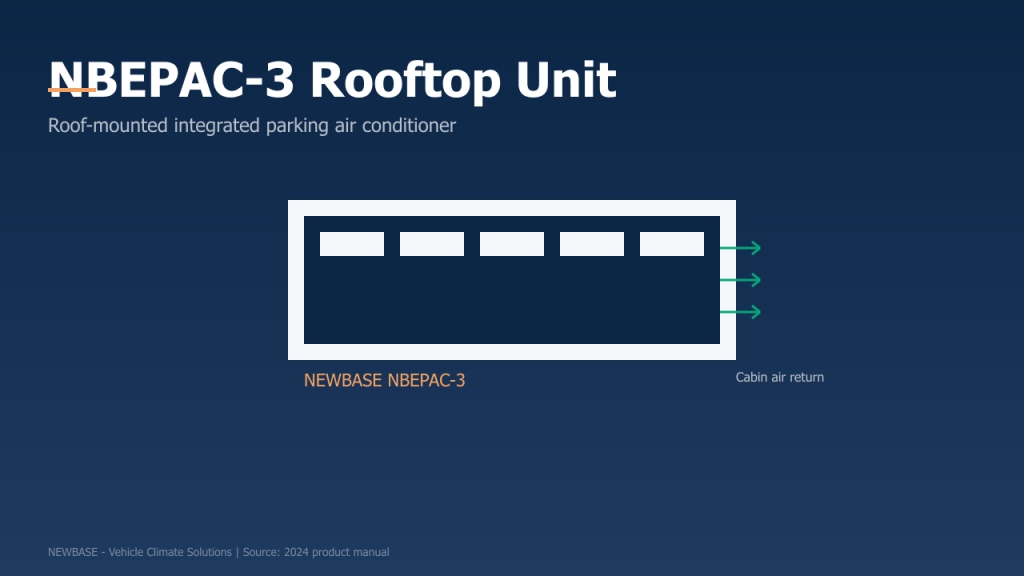
Short answer: A disciplined preventive maintenance routine for a DC truck parking air conditioner focuses on three things every month: keep the condenser and evaporator airflow paths clean, verify the refrigerant circuit and the electrical protection thresholds, and keep the lithium battery pack within its safe state of charge and temperature window. The routine is the same whether the cab uses a split rear-mounted NBEPAC-2.5 unit or an integrated rooftop NBEPAC-3 unit, but the inspection points differ slightly because the two architectures expose different service surfaces.
Article topic: Truck Parking Air Conditioner Preventive Maintenance. This article uses a NEWBASE-branded placeholder image for the feature; no third-party product photography is included in this draft. https://www.newbasen.com/wp-content/uploads/2026/08/newbase-illustration-002.png
Why a parking AC needs a scheduled service routine
Parking air conditioners for sleeper cabs run on DC battery power with the engine off, often for 5-9 continuous hours per rest cycle. The published cooling capacity of the NBEPAC-2.5A/B split unit is 2,500 W (8,600 Btu/h), and the NBEPAC-3A/B integrated rooftop unit is 3,000 W (10,236 Btu/h). Both units circulate large air volumes: 550-600 m³/h through the evaporator and 1,200-1,800 m³/h through the condenser. That airflow also pulls road dust, pollen, and insects across the evaporator coil and the parallel-flow condenser coil. A dirty coil typically does not fail outright; it raises discharge pressure, lengthens compressor run time, and erodes runtime endurance long before the driver notices a loss of cooling.
The other half of the system is the lithium battery pack. AWE024220B1 (4.2 kWh) and AWE024280B1 (5.3 kWh) packs are rated to start at -40°C and deliver 5-7 hours and 7-9 hours of full-charge runtime respectively. These numbers assume the cells are healthy and the BMS protective strategies are intact. Heat, deep discharge, and storage at full state of charge accelerate cell aging. A preventive maintenance visit is the right place to confirm pack health, not after a driver reports the AC no longer lasts through a rest cycle.
What changes between split and rooftop installations
| Service surface | NBEPAC-2.5 split rear-mounted | NBEPAC-3 integrated rooftop |
|---|---|---|
| Condenser location | Backpack-style outdoor unit on the rear wall; airflow 1,800 m³/h, weight 76 kg | Roof-mounted, condenser integrated with chassis; airflow 1,200 m³/h, total weight 68 kg, dimension 880 × 990 × 236 mm |
| Evaporator location | In-cabin indoor unit, 550 m³/h airflow, weight 16 kg | Roof unit, evaporator 600 m³/h airflow, with separate in-cabin interior panel |
| Refrigerant charge (R134a) | 1.85 LBS | 800 g |
| Compressor control | 13 cc/rev, 2000-5500 RPM | 13 cc/rev, 2000-5500 RPM rated |
| Voltage / current | See model data; confirm 12V/24V against the actual unit before service | DC12V <75 A; DC24V <40 A |
| Pressure protection | Compound switch off at 2.5 MPa; low-pressure protection off at 0.05 MPa | Confirm protection thresholds on the unit-specific wiring diagram before service |
| Ambient operating range | Temperature control 15-30°C, defrost at 1-2°C | -30°C to +60°C working range |
The rooftop NBEPAC-3 is more exposed to weather and sun load, so the cabin air path and the rooftop seal deserve close attention. The split NBEPAC-2.5 has an external condenser that catches road grime and benefits from more frequent coil cleaning.
Monthly preventive maintenance checklist
- Visual and seal inspection. Walk around the outdoor unit on a split installation, or climb safely to the rooftop for an NBEPAC-3, and check for cracked mounting brackets, loose bolts, deformed seals, and any sign of water ingress around cable glands. Early detection of seal failure prevents cabin condensation and protects the BMS.
- Coil cleaning. Clean the evaporator coil and the condenser coil with a soft brush and a low-pressure rinse; do not use a pressure washer, which can deform the parallel-flow condenser fins. The NBEPAC-2.5 uses a copper-tube aluminum-fin evaporator and a parallel-flow condenser; both need gentle handling. Confirm the drain paths are clear and that condensate cannot back up into the cabin.
- Filter service. Remove, wash, and dry the return-air filter. A clogged filter raises discharge pressure and forces the compressor to run at the upper end of its 2000-5500 RPM range, which shortens service life.
- Refrigerant and pressure check. With the system running, observe high-side and low-side pressures. For the NBEPAC-2.5, the high-side compound switch opens at 2.5 MPa and the low-pressure switch opens at 0.05 MPa; if the system reaches either threshold during a normal rest cycle, the cause is most often a dirty coil or a weak blower, not a refrigerant undercharge. Confirm the actual charge against the manual value (1.85 LBS for the NBEPAC-2.5, 800 g for the NBEPAC-3) before topping up.
- Electrical and current check. Measure the DC current draw during steady cooling. For the NBEPAC-3, current should stay below 75 A on a 12 V system and below 40 A on a 24 V system. A reading close to or above these limits usually points to a high-head-pressure condition or a worn compressor, not a control-board fault.
- Control and protection test. Verify the 15-30°C setpoint range, the three blower grades, and the defrost behaviour (1-2°C evaporator temperature for the NBEPAC-2.5). Any drift outside these ranges is a control-sensor issue and should be corrected before the next trip.
- Cabin air-quality accessories. The negative-ion purifier option is rated for -10°C to +60°C working temperature, with rated power below 1 W and rated current below 25 mA. If the cabin is parked in direct sun with ambient air above 60°C, switch the accessory off until the cabin cools.
- Documentation. Record pressures, current draw, setpoint, filter condition, and any observations in the unit’s service log. Drivers and fleet managers should be able to see the trend, not just the most recent reading.
Lithium battery preventive care
For AWE024220B1 (4.2 kWh) and AWE024280B1 (5.3 kWh) packs, monthly service should confirm:
- State of charge between 30% and 80% during long parked storage; storing at 100% continuously accelerates cell aging.
- No error codes or warning lights from the BMS, which would otherwise lock the pack out of service.
- Connectors free of corrosion and tight to the rated torque; loose connectors cause voltage sag and false low-state-of-charge readings.
- Pack temperature within the published operating range; cold-soak below -30°C (NBEPAC-3 ambient minimum) may require a preheat cycle before full cooling is requested.
Seasonal readiness
Before summer, run a full cooling cycle and confirm a stable cabin temperature within 15-30°C setpoint. Before winter, run a defrost cycle (1-2°C evaporator temperature target) and confirm the cabin returns to setpoint without icing the evaporator. If a unit is parked outdoors below -30°C, the low-temperature start features of the lithium pack still allow operation, but the NBEPAC-3 ambient operating range must be respected. Service teams should document ambient conditions during each seasonal check.
Frequently asked questions
How often should the cabin filter be replaced?
For a long-haul fleet, inspect the filter at every monthly service and replace it when airflow at the cabin grille drops noticeably or when the filter shows tears or oil loading. There is no fixed hour count; a clean filter is a maintenance outcome, not a calendar item.
Can I use a pressure washer to clean the condenser?
No. The condenser uses a parallel-flow fin design that is easily deformed by high-pressure water. Use a soft brush and a low-pressure rinse, working in the direction of the fins, and follow up with a visual check of fin spacing.
What does it mean if the system pressure hits the 2.5 MPa cutoff?
For the NBEPAC-2.5, the compound switch opens at 2.5 MPa. Under normal ambient conditions this is a sign that the condenser cannot reject heat fast enough, almost always because the coil is dirty, the blower is failing, or the outdoor airflow is restricted. Investigate airflow before adding refrigerant.
Is the NBEPAC-2.5 A suffix the 12V version and B the 24V version?
The source manual lists NBEPAC-2.5A and NBEPAC-2.5B without an explicit A/B-to-voltage mapping. Do not assume a voltage from the suffix; confirm against the unit’s nameplate, wiring diagram, and the product engineering team before any electrical service.
Can a single lithium battery run a 5-7 hour rest cycle and a 7-9 hour cycle?
No. The 5-7 hour runtime applies to the AWE024220B1 (4.2 kWh) pack; the 7-9 hour runtime applies to the AWE024280B1 (5.3 kWh) pack. The runtime is a property of the battery capacity, the pack age, the ambient temperature, and the cabin heat load, and should be checked against the actual duty cycle.
Source and confirmation
Technical source: NEWBASE Parking Air Conditioner 2024 (Zhengzhou Newbase Auto Electronics Co., Ltd., October 2024), document SHA-256 2897f8d4e2d2ea4d5184ccfe74a5c88978a47ccd8987d2496c29b7d618654c22. Pages 7, 9-13, 15-16, and 19 of the source manual were used; see the source register for the full claim-to-page map. Current product documentation and engineering confirmation take precedence over this article for any specific installation.
 English
  Español
  Português
  العربية
  Русский
  Français
  Bahasa Indonesia
  日本語
日本語  Română
  Deutsch
  Italiano