
Pendahuluan
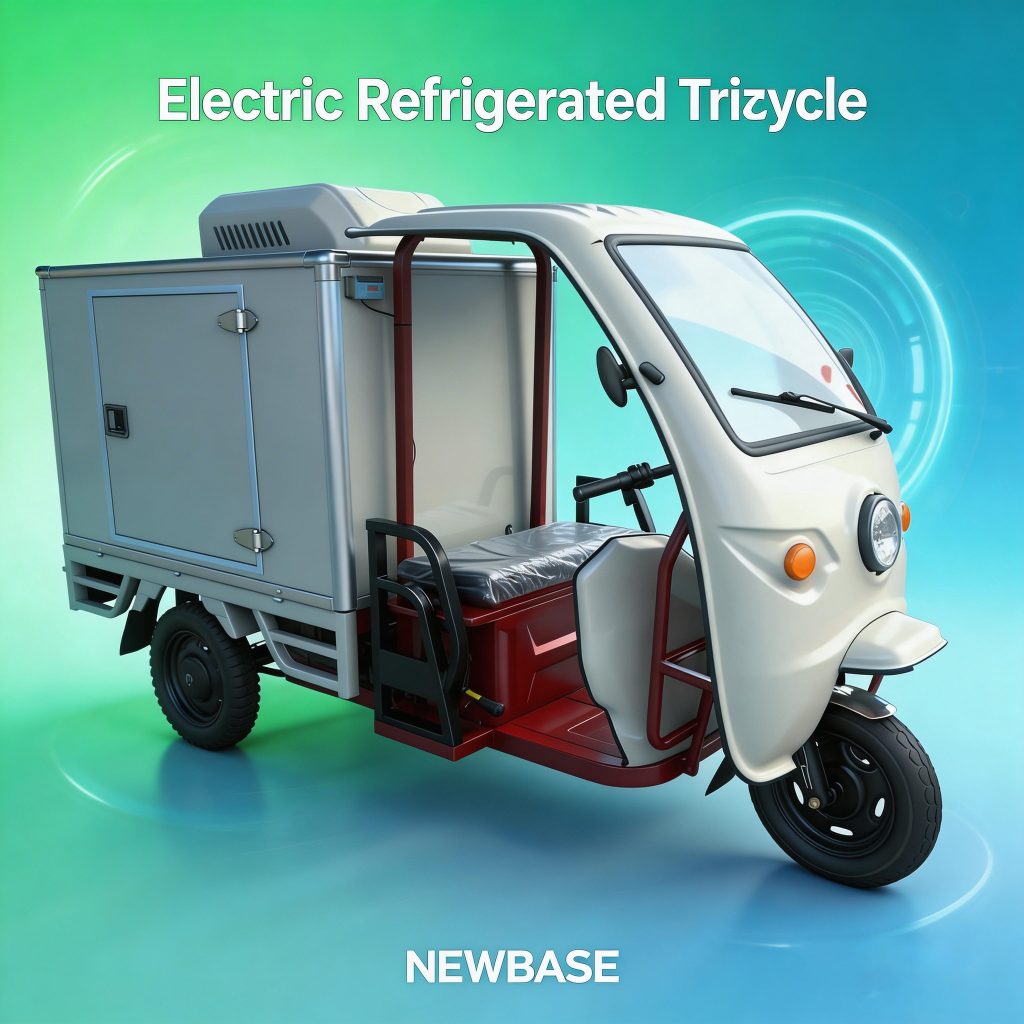
The refrigeration system is the most critical component of a cold chain tricycle. NEWBASE offers two primary cooling technologies — compressor-based and thermoelectric (semiconductor) cooling — each with distinct advantages depending on the application.
Compressor Refrigeration Systems
Compressor systems work on the vapor-compression cycle — the same technology used in household refrigerators and commercial cold storage.
How It Works
1. Refrigerant gas is compressed, raising its pressure and temperature
2. Hot gas passes through a condenser coil, releasing heat
3. Cooled liquid refrigerant expands through an expansion valve, dropping temperature
4. Cold refrigerant absorbs heat from the cargo compartment via the evaporator
Keuntungan
Deep-freeze capability: Achieves -22°C for frozen products
High efficiency in hot weather: Performance improves with proper ventilation
Proven reliability: Millions of units in service worldwide
Lower operating cost per cooling unit: 30–50% more efficient than semiconductor at high temperature differentials
Best For
Frozen foods, ice cream, meat
Pharmaceutical cold chain (2–8°C and -20°C)
Hot climate operations (ambient >35°C)
Thermoelectric (Semiconductor / Peltier) Cooling Systems
Thermoelectric coolers use the Peltier effect — applying voltage across semiconductor junctions creates a temperature differential.
How It Works
1. DC current flows through a Peltier module
2. One side becomes cold (cooling the cargo box)
3. The opposite side becomes hot (dissipated via heat sink and fan)
Keuntungan
Silent operation: No moving compressor parts
Compact and lightweight: Saves space and reduces vehicle weight
Vibration-free: Ideal for delicate products
Instant temperature response: Cools quickly upon startup
Lower initial cost: More affordable upfront
Limitations
Temperature limited: Typically 15–20°C below ambient (cannot deep-freeze in hot weather)
Energy consumption: Less efficient at large temperature differentials
Ambient temperature dependent: Performance drops in extreme heat
Best For
Chilled beverages and dairy products (2–8°C)
Fresh produce and flower delivery
Short-distance urban delivery
Mild climate operations
Comparison Table
| Parameter | Compressor System | Thermoelectric System |
| Minimum Temperature | -22°C | 2–15°C below ambient |
| Typical Power Draw | 500–800W | 300–600W |
| Tingkat Kebisingan | 45–55 dB | <30 dB (silent) |
| Lifespan | 8–12 years | 3–5 years |
| Maintenance | Annual service recommended | Minimal |
| Berat | 25–40 kg | 5–15 kg |
NEWBASE Cooling System Selection Guide
| Product Type | Recommended System | Why |
| Ice Cream / Frozen Food | Kompresor | Requires -18°C or below |
| Fresh Meat / Seafood | Kompresor | Needs stable 0–4°C in all climates |
| Dairy / Beverages | Either | Both work well for 2–8°C |
| Fruits / Vegetables | Thermoelectric | Adequate cooling, lower cost |
| Flowers / Plants | Thermoelectric | Lightweight, silent operation |
| Obat-obatan | Kompresor | Regulatory temperature compliance |
Kesimpulan
NEWBASE offers both compressor and thermoelectric cooling options across its refrigerated tricycle range. By understanding the temperature requirements of your specific products and the ambient conditions of your operating environment, you can select the optimal refrigeration technology for your cold chain delivery needs.
*Last Updated: June 2026 | NEWBASE (新基业) — Engineering Cold Chain Excellence*
 Bahasa Indonesia
  English
  Español
  Português
  العربية
  Русский
  Français
  日本語
日本語  Română
  Deutsch
  Italiano