
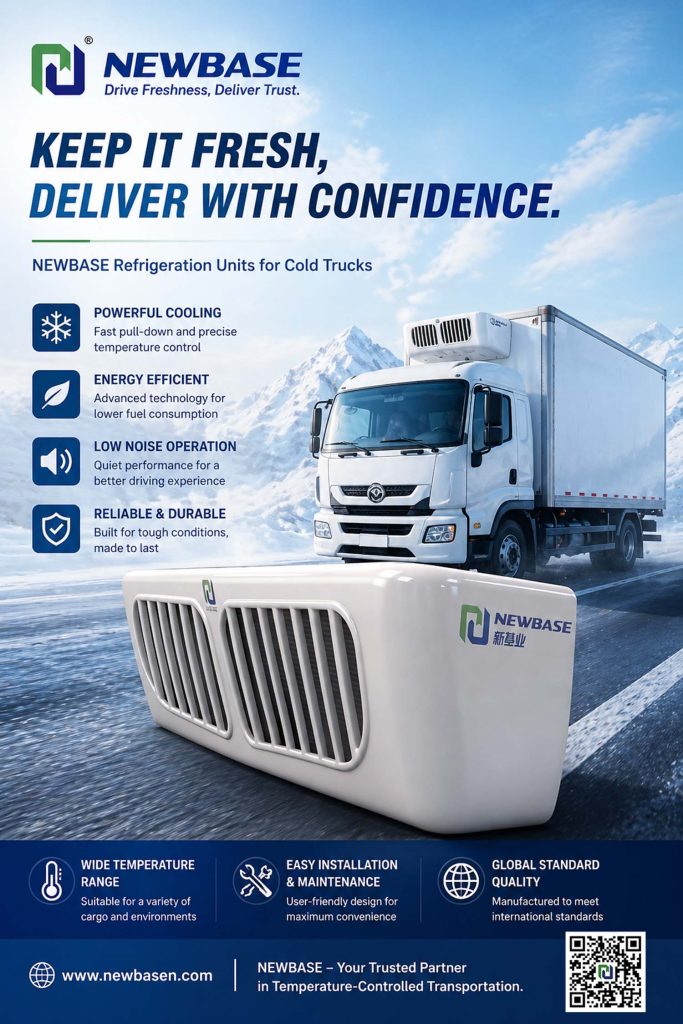
By NEWBASE Financial Analysis Team | Published April 30, 2026 | 10 min read
The commercial vehicle industry is undergoing the most significant transformation in its history. As fleets evaluate their refrigeration options, the debate between diesel transport refrigeration units (TRUs) and pure electric refrigeration systems like the NEWBASE NBESR-1000A has become central to fleet investment decisions. This comprehensive analysis examines both options across all relevant dimensions — from acquisition costs to environmental impact — to help fleet operators make informed decisions about their refrigeration future.
Understanding the Options
Diesel Transport Refrigeration Units (TRUs)
Diesel TRUs have been the standard for transport refrigeration for decades:
- Engine-driven compressor: Small diesel engine specifically for refrigeration
- Belt-driven alternative: Powered by vehicle engine via belt/PTO
- Auxiliary power units: Standalone diesel generators for stationary operation
NEWBASE NBESR-1000A Pure Electric
The NBESR-1000A represents the modern approach:
- Integrated electric compressor: Variable speed, electronically controlled
- Direct 48V DC power: Draws from vehicle electrical system
- AC380V standby: Grid power for stationary operation
- Built-in intelligence: IoT connectivity, advanced diagnostics
Total Cost of Ownership: 5-Year Analysis
Analysis Parameters
Base Assumptions:
- Annual operating hours: 2,000 hours (typical urban delivery)
- Fuel price: $1.50/liter diesel, $0.12/kWh electricity
- Equipment lifecycle: 5 years
- Residual value: 15% of initial cost
- Operating area: Urban delivery, 70% of miles in urban zones
5-Year TCO Comparison
| Cost Category | Diesel TRU | NBESR-1000A Listrik | Difference |
| Instalasi | $2,500 | $1,500 | +$1,000 |
| Initial Investment | $11,000 | $16,000 | -$5,000 |
| Fuel/Energy (5yr) | $65,000 | $14,000 | +$51,000 |
| Maintenance (5yr) | $18,000 | $6,500 | +$11,500 |
| Kepatuhan terhadap Peraturan | $12,000 | $0 | +$12,000 |
| Uptime Impact | $8,000 | $3,000 | +$5,000 |
| Residual Value | -$1,275 | -$2,175 | +$900 |
| 5-Year TCO | $112,725 | $37,325 | +$75,400 |
Conclusion: NBESR-1000A delivers $75,400 lower total cost over 5 years — a 67% savings.
Detailed Cost Analysis
1. Energy Costs: The Largest Variable
Energy represents the most significant ongoing expense: Diesel TRU Energy Profile:
| Operating Mode | Consumption | Cost per Hour |
| Urban driving | 3.5-4.5 L/hr | $5.25-6.75 |
| Stationary (standby) | 2.0-3.0 L/hr | $3.00-4.50 |
| Stationary (working) | 3.0-4.5 L/hr | $4.50-6.75 |
NBESR-1000A Energy Profile:
| Operating Mode | Consumption | Cost per Hour |
| Partial load (0°C) | 1.5-2.0 kWh | $0.18-0.24 |
| Temperature maintenance | 0.8-1.2 kWh | $0.10-0.14 |
| Standby (monitoring) | 0.1-0.15 kWh | $0.01-0.02 |
| AC380V standby | Grid power | Off-peak rates |
Annual Energy Cost Comparison:
| Scenario | Diesel Annual | NBESR-1000A Annual | Savings |
| Urban-dominant | $12,500 | $2,400 | $10,100 |
| Heavy standby | $10,000 | $1,800 | $8,200 |
| Average | $11,000 | $2,200 | $8,800 |
5-Year Energy Savings: $44,000
2. Maintenance Costs: Electric’s Structural Advantage
Electric systems have fundamentally simpler maintenance requirements: Diesel TRU Maintenance Needs:
| Service | Frequency | Cost per Event | 5-Year Total |
| Belt replacement | 1,000 hrs | $350 | $700 |
| Fuel system service | Annual | $500 | $2,500 |
| Engine overhaul | 15,000 hrs | $4,000 | (beyond 5yr) |
| Electrical system | Annual | $300 | $1,500 |
| Refrigerant service | Annual | $350 | $1,750 |
| Total 5-Year | $9,250 |
NBESR-1000A Maintenance Needs:
| Service | Frequency | Cost per Event | 5-Year Total |
| Coil cleaning | Annual | $150 | $750 |
| Electrical inspection | Annual | $150 | $750 |
| Refrigerant check | Annual | $150 | $750 |
| Controller calibration | Annual | $100 | $500 |
| Total 5-Year | $2,910 |
5-Year Maintenance Savings: $6,340
3. Regulatory Compliance: Hidden Diesel Costs
Regulatory costs are often overlooked but significant: Diesel TRU Compliance Costs:
| Kategori | Annual Cost | 5-Year Total |
| CARB compliance (California) | $800 | $4,000 |
| Emissions testing | $300 | $1,500 |
| Retrofit requirements | $3,500 | $3,500 (one-time) |
| Total 5-Year | $16,500 |
NBESR-1000A Compliance:
- Zero urban access fees — qualifies as zero-emission
- CARB compliant by design
- No emissions testing required
- No retrofit requirements
- 5-Year Total: $0
5-Year Compliance Savings: $16,500
4. Downtime and Reliability Impact
Downtime has hidden costs beyond immediate lost revenue: Diesel TRU Downtime:
- Average uptime: 92-95%
- Expected downtime: 250-400 hours over 5 years
- Roadside breakdowns: 2-4 events per year
- Recovery time per breakdown: 3-6 hours
NBESR-1000A Downtime:
- Average uptime: 97-99%
- Expected downtime: 100-150 hours over 5 years
- Roadside breakdowns: 0-1 events per year
- Recovery time per breakdown: 1-2 hours
Downtime Cost Comparison:
| Cost Element | Diesel | NBESR-1000A |
| Emergency service | $4,000 | $1,000 |
| Cargo spoilage risk | $3,000 | $1,000 |
| Driver time | $2,000 | $800 |
| Total 5-Year | $17,000 | $5,800 |
5-Year Downtime Savings: $11,200
Non-Financial Considerations
Environmental Impact
Carbon Emissions Comparison:
| Metrik | Diesel TRU | NBESR-1000A | Reduction |
| NOₓ per hour | 80g | 0g | 100% |
| PM per hour | 3g | 0g | 100% |
| Annual CO₂ (2,000 hrs) | 21 metric tons | 0 metric tons | 100% |
Note: NBESR-1000A indirect emissions depend on electricity source grid mix.
Operational Advantages
| Factor | Diesel TRU | NBESR-1000A | Advantage |
| Noise level | 75-85 dB | 55-65 dB | Electric |
| Akurasi suhu | ±2-3°C | ±0.5°C | Electric |
| Standby operation | High fuel cost | Low/zero cost | Electric |
| Cold weather startup | Problematic | Protected | Electric |
Strategic Positioning
Corporate Sustainability:
- ESG reporting benefits from Scope 3 reductions
- Alignment with customer sustainability requirements
- First-mover advantage in EV transition
- Attraction of sustainability-conscious drivers
Future-Proofing:
- No exposure to future emissions restrictions
- Prepared for tightening regulations
- Locked-in compliance for vehicle lifetime
Scenario Analysis
Scenario 1: High-Utilization Urban Fleet (3,000 hours/year)
| Kategori | Diesel | NBESR-1000A | Advantage |
| 5-Year Operating Cost | $98,000 | $25,000 | +$73,000 |
| 5-Year TCO | $109,000 | $41,000 | +$68,000 |
Recommendation: Strong NBESR-1000A advantage — fastest payback
Scenario 2: Low-Utilization Regional Fleet (1,000 hours/year)
| Kategori | Diesel | NBESR-1000A | Advantage |
| 5-Year Operating Cost | $32,000 | $9,000 | +$23,000 |
| 5-Year TCO | $43,000 | $25,000 | +$18,000 |
Recommendation: NBESR-1000A still favorable — extended payback but still positive
Scenario 3: Mixed Urban/Highway Operations (2,500 hours/year)
| Kategori | Diesel | NBESR-1000A | Advantage |
| 5-Year Operating Cost | $82,000 | $22,000 | +$60,000 |
| 5-Year TCO | $93,000 | $38,000 | +$55,000 |
Recommendation: Clear NBESR-1000A advantage for any realistic utilization
Payback Period Analysis
Simple Payback Calculation
Additional Investment: $16,000 – $11,000 = $5,000 Annual Savings: $8,800 (energy) + $1,268 (maintenance) + $3,300 (compliance) + $2,240 (downtime) = $15,608 Simple Payback: $5,000 / $15,608 = 3.8 months
Return on Investment
Total Investment: $16,000 5-Year Net Savings: $75,400 ROI: 471% Annual ROI: 94%
Net Present Value (5-year, 5% discount rate)
| Metrik | Diesel | NBESR-1000A |
| NPV Advantage | +$65,000 |
Why Electric is the Inevitable Future
Regulatory Trajectory
| Year | Expected Regulatory Change |
| 2028-2030 | CARB potentially requiring zero-emission for additional facilities |
| 2030-2035 | Major urban areas likely diesel-free for last-mile |
Technology Trajectory
- Battery costs continuing to decline
- Vehicle range improvements accelerating
- Charging infrastructure expanding rapidly
- Electric component reliability improving
Market Signals
- Major retailers requiring sustainable logistics
- Consumer preference for green delivery options
- Driver preference for modern equipment
- Competitor adoption creating competitive pressure
Conclusion: The Economics Are Clear
The data is unambiguous: The NBESR-1000A delivers:
- $75,400 lower total cost of ownership over 5 years
- Payback in under 4 months
- 471% return on investment
- Zero direct emissions
- Superior temperature control
- Mengurangi polusi suara
- No exposure to future regulations
Diesel TRUs face:
- Ongoing fuel costs that electric systems eliminate
- Increasing regulatory burdens as zones expand
- Aging technology vs. advancing electric systems
- Stranded asset risk as regulations tighten
For fleet operators seeking to optimize their economics while preparing for an increasingly regulated and sustainability-focused future, the NBESR-1000A represents not just the better choice — but the inevitable choice. The question is no longer whether to transition to electric refrigeration, but how quickly to do so. The NBESR-1000A makes that transition economically compelling from day one.
About NEWBASE: NEWBASE provides comprehensive financial analysis support for fleet operators evaluating electric refrigeration, including custom TCO calculations and pilot program options. References:
1. NACFE — Electric Truck Total Cost of Ownership Research 2026
2. Thermo King — Electric Refrigeration Economic Analysis
3. EU Commission — Urban Mobility Zone Regulations
4. California ARB — TRU ATCM Compliance Guide
5. IEA — Global EV Outlook 2026
 Bahasa Indonesia
  English
  Español
  Português
  العربية
  Русский
  Français
  日本語
日本語  Română
  Deutsch
  Italiano