
Abstract
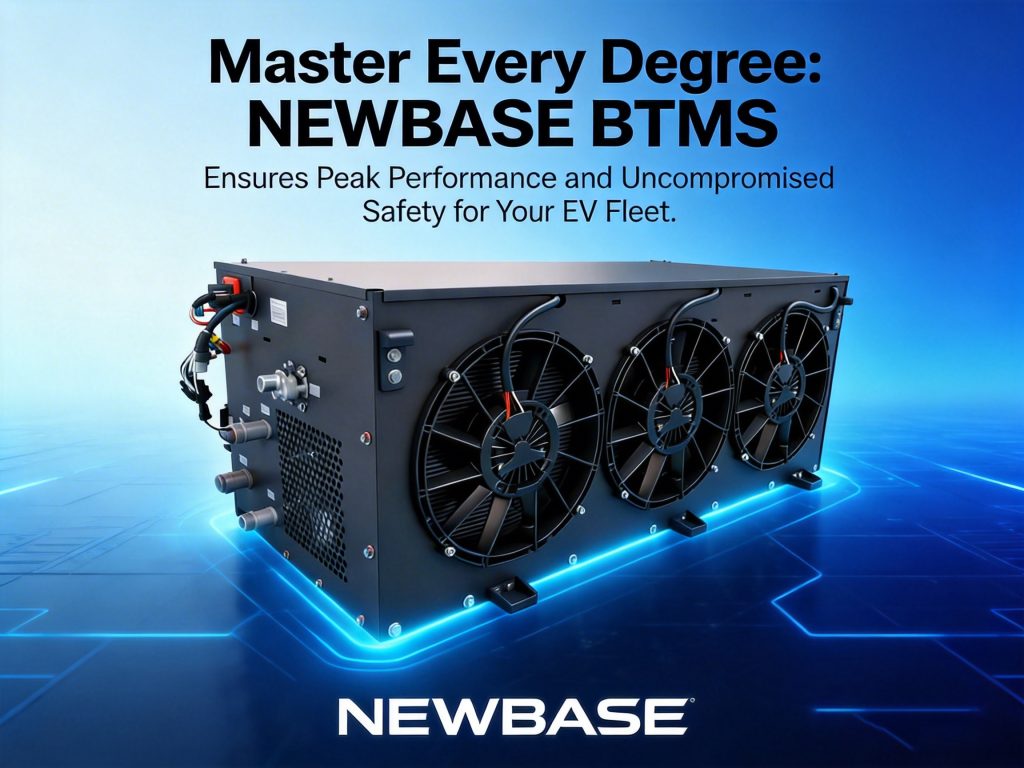
As the global electric vehicle (EV) market accelerates toward mass adoption, battery thermal management has emerged as a critical engineering discipline that directly determines vehicle safety, charging performance, battery lifespan, and real-world driving range. This article presents NEWBASE (Xinjiye) Electric Vehicle Co., Ltd.’s comprehensive line of liquid cooling chiller units—engineered specifically for battery thermal management systems (BTMS) in electric commercial vehicles, passenger EVs, hybrid electric vehicles, and industrial machinery. With power configurations ranging from 3 kW to 5 kW refrigeration capacity, optional PTC liquid heaters (6–14 kW), CAN 2.0 communication, self-diagnostic capabilities, real-time power telemetry, and EMC Class III compliance, the NEWBASE BTMS portfolio delivers precise, reliable, and scalable thermal control across diverse vehicle platforms and operating environments. This article examines the technical architecture, product specifications, industry certifications, and application scenarios of the NEWBASE water-cooled chiller units, contextualizing these solutions within the rapidly evolving EV thermal management landscape.
1. Introduction: The Critical Role of Battery Thermal Management in Electric Vehicles
Lithium-ion batteries—the dominant power source for electric vehicles today—operate optimally within a narrow temperature window, typically between 20°C and 40°C. Outside this range, performance degrades substantially: low temperatures reduce available power and increase internal resistance, while elevated temperatures accelerate chemical degradation, shorten cycle life, and—in extreme cases—precipitate thermal runaway, a self-sustaining exothermic reaction that can lead to battery fires. As battery energy densities increase and fast-charging technologies push charge rates above 2C (30-minute full charges), the heat flux generated within the battery pack rises correspondingly, making effective thermal management not merely a performance optimization but a fundamental safety requirement.
Modern battery thermal management systems have evolved beyond simple passive cooling into intelligent, software-defined active systems that integrate liquid cooling loops, refrigerant circuits, PTC heaters, electric pumps, electronically controlled valves, and sophisticated control algorithms. Among the various cooling methodologies—air cooling, passive phase-change materials, direct refrigerant cooling, and liquid cooling—liquid-based systems have emerged as the industry standard for high-performance EV applications due to their superior heat transfer coefficients, uniform temperature distribution, and ability to both cool and heat the battery pack as needed.
The global BTMS market reflects this technological imperative. Valued at approximately USD 4.42 billion in 2025, the market is projected to grow at a compound annual growth rate (CAGR) of 14.4%, reaching USD 14.83 billion by 2034. Other estimates suggest even more aggressive growth, with the global automotive BTMS market projected to expand from USD 1.56 billion in 2025 at a CAGR of 24.78% through 2032. This rapid expansion is driven by stringent safety regulations mandating thermal propagation control (e.g., UNECE R100 requiring a minimum five-minute evacuation delay, GB 38031-2020 requiring zero thermal propagation within the battery pack), consumer demand for fast-charging capabilities, and the need to maintain battery durability across extreme climatic conditions.
Within this dynamic market context, NEWBASE offers a family of liquid cooling chiller units designed to meet the diverse thermal management requirements of electric commercial vehicles, battery electric buses, hybrid trucks, construction machinery, and industrial EVs.
2. Technical Architecture of the NEWBASE Liquid Cooling Chiller Units
2.1 System Configuration and Operating Modes
The NEWBASE BTMS product family is built around a modular liquid cooling architecture that circulates a coolant mixture—typically a 50/50 solution of water and ethylene glycol—through cold plates integrated within the battery pack, extracting heat from the cells and rejecting it through a refrigeration loop via a plate-and-frame or brazed plate chiller. Each unit supports four distinct operating modes, enabling year-round thermal management regardless of ambient conditions.
Standby Mode. In standby, the system remains idle, awaiting command signals from the vehicle’s battery management system (BMS) or thermal domain controller. Power consumption is minimized while all sensors and communication interfaces remain active to detect thermal events.
Cooling Mode. When battery temperatures exceed the optimal setpoint, the refrigeration circuit activates. The electric compressor draws in low-pressure refrigerant vapor, compresses it to high-temperature, high-pressure gas, and discharges it to the condenser, where heat is rejected to the ambient air. The condensed liquid refrigerant then passes through an expansion valve, evaporates within the chiller, and absorbs heat from the coolant loop, thereby reducing battery temperature. The coolant is circulated by an electric pump, with flow rate modulated by the control logic based on real-time temperature feedback.
Heating Mode. In cold climates or prior to fast-charging events, the optional PTC liquid heater activates. PTC (positive temperature coefficient) heating elements offer inherent safety advantages over traditional resistance heaters: as the element temperature rises above a threshold, its electrical resistance increases dramatically, creating a self-limiting effect that prevents overheating even under boil-dry conditions. With power ratings configurable from 6 kW to 14 kW, the PTC heater ensures rapid battery preheating to bring cells into their optimal operating range before high-current draw scenarios.
Self-Circulation Mode. When battery temperatures are already within the acceptable range, the system may operate in self-circulation mode, running the coolant pump without activating either the compressor or the PTC heater. This mode equalizes temperature across individual cells within the pack, eliminates temperature gradients that could cause uneven aging, and maintains thermal readiness for immediate cooling or heating as demand changes.
2.2 Core Hardware Components
The NEWBASE chiller unit integrates several critical subsystems:
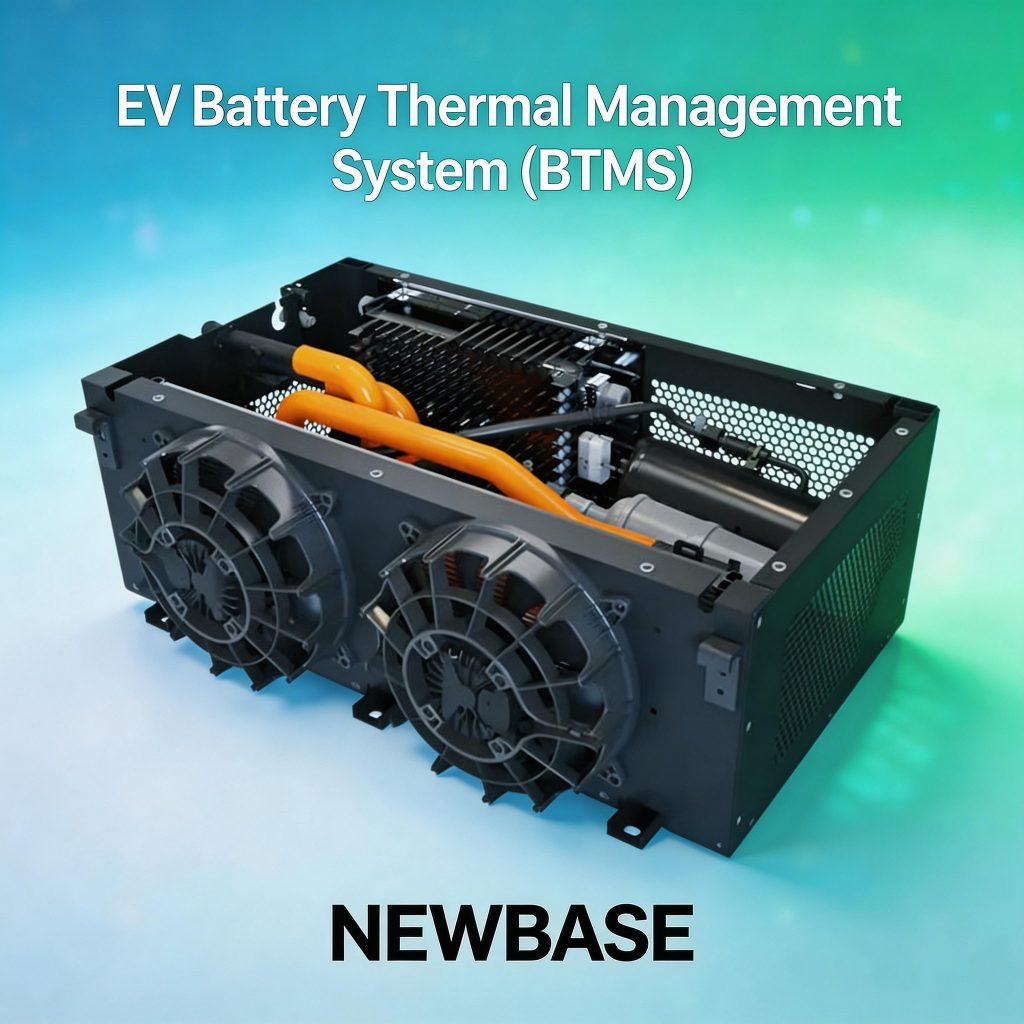
- Refrigeration Circuit. A hermetically sealed refrigerant loop using low-GWP refrigerants (compatible with R134a or R1234yf) comprises a variable-speed electric compressor, fin-and-tube or parallel-flow condenser with integrated fan, thermostatic or electronic expansion valve, and brazed plate chiller. The compressor speed is continuously variable, allowing the cooling capacity to be precisely matched to the instantaneous thermal load, thereby optimizing energy efficiency.
- Coolant Loop. The hydronic circuit includes an electric coolant pump, PTC heater module (optional), expansion tank for thermal volume compensation, and corrosion-resistant piping. All wetted components are validated for long-term compatibility with ethylene-glycol-based coolants.
- Control Electronics. A dedicated microcontroller unit (MCU) executes PID-based thermal control algorithms, monitors sensor inputs (coolant temperature, refrigerant pressure, ambient temperature, battery SoC/SoH), and communicates with the vehicle CAN network. The controller continuously evaluates pack thermal gradients and adjusts pump speed, compressor speed, and PTC heater duty cycle to maintain uniform cell temperatures.
2.3 Intelligent Control and Fault Self-Diagnosis
Modern BTMS performance depends as much on software intelligence as on hardware capability. The NEWBASE chiller units incorporate advanced control features:
- CAN 2.0 Communication. All units employ CAN 2.0B protocol (250 kbps or 500 kbps selectable) for bidirectional communication with the vehicle’s BMS, VCU (vehicle control unit), and thermal domain controller. Real-time data exchange includes temperature readings, pump and compressor status, fault codes, and power consumption metrics.
- Fault Self-Diagnosis. The onboard diagnostic system continuously monitors system health, detecting abnormal conditions such as compressor overcurrent, refrigerant leak (via pressure decay monitoring), coolant flow obstruction, PTC heater overtemperature, and communication loss. Detected faults are encoded as standardized diagnostic trouble codes (DTCs) and transmitted over CAN for logging and operator alerting.
- Power Telemetry. Real-time power consumption data—including compressor electrical load, pump draw, and PTC heater usage—is continuously uploaded, enabling fleet operators to monitor energy usage patterns and optimize thermal management strategies for range preservation.
3. Product Series Specifications
NEWBASE offers four primary model configurations within the water-cooled chiller family, each optimized for specific vehicle classes and thermal load requirements.
3.1 Model NB-BTMS-3: Compact Cooling for Light Commercial EVs
The entry-level configuration delivers 3 kW refrigeration capacity and is designed for small commercial vehicles, electric vans, and light-duty logistics EVs. Key specifications include:
- Cooling capacity: 3 kW
- Optional PTC heater: 6–14 kW (configurable)
- Operating modes: Standby, cooling, heating, self-circulation
- Communication: CAN 2.0
- Self-diagnosis: Full-system fault detection
- Telemetry: Real-time power data upload
- EMC compliance: Class III
- Unit weight: 35 kg ± 1 kg
This lightweight configuration—ideal for applications where weight and packaging space are critical—provides sufficient thermal capacity for battery packs in the 30–60 kWh range under typical driving conditions.
3.2 Model NB-BTMS-5: Mid-Range Cooling for Standard Commercial Vehicles
For heavier duty cycles and larger battery capacities, the 5 kW configuration offers increased thermal headroom. This unit shares the same feature set as the NB-BTMS-3 but with enhanced refrigeration capacity:
- Cooling capacity: 5 kW
- Optional PTC heater: 6–14 kW (configurable)
- Operating modes: Standby, cooling, heating, self-circulation
- Communication: CAN 2.0
- Self-diagnosis: Full-system fault detection
- Telemetry: Real-time power data upload
- EMC compliance: Class III
- Unit weight: 40 kg ± 1 kg
The NB-BTMS-5 is suitable for battery packs in the 60–120 kWh range, including those found in medium-duty electric trucks, electric buses, and heavy-duty logistics vehicles.
3.3 Model NB-BTMS-50: Advanced Thermal Management with Network Control
The NB-BTMS-50 represents a significant advancement in system architecture, incorporating network control capabilities for multi-unit coordination in large battery installations. Key features include:
- PTC heater: Configurable (6–14 kW range)
- Operating modes: Standby, cooling, heating, self-circulation
- Network control: Support for multi-unit coordination and group management
- Communication: CAN 2.0
- Self-diagnosis: Full-system fault detection
- Telemetry: Real-time power data upload
- EMC compliance: Class III
- Unit weight: 50 kg ± 2 kg
The network control feature allows multiple NB-BTMS-50 units to be deployed in parallel for large-capacity battery packs exceeding 200 kWh, such as those used in heavy-duty electric trucks, electric construction machinery (excavators, loaders, bulldozers), and grid-scale battery buffers for vehicle-to-grid (V2G) applications.
3.4 Model NB-BTMS-68: High-Capacity Continuous Operation
Engineered for applications requiring sustained cooling under heavy thermal loads—such as high-power fast-charging events or operation in extreme ambient temperatures—the NB-BTMS-68 offers enhanced durability and robust performance:
- PTC heater: Configurable (6–14 kW range)
- Operating modes: Standby, cooling, heating, self-circulation
- Network control: Support for multi-unit coordination
- Communication: CAN 2.0
- Self-diagnosis: Full-system fault detection
- Telemetry: Real-time power data upload
- EMC compliance: Class III
- Unit weight: 68 kg ± 2 kg
This configuration employs larger heat exchangers, a more robust compressor, and increased coolant flow capacity, making it ideal for electric buses operating in high-ambient-temperature regions, heavy-duty mining vehicles, and electric truck fleets requiring frequent DC fast-charging stops.
3.5 Model NB-BTMS-110: Heavy-Duty Industrial EV Solution
The flagship heavy-duty configuration is designed for the most demanding applications, including large electric mining trucks, port equipment, heavy construction vehicles, and stationary battery storage systems. While this model omits network control functionality in the standard configuration, its massive thermal capacity and robust construction ensure reliable operation under continuous maximum load conditions:
- PTC heater: Configurable (6–14 kW range)
- Operating modes: Standby, cooling, heating, self-circulation
- Communication: CAN 2.0
- Self-diagnosis: Full-system fault detection
- Telemetry: Real-time power data upload
- EMC compliance: Class III
- Unit weight: 110 kg ± 4 kg
4. EMC Compliance and Certification Framework
Electromagnetic compatibility (EMC) is a critical requirement for EV components due to the dense concentration of power electronics—inverters, onboard chargers, DC-DC converters, traction motors, and communication systems—operating simultaneously within the vehicle. Electromagnetic interference (EMI) emissions can degrade ADAS sensor performance, disrupt gateway communications, and interfere with vehicle control functions. Conversely, inadequate immunity leaves components vulnerable to conducted and radiated disturbances from neighboring systems.
The NEWBASE chiller units are certified to EMC Class III—the highest classification for automotive electronic components, indicating compliance with the most stringent emission limits and the strongest immunity requirements. This certification validates that the units:
- Emit minimal conducted noise (150 kHz to 30 MHz) and radiated emissions (30 MHz to 1 GHz), ensuring compatibility with adjacent ADAS radar, LiDAR, camera systems, and RF-based telematics modules
- Demonstrate robust immunity to electrostatic discharge (ESD), transient voltage spikes from traction system switching, and radiated RF fields up to 200 V/m
- Maintain functional safety under simultaneous exposure to multiple EMI sources, such as during fast-charging while running the cabin HVAC system
Industry benchmarks for BTMS EMC compliance include CISPR 25 Class 5 (conducted and radiated emissions in automotive environments) and ISO 11452-2/4/8 (immunity testing for radiated and conducted disturbances), with some high-end systems also validated per ISO 16750-4 for environmental robustness.
5. PTC Liquid Heating Technology: Engineering for Cold-Climate Performance
Low-temperature operation presents particular challenges for lithium-ion batteries. At temperatures below 0°C, charge acceptance drops precipitously, fast-charging becomes unsafe due to lithium plating, and usable capacity falls as internal resistance rises. To address these challenges, NEWBASE units can be equipped with high-voltage PTC liquid heaters in the 6–14 kW range, enabling rapid battery preconditioning prior to driving or charging.
5.1 Operating Principle
PTC heaters utilize a ceramic heating element whose resistance increases exponentially at temperatures above a material-specific Curie point. This self-limiting behavior provides inherent thermal safety: even under loss-of-coolant or stagnant-flow conditions, the element cannot exceed its design temperature, eliminating the risk of combustion or heater failure that plagues conventional fixed-resistance heating elements. Heat is transferred from the PTC elements to the circulating coolant via an aluminum or brazed-plate heat exchanger.
5.2 Key Performance Advantages
- Self-regulating thermal output: PTC resistance increases as temperature rises, automatically reducing power draw when the coolant approaches the target temperature
- Rapid warm-up time: High power density (typically 5–10 W/cm² per element) enables fast heat delivery to the coolant circuit
- Wide voltage compatibility: PTC heaters are intrinsically tolerant of voltage fluctuations, drawing less current as element temperature increases, making them well-suited to the 400–800 VDC electrical architectures common in modern EVs
- Fail-safe operation: In the event of coolant loop failure, the PTC elements simply self-limit, preventing dangerous overheat conditions
6. Application Scenarios and Target Markets
The NEWBASE liquid cooling chiller family addresses a diverse range of electrified vehicle applications:
- Battery Electric Buses (BEBs). Transit buses operating in urban environments face frequent acceleration/deceleration cycles, stop-and-go traffic, and prolonged stationary periods while dwelling at terminals. The NB-BTMS-68 and NB-BTMS-110 configurations provide the continuous cooling capacity required for 200–400 kWh bus battery packs, with network control enabling fleet-wide thermal monitoring.
- Electric Commercial Trucks. Medium- and heavy-duty trucks—including distribution vehicles, refuse haulers, and long-haul semis—demand robust thermal management for battery packs that may be discharged and recharged multiple times daily. The NB-BTMS-5, NB-BTMS-50, and NB-BTMS-68 offer scalable solutions matched to vehicle weight class and duty cycle.
- Construction Machinery. Electric excavators, wheel loaders, bulldozers, and other off-highway equipment operate in dusty, vibration-intensive environments with high ambient temperatures and intermittent high-load cycles. The robust construction and EMC Class III certification of the NEWBASE units ensure reliable operation under these demanding conditions.
- Industrial EVs. Warehousing logistics vehicles (pallet jacks, order pickers), airport ground support equipment (tugs, belt loaders, baggage tractors), and mining transport vehicles benefit from the lightweight NB-BTMS-3 and NB-BTMS-5 configurations, which combine adequate cooling capacity with compact packaging.
- Hybrid Commercial Vehicles. Range-extended electric trucks and plug-in hybrid heavy vehicles require thermal management systems capable of handling both battery heat generation and waste heat recovery from internal combustion auxiliary power units. The NEWBASE platform’s flexible control architecture adapts to these dual-source thermal loads.
7. Industry Standards and Future Outlook
7.1 Current Regulatory Landscape
BTMS components must comply with a growing matrix of international standards:
- UNECE R100 (Europe, UNECE signatories): Requires that thermal propagation from a single-cell thermal runaway event be delayed by more than five minutes to ensure safe occupant evacuation
- GB 38031-2020 (China): Mandates zero thermal propagation within the battery pack, requiring advanced thermal management such as microfluidic cooling or immersion cooling to fully suppress runaway propagation
- ISO 6469-3:2021 (International): Specifies dielectric strength and isolation requirements for coolant and BTMS components, ensuring electrical safety in liquid-cooled systems
The NEWBASE chiller units are designed with these regulatory requirements in mind, incorporating redundant cooling circuits, fault-tolerant control logic, and electrical isolation features that facilitate vehicle-level certification.
7.2 Emerging Technology Trends
Several technology trends are shaping the next generation of BTMS products:
- Software-defined thermal management. As described by Promwad’s 2026 analysis, battery temperature now directly affects fast-charging speed, safety, and real-world range consistency; thermal management has evolved from a purely hardware problem into a combined software-and-hardware discipline. NEWBASE’s CAN 2.0 implementation and programmable operating modes align with this paradigm shift.
- Intelligent control with AI/ML. Recent academic reviews highlight the application of artificial intelligence and machine learning to predict thermal loads, optimize cooling/heating schedules, and detect incipient faults before they lead to system failures.
- Advanced cooling topologies. Innovations such as microchannel cold plates, topological flow optimization, and dual-direction liquid heating are being integrated into next-generation BTMS designs to improve temperature uniformity and reduce parasitic energy consumption.
- Fast-charge pre-conditioning. As EV platforms adopt 800 V and higher voltages, the ability to pre-condition battery packs to their optimal temperature window prior to charging events becomes critical. The NEWBASE PTC heater option directly addresses this requirement.
8. Conclusion
The NEWBASE series of electric vehicle liquid cooling chiller units represents a comprehensive solution for battery thermal management across the electrified transportation sector. With refrigeration capacities spanning 3 kW to 5 kW base configurations, optional PTC liquid heaters delivering 6–14 kW of heat output, full CAN 2.0 connectivity, onboard fault self-diagnosis, real-time power telemetry, and EMC Class III compliance, these units provide the precise, reliable, and intelligent temperature control that next-generation EVs demand.
As the global EV market continues its rapid expansion—with projections indicating 30–40% annual growth rates for BTMS products through 2030—the importance of robust, scalable, and certifiable thermal management solutions cannot be overstated. NEWBASE remains committed to engineering excellence in this critical domain, delivering products that enhance battery safety, extend service life, and ensure consistent vehicle performance across all operating conditions—from arctic cold to desert heat, from urban stop-and-go to highway high-speed driving, from routine charging to high-power DC fast-charging events.
For OEMs, battery pack integrators, and fleet operators seeking proven thermal management solutions for electric commercial vehicles, the NEWBASE liquid cooling chiller family offers a performance-validated, regulation-compliant, and application-optimized choice.
About NEWBASE (Xinjiye) Electric Vehicle Co., Ltd.
NEWBASE is a specialist manufacturer of electric vehicle thermal management systems, serving the global commercial EV market with innovative cooling and heating solutions. The company’s product portfolio includes liquid cooling chiller units, PTC liquid heaters, and integrated battery thermal management modules for electric buses, trucks, construction machinery, and industrial EVs.
For technical specifications, application engineering support, or to discuss custom configurations, please contact the NEWBASE thermal management team.
参考文献
- Research and Markets, “Battery Thermal Management System Market Outlook 2026-2034,” November 2025
- LookWhole Insight, “Global Automotive Battery Thermal Management System Market Research Report 2026-2035,” April 2026
- Boretti, A., “Advanced Battery Thermal Management: A Review of Materials, Cooling Systems, and Intelligent Control,” Energy Storage, 2025
- ScienceDirect, “Research progress on the optimization of thermal management systems for lithium-ion batteries in new energy vehicles,” 2025
- Academic.oup.com, Table 2: Regional Battery Safety Standards and BTMS Implications
- Promwad, “Why Battery Thermal Management in EVs Is Now a Software-and-Hardware Problem,” 2026
- SAE International, “Applicability of EMC Validation for EV Powertrain Components,” Technical Paper 2026-26-0197
- Danfoss/Ecascadia, “Electric Vehicle Cooling Components,” Technical Documentation, 2024
- Hebei Nanfeng, “NF BTMS Refrigeration 7kW Heating 8kW 600V Thermal Management System,” Product Technical Specification
 日本語
日本語  English
  Español
  Português
  العربية
  Русский
  Français
  Bahasa Indonesia
  Română
  Deutsch
  Italiano