
By NEWBASE品質保証チーム|2026年4月30日公開|9分で読める
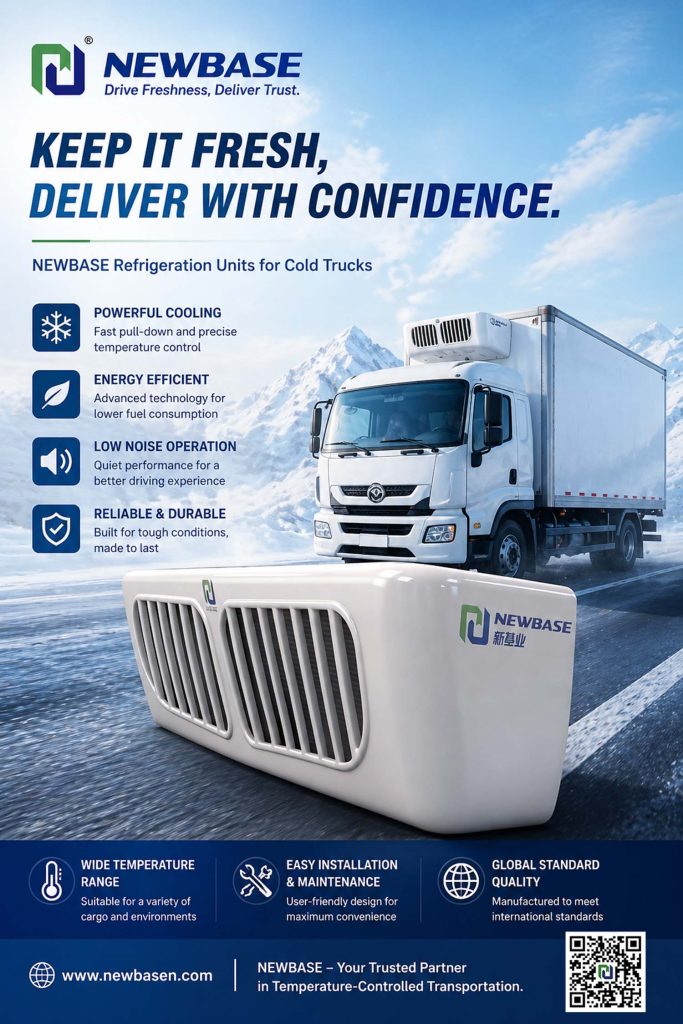
商用車の冷凍機は、想像を絶する過酷な環境で作動します。NBESR-1000Aは、路面からの絶え間ない振動、雨や路面からのしぶき、極端な温度条件、車両の電気システムからの電磁干渉に耐えなければなりません。このような妥協のない環境では、一般的な民生用電子機器や産業用電子機器の要件を上回る厳しい試験基準が要求されます。NBESR-1000Aは、振動、レインシャワー、絶縁、電磁適合性を含む包括的な型式試験を受け、車両の耐用年数を通じて信頼性の高い性能を保証します。
商用車テストが重要な理由
自動車運転の厳しい現実
定置式冷凍システムとは異なり、NBESR-1000Aは倉庫や家庭にはない課題に直面しています:機械的な課題
- 路面振動:荒れた路面からの絶え間ない機械的ストレス
- 衝撃荷重:甌穴、スピードバンプ、ラフブレーキングは、突然の力を発生させる。
- 取り付けストレス:部品間の熱膨張差
- 摩耗の促進:車両寿命期間中の連続運転
環境問題への挑戦:
- 天候にさらされる:雨、雪、氷、路面塩
- 極端な温度: -40°C ~ +70°Cの周囲温度範囲
- 湿度サイクル:温度変化による結露
- ホコリとゴミ:路面の汚れの浸入
電気的な課題:
- 自動車の電気ノイズ:オルタネーター、インジェクター、モーターが干渉を起こす
- 電圧過渡現象:ロードダンプとサージイベント
- アースの電位差:車内の複数の接地点
- ESD事象:取り扱いによる静電気放電
テスト哲学
NEWBASEのテストアプローチは、「生き残るための設計」の原則に従っています:
- 加速寿命試験:長年の現場環境を数週間に圧縮
- 最悪のシナリオ:典型的な条件ではなく、限界でのテスト
- 故障モード解析:意図的な失敗は設計の改善に役立つ
- マージンの検証:仕様以上のテストにより安全マージンを確保
1.振動試験
振動の挑戦
振動はおそらく、車載機器にとって最も広範な脅威である:
- 疲労破壊:繰り返し応力がき裂を進展させる
- 接続の緩み:振動によりファスナーやコネクターが緩むことがある
- 部品の損傷:敏感な部品は共振によって損傷する可能性がある
- 性能低下:振動が冷媒の封じ込めに影響
振動試験規格
NBESR-1000Aは、商用車用電子機器の標準であるSAE J1455準拠の振動試験を受けています:テストプロファイル(ランダム振動):
| 周波数範囲 | テストレベル | 期間 |
| 20-50 Hz | +6 dB/オクターブ | 各軸8時間 |
| 50-200 Hz | 0.15 g²/Hz | 各軸8時間 |
| 200-500 Hz | -6 dB/octave | 各軸8時間 |
| 500-2000 Hz | 0.02 g²/Hz | 各軸8時間 |
テスト軸:
- 垂直方向(Z軸):一次道路入力
- 縦方向(X軸):加速/ブレーキ
- 横方向(Y軸):コーナリングフォース
Key Test Procedures
Functional Vibration Test:
- Unit mounted as in production vehicle
- Operates throughout test at rated conditions
- Performance monitored continuously
- Temperature maintained within specification
Resonance Search:
- Low-level sine sweep identifies natural frequencies
- Dwell tests at resonant frequencies
- Identifies potential failure modes
- Informs mounting recommendations
Mechanical Integrity Test:
- Post-vibration inspection
- Torque verification on all fasteners
- Electrical continuity check
- Refrigerant leak detection
NBESR-1000A Design Features
Vibration-Ruggedized Construction:
- Lock-tight fasteners: Prevents loosening from vibration
- Rubber isolators: Absorbs vibration energy
- Reinforced mounting: Thick mounting flanges reduce stress
- Short circuit protection: Prevents vibration-induced shorts
2. Rain Shower Testing
Water Ingress: The Hidden Threat
Water is relentless:
- Road splash: High-pressure water hits undercarriage components
- Pressure washing: Cleaning crews spray vehicles directly
- Condensation: Temperature cycling causes internal moisture
- Leak paths: Small gaps become significant over time
Water ingress causes:
- Electrical failures: Short circuits and corrosion
- Insulation breakdown: Reduced dielectric strength
- Component failure: Corrosion destroys metal parts
- Safety hazards: Electrical shock risks
Rain Shower Test Standard
The NBESR-1000A passes SAE J575 shower test requirements: Test Conditions:
| パラメータ | 仕様 |
| Nozzle distance | 1.5-2.5 meters from unit |
| Test duration | 40 minutes minimum |
| Water temperature | 10-30°C ambient |
| Nozzle pattern | Full cone, 30° spread |
| Coverage | All accessible surfaces |
Test Sequence:
1. Pre-test inspection: Baseline visual and electrical verification
2. Horizontal spray: Unit horizontal, spray from all angles
3. Tilted spray: 15° tilt, repeat spray pattern
4. Overhead spray: Simulates overhead water sources
5. Post-test inspection: Full functional verification
6. Dielectric test: Verifies insulation integrity
NBESR-1000A Water Protection
IP Rating Designation: The NBESR-1000A is designed to meet IP54 minimum protection:
| Protection Feature | 仕様 |
| Liquid protection | Splash from any direction (4) |
| Condensate management | Drain provisions for internal moisture |
| Sealed connectors | Deutsch DT series with silicone seals |
| Gasket design | Continuous rubber gaskets on all joints |
Design Features:
- Sealed condenser housing: No openings for water entry
- Drainage paths: Water exits without accumulation
- Corrosion-resistant materials: Aluminum housing with e-coat
- Protected electronics: Controller in sealed enclosure
3. Insulation Testing
Electrical Safety: The Non-Negotiable
Insulation failure can result in:
- Equipment damage: Short circuits destroy components
- Safety hazards: Electric shock risks personnel
- Fire risks: Insulation breakdown can ignite
- Fleet liability: Regulatory non-compliance
Insulation Test Requirements
The NBESR-1000A undergoes dielectric withstand testing per IEC and SAE standards: Test Voltage Levels:
| Test Type | Voltage Applied | 期間 | Acceptance |
| Insulation Resistance | 500V DC megohmmeter | 60 seconds | >10 MΩ |
| Ground Bond | 30A, millivolt drop | 60 seconds | <3 mV per amp |
| Leakage Current | Working voltage applied | Continuous | <3.5 mA |
Test Points:
- Line-to-ground: All powered conductors to chassis
- Line-to-line: Between phase conductors
- Surge withstand: High-voltage pulse testing
- Transient voltage: Simulated load dump events
Hipot Testing Procedures
Production Hipot: Every unit undergoes hipot testing during production:
1. Fixture mounting: Unit properly grounded in test fixture
2. Voltage application: Gradual ramp to test voltage
3. Dwell period: 1 minute at full test voltage
4. Pass/fail detection: Immediate detection of breakdown
5. Record retention: Test results logged with unit serial number
Type Testing (Sample Basis):
- 100-hour extended hipot test
- Humidity-withstand test (85°C/85% RH)
- Temperature-cycling hipot test
NBESR-1000A Insulation Design
Double Insulation Architecture:
- Primary insulation: Basic insulation on live parts
- Reinforced insulation: Additional barriers for critical circuits
- Protective earth: Redundant ground paths
- Isolation transformers: Galvanic isolation where required
Materials:
- High-temperature wire: 105°C rated minimum
- Ceramic components: Where applicable for high-voltage
- Creepage distances: Exceeds minimum requirements
- Clearance distances: Adequate spacing prevents arcing
4. EMC Level III Testing
Electromagnetic Compatibility: Living with Electrical Noise
Modern vehicles are electrically noisy environments: Noise Sources:
- Alternator charging systems
- Electric motors (starters, wipers, fans)
- Ignition systems (for combustion vehicles)
- Switching power supplies
- Radio transceivers
- Electric drive systems
This noise can:
- Disrupt control systems: Causes malfunction or reset
- Introduce measurement errors: Sensor readings corrupted
- Trigger false faults: Spurious fault codes generated
- Reduce system lifespan: Long-term component degradation
EMC Level III Requirement
CISPR 25 / SAE J1113-41 Level III represents the highest commercial vehicle EMC standard: Emissions Limits (Level III):
| 周波数範囲 | Radiated Emissions | Conducted Emissions |
| 500 kHz – 30 MHz | 50 dBμV/m | 70 dBμV |
| 30 MHz – 200 MHz | 40-50 dBμV/m | — |
| 200 MHz – 1 GHz | 30-40 dBμV/m | — |
Immunity Requirements (Level III):
| Test | Severity | Performance Criteria |
| Conducted immunity | 10 V RMS | A (Normal performance) |
| ESD immunity | ±8 kV contact, ±15 kV air | A (Normal performance) |
| Transient immunity | Per ISO 7637-2 | B (Graceful degradation) |
EMC Test Procedures
Radiated Emissions (CISPR 25):
- Absorbing clamp method for harness emissions
- Antenna measurement in anechoic chamber
- ALSE (Anechoic Large Screen Enclosure) method
Conducted Emissions:
- Current probe method on power leads
- Voltage probe method at battery terminals
- Emissions measured over full frequency range
RF Immunity (ISO 11452):
- Bulk current injection (BCI) method
- Far-field radiation testing
- Antenna near-field injection
Transient Immunity (ISO 7637):
- Pulse 1: Supply voltage disconnection
- Pulse 2a: Inductive load switching
- Pulse 3a/b: Transients on data lines
- Pulse 4: Engine start simulation
- Pulse 5a: Load dump transient
NBESR-1000A EMC Engineering
EMI Suppression Design:
| Technique | Application |
| Filtering | Input/output filter networks |
| Decoupling | Capacitors on power pins |
| Grounding | Star ground topology |
| Layout | 4-layer PCB with ground planes |
Specific EMC Features:
- Filter modules: Integrated EMI filters on all connectors
- Transient protection: TVS diodes and suppressors
- PCB shielding: Internal copper pour areas
- Cable routing: Separation of noisy and sensitive circuits
5. Additional Testing Programs
Environmental Testing
Temperature Testing:
- Operating temperature: -40°C to +70°C ambient
- Storage temperature: -40°C to +85°C
- Thermal shock: -40°C to +70°C rapid cycling
- Temperature gradient: Tests response to changing conditions
Humidity Testing:
- Damp heat: 85°C/85% RH for 1000 hours
- Cyclic humidity: Temperature-humidity cycling
- Condensing humidity: Water condensation during temperature drop
Performance Testing
Endurance Testing:
- 1000-hour continuous operation: Full-load operation for 42 days
- Thermal cycling endurance: Repeated heat/cool cycles
- Load cycling: Varying thermal loads simulate real-world operation
Performance Validation:
- Cooling capacity: Verified per AHRI standards
- Energy efficiency ratio: COP verification
- Temperature uniformity: Cargo space mapping
6. Quality Documentation
Traceability System
Every NBESR-1000A is fully traceable: Traceability Records:
- Serial number: Unique identification for each unit
- Manufacturing date: Production date code
- Component lot codes: All major components tracked
- Test records: Complete test data retention
- Warranty registration: Customer and installation tracking
Certification Documentation
Standard Certifications:
- CE marking: European compliance
- UKCA marking: UK compliance
- E-mark: Vehicle type approval
- CCC: China compulsory certification
- UL listing: North American safety
Test Reports:
- Type test reports available for regulatory compliance
- Certificates from accredited test laboratories
- Performance data sheets
- Material declarations (RoHS, REACH)
Conclusion: Quality You Can Trust
The NBESR-1000A’s rigorous testing program ensures that every unit delivered will:
- Survive years of vibration: Lock-tight construction and isolated mounting
- Withstand water exposure: IP54 protection and sealed electronics
- Maintain electrical safety: Hipot and insulation testing exceed standards
- Operate reliably in electrical noise: EMC Level III certification
- Perform consistently: Performance validated under extreme conditions
For fleet operators, this testing translates to reliability, reduced downtime, and protected cargo — the foundation of a successful cold chain operation.
About NEWBASE: NEWBASE maintains an accredited testing laboratory and partners with certified test facilities worldwide to ensure NBESR-1000A meets or exceeds all relevant commercial vehicle standards. References:
1. SAE J1455 — Joint SAE/TMC Recommended Environmental Practices for Automotive Electronic Electrical Equipment
2. SAE J575 — Tests for Electrical Lighting Devices and Components on Vehicles
3. IEC 60068 — Environmental Testing
4. CISPR 25 — Vehicles, Boats and Internal Combustion Engines Radio Disturbance
5. ISO 7637 — Road Vehicles — Electrical Disturbances from Conduction and Coupling
 日本語
日本語  English
  Español
  Português
  العربية
  Русский
  Français
  Bahasa Indonesia
  Română
  Deutsch
  Italiano