技術アップデートとイノベーション

HVACの効率化、スマート制御アルゴリズム、統合電源システムなど、当社の最新の研究開発の躍進をご覧ください。

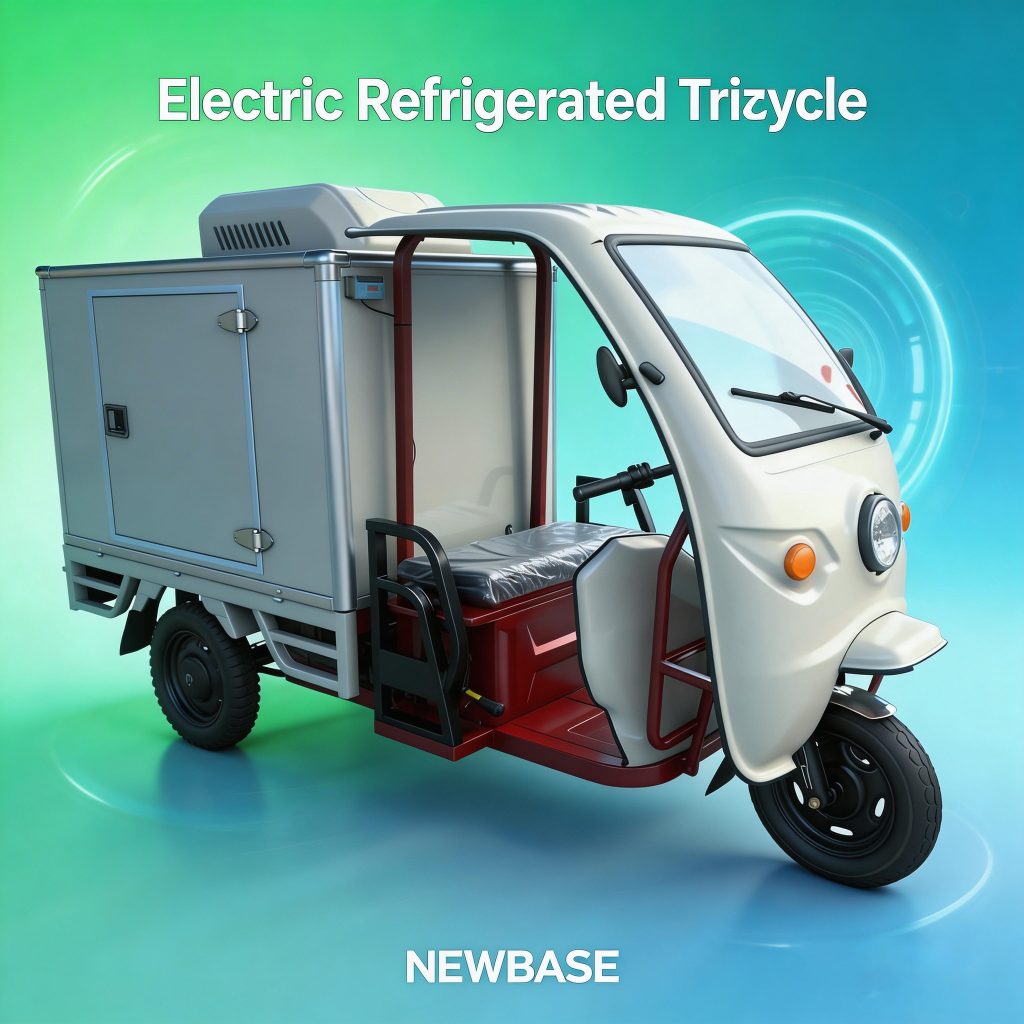
Refrigeration Technology in NEWBASE Cold Chain Tricycles: Compressor vs. Semiconductor Cooling

Introduction The refrigeration system is the most critical component of a cold chain tricycle. NEWBASE offers two primary cooling technologies — compressor-based and thermoelectric (semiconductor) cooling — each with distinct advantages depending on the application. Compressor Refrigeration Systems Compressor systems work on the vapor-compression cycle — the same technology used in household refrigerators and commercial cold storage. How It Works 1. Refrigerant gas is compressed, raising its pressure and temperature 2. Hot gas passes through a condenser coil, releasing heat 3. Cooled liquid refrigerant expands through an expansion valve, dropping temperature 4. Cold refrigerant absorbs heat from the cargo compartment via the evaporator Advantages Deep-freeze capability: Achieves -22°C for frozen […]
Refrigeration Technology in NEWBASE Cold Chain Tricycles: Compressor vs. Semiconductor Cooling 続きを読む »

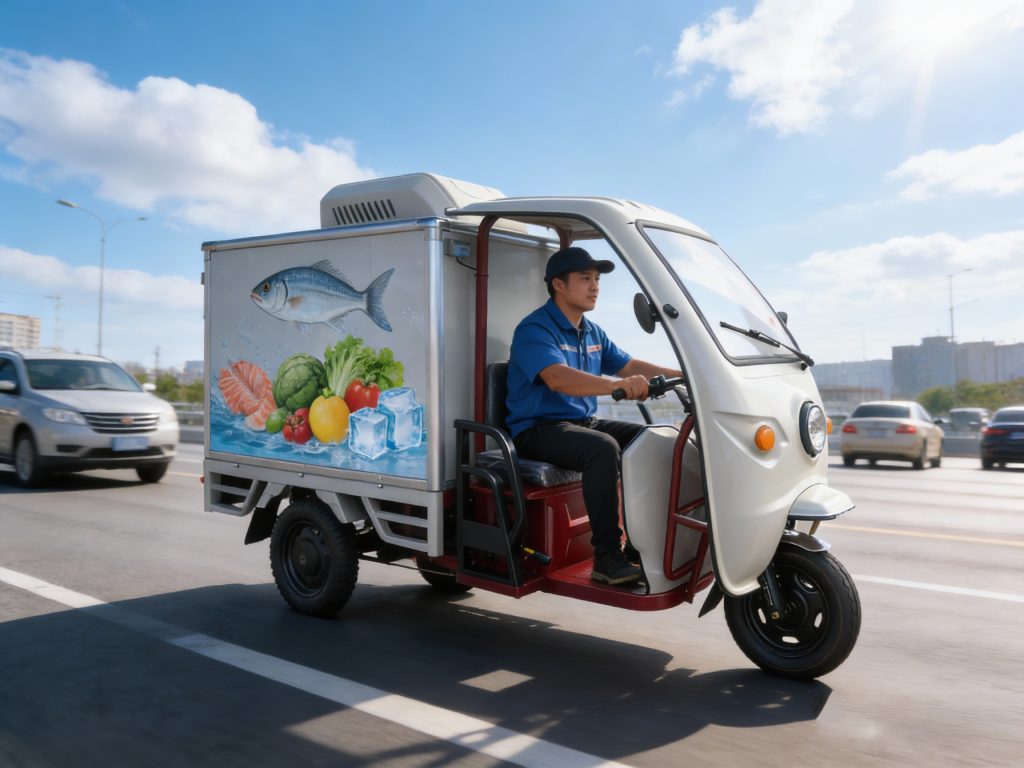
Why Refrigerated Tricycles Are the Future of Urban Cold Chain Logistics

The Urban Logistics Challenge Cities worldwide face mounting pressure to reduce traffic congestion, lower carbon emissions, and improve delivery efficiency. Traditional refrigerated vans struggle with: Restricted access zones in city centers Traffic congestion that delays deliveries High operating costs from fuel and maintenance Parking difficulties that waste driver time NEWBASE refrigerated tricycles address each of these challenges directly. Cost Comparison: Tricycle vs. Van Delivery Daily Operating Costs Cost Category Refrigerated Van NEWBASE Refrigerated Tricycle Fuel/Energy (daily) $25–40 $1.50–3.00 Insurance (monthly) $150–300 $50–100 Maintenance (monthly) $120–200 $20–50 Parking/Congestion Charges $10–30/day $0–5/day Driver License Requirement Commercial Standard Efficiency Metrics A NEWBASE refrigerated tricycle can complete 40–60 delivery stops per day in dense

Why Refrigerated Tricycles Are the Future of Urban Cold Chain Logistics 続きを読む »

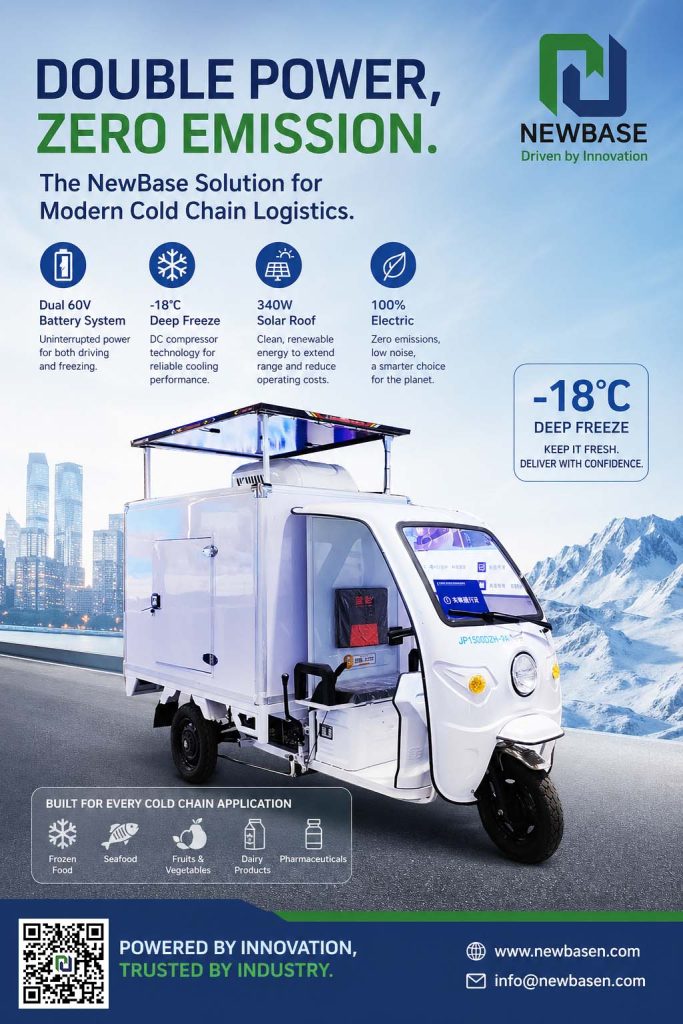
Technical Specifications and Performance Analysis of Advanced Electric Refrigerated Tricycles for Last-Mile Urban Cold Chain Distribution

Executive Summary: The expanding reliance on decentralized urban food systems and temperature-sensitive pharmaceutical distribution requires highly specialized transport assets capable of micro-climate regulation within dense metropolitan configurations. This technical paper provides a rigorous engineering analysis of the electric refrigerated tricycle engineered by NEWBASE (Zhengzhou NewBase Automotive Electronics Co., Ltd.). By evaluating the mechanical dimensions, thermodynamic capabilities of the 650W DC air-cooled refrigeration framework, and the independent dual-energy storage architecture, this document establishes the vehicle’s alignment with contemporary global cold chain compliance standards. 1. Dimensional Architecture and Chassis Engineering The physical footprint of an urban distribution vehicle directly governs its operational efficiency, maneuverability in constrained pathways, and spatial compatibility with standard

Technical Specifications and Performance Analysis of Advanced Electric Refrigerated Tricycles for Last-Mile Urban Cold Chain Distribution 続きを読む »

Electric Refrigerated Tricycle for Cold Chain Logistics: Technical Specifications, Refrigeration Performance, and Commercial Applications

Introduction The rapid growth of cold chain logistics has transformed the way temperature-sensitive products are transported worldwide. Fresh produce, frozen foods, dairy products, seafood, pharmaceuticals, vaccines, and biotechnology products all require precise temperature control throughout the supply chain. As urban distribution networks become increasingly complex, logistics operators are searching for transportation solutions that combine refrigeration efficiency, low operating costs, environmental sustainability, and maneuverability. The Electric Refrigerated Tricycle has emerged as an ideal solution for urban cold chain delivery. Compared with conventional refrigerated trucks, electric refrigerated tricycles offer lower operating expenses, reduced carbon emissions, simplified maintenance requirements, and superior accessibility in congested city environments. Developed by NEWBASE (Zhengzhou NewBase Automotive Electronics

Electric Refrigerated Tricycle for Cold Chain Logistics: Technical Specifications, Refrigeration Performance, and Commercial Applications 続きを読む »

電気冷凍機の仕組み:4.2m電気トラックの蒸気圧縮技術

By NEWBASE Technical Engineering Team | Published April 30, 2026 | 9 min read To appreciate the sophistication of modern electric truck refrigeration systems like the NEWBASE NBESR-1000A, it is essential to understand the fundamental principles that make cooling possible. The vapor compression refrigeration cycle — the same principle that powers household refrigerators, air conditioners, and traditional transport refrigeration — forms the foundation of all commercial refrigeration technology. The Fundamental Principle: Heat Transfer Against the Gradient Unlike heating, which naturally flows from hot to cold, cooling requires forcing heat to move from a cooler space to a warmer one — against its natural tendency. Refrigeration works on a fundamental physical

電気冷凍機の仕組み:4.2m電気トラックの蒸気圧縮技術 続きを読む »

4.2m軽トラックに最適な純電気式冷凍ユニット:2026年の冷却ソリューション

By NEWBASE Thermal Systems Engineering | Published April 30, 2026 | 10 min read The commercial vehicle industry is experiencing a profound electrification transformation, and refrigerated transport is at the forefront of this change. As cities worldwide implement stricter emissions regulations and fleet operators seek sustainable cooling solutions, the demand for purpose-built electric refrigeration systems for light trucks has never been higher. NEWBASE, a pioneer in transport refrigeration technology and a subsidiary of Xinjiye Automotive Electronics Co., Ltd., has answered this call with the NBESR-1000A Pure Electric Integrated Refrigeration Unit — a groundbreaking cooling system specifically engineered for new energy light trucks including pure electric, hydrogen, methanol, and range-extended vehicles.

4.2m軽トラックに最適な純電気式冷凍ユニット:2026年の冷却ソリューション 続きを読む »

4.2mトラックにおける電気式冷凍機とディーゼル冷凍機の比較:総所有コスト分析

By NEWBASE Financial Analysis Team | Published April 30, 2026 | 10 min read The commercial vehicle industry is undergoing the most significant transformation in its history. As fleets evaluate their refrigeration options, the debate between diesel transport refrigeration units (TRUs) and pure electric refrigeration systems like the NEWBASE NBESR-1000A has become central to fleet investment decisions. This comprehensive analysis examines both options across all relevant dimensions — from acquisition costs to environmental impact — to help fleet operators make informed decisions about their refrigeration future. Understanding the Options Diesel Transport Refrigeration Units (TRUs) Diesel TRUs have been the standard for transport refrigeration for decades: NEWBASE NBESR-1000A Pure Electric The

4.2mトラックにおける電気式冷凍機とディーゼル冷凍機の比較:総所有コスト分析 続きを読む »

振動・雨天試験済み:4.2mトラック用冷凍ユニット(NBESR-1000A)の耐久性規格

By NEWBASE Quality Assurance Team | Published April 30, 2026 | 9 min read Commercial vehicle refrigeration operates in one of the most demanding environments imaginable. The NBESR-1000A must endure constant vibration from road surfaces, exposure to rain and road splash, extreme temperature conditions, and electromagnetic interference from the vehicle’s electrical systems — all while maintaining precise temperature control for valuable cargo. This uncompromising environment demands rigorous testing standards that exceed typical consumer or even industrial electronics requirements. The NBESR-1000A undergoes comprehensive type testing encompassing vibration, rain shower, insulation, and electromagnetic compatibility — ensuring reliable performance throughout the vehicle’s service life. Why Commercial Vehicle Testing Matters The Harsh Reality of

振動・雨天試験済み:4.2mトラック用冷凍ユニット(NBESR-1000A)の耐久性規格 続きを読む »

Complete Guide to NBESR-1000A Core Functions: Temperature Control, Air Circulation, Gas Exchange, and Energy-Saving Technologies

By NEWBASE Product Engineering Team | Published April 30, 2026 | 9 min read The NEWBASE NBESR-1000A Pure Electric Refrigeration Unit represents a comprehensive approach to cargo cooling, integrating multiple technologies to address every aspect of maintaining cargo quality during transport. Beyond simply making things cold, the NBESR-1000A delivers complete environmental control that preserves freshness, extends shelf life, and reduces waste throughout the cold chain. 1. Precision Temperature Control The Challenge of Temperature Management Maintaining precise temperature is the most critical requirement in cold chain logistics. Even small deviations can compromise cargo quality: NBESR-1000A Temperature Control System The NBESR-1000A employs multiple technologies to achieve exceptional temperature precision: Variable Frequency Compressor

Complete Guide to NBESR-1000A Core Functions: Temperature Control, Air Circulation, Gas Exchange, and Energy-Saving Technologies 続きを読む »

スマートな温度制御とエネルギー効率が冷凍車技術を変える

Published by NEWBASE | Technology Insights The refrigerated transport industry is no longer focused solely on cooling performance. Today, fleet operators are equally concerned with: As a result, refrigerated vehicle technology is rapidly evolving toward smarter and more sustainable solutions. Refrigeration Technology Is Becoming More Intelligent Modern refrigerated vehicles increasingly incorporate digital technologies to improve operational reliability. Key technology upgrades include: Digital Temperature Controllers Advanced digital control systems enable: This is especially important for transporting products with strict temperature requirements. Multi-Mode Cooling Capabilities New refrigeration systems often support: This allows one vehicle platform to handle multiple cargo categories. Applications include: Energy Efficiency Becomes Core Competitiveness Energy consumption is becoming a

スマートな温度制御とエネルギー効率が冷凍車技術を変える 続きを読む »

ja日本語